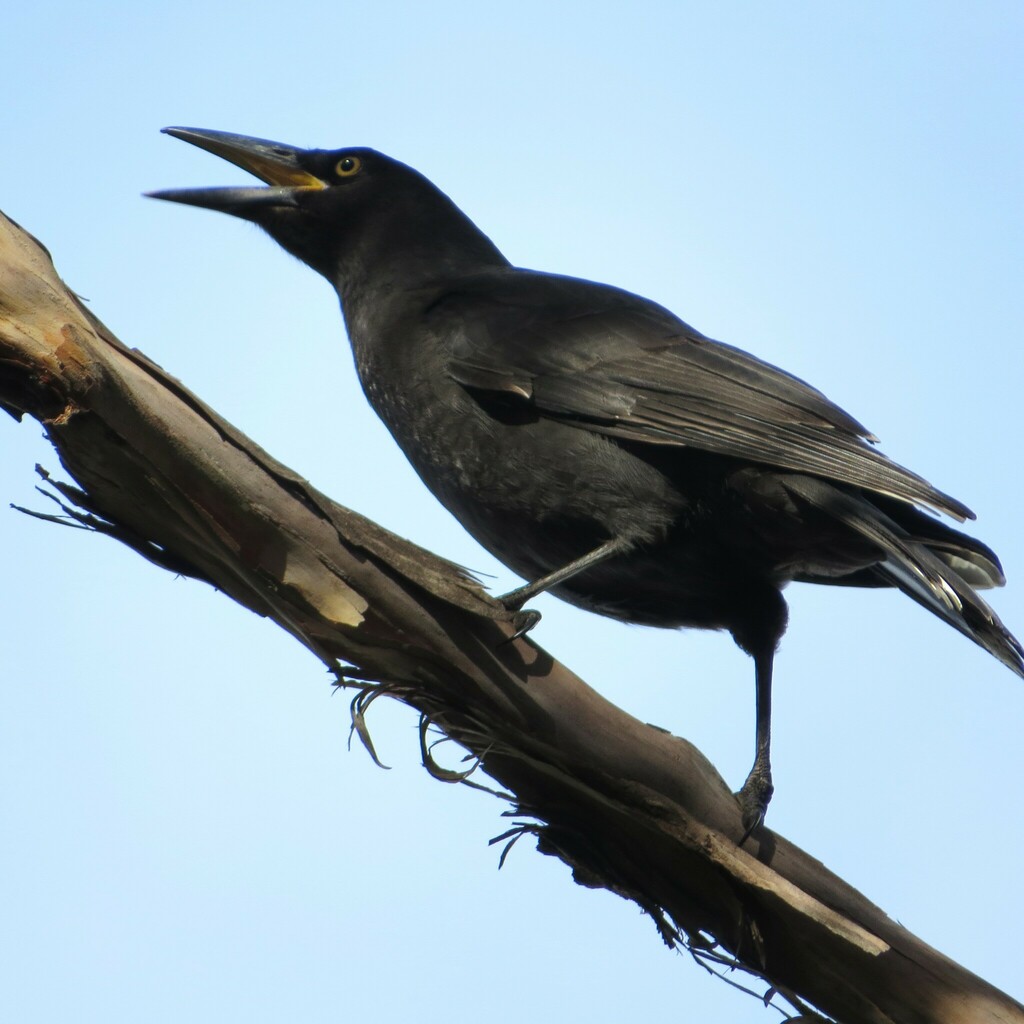
Black Currawong
Photo © pimelea
Photo © pimelea — CC BY 4.0 — Source: iNaturalist #224352029The black currawong (Strepera fuliginosa), also known locally as the black jay, is a large passerine bird endemic to Tasmania and the nearby islands within the Bass Strait. One of three currawong species in the genus Strepera, it is closely related to the butcherbirds and Australian magpie within the family Artamidae. It is a large crow-like bird, around 50 cm (20 in) long on average, with yellow irises, a heavy bill, and black plumage with white wing patches. The male and female are similar in appearance. Three subspecies are recognised, one of which, Strepera fuliginosa colei of King Island, is vulnerable to extinction. Within its range, the black currawong is generally sedentary, although populations at higher altitudes relocate to lower areas during the cooler months. The habitat includes densely forested areas as well as alpine heathland. It is rare below altitudes of 200 m (660 ft). Omnivorous, its diet includes a variety of berries, invertebrates, and small vertebrates. Less arboreal than the pied currawong, the black currawong spends more time foraging on the ground. It roosts and breeds in trees. == Taxonomy == The black currawong was first described by ornithologist John Gould in 1836 as Cracticus fuliginosus, and in…
Cradle Mountain-Lake St Clair National Park
Australia
+72 birds+8 mammals
Where glacial valleys plunge between quartzite peaks, Tasmania's Cradle Mountain-Lake St Clair National Park unfolds as a temperate wilderness of uncommon grandeur. The park's terrain ranges…
VIEW NATIONAL PARKFreycinet National Park
Coles Bay, Australia
+115 birds+9 mammals
Granite peaks rise abruptly from the Tasmanian coast where Coles Bay opens into the Freycinet Peninsula, sculpting one of southeastern Australia's most dramatically vertical national parks.…
VIEW NATIONAL PARKTasman National Park
White Beach, Australia
+53 birds+3 mammals
Where the Tasman Peninsula's windswept coastline meets temperate rainforest, White Beach unfolds as one of Tasmania's most dramatic meeting points between land and sea. The park's…
VIEW NATIONAL PARKNo community photos yet. Log in to add the first one.
No community observations of this species yet.