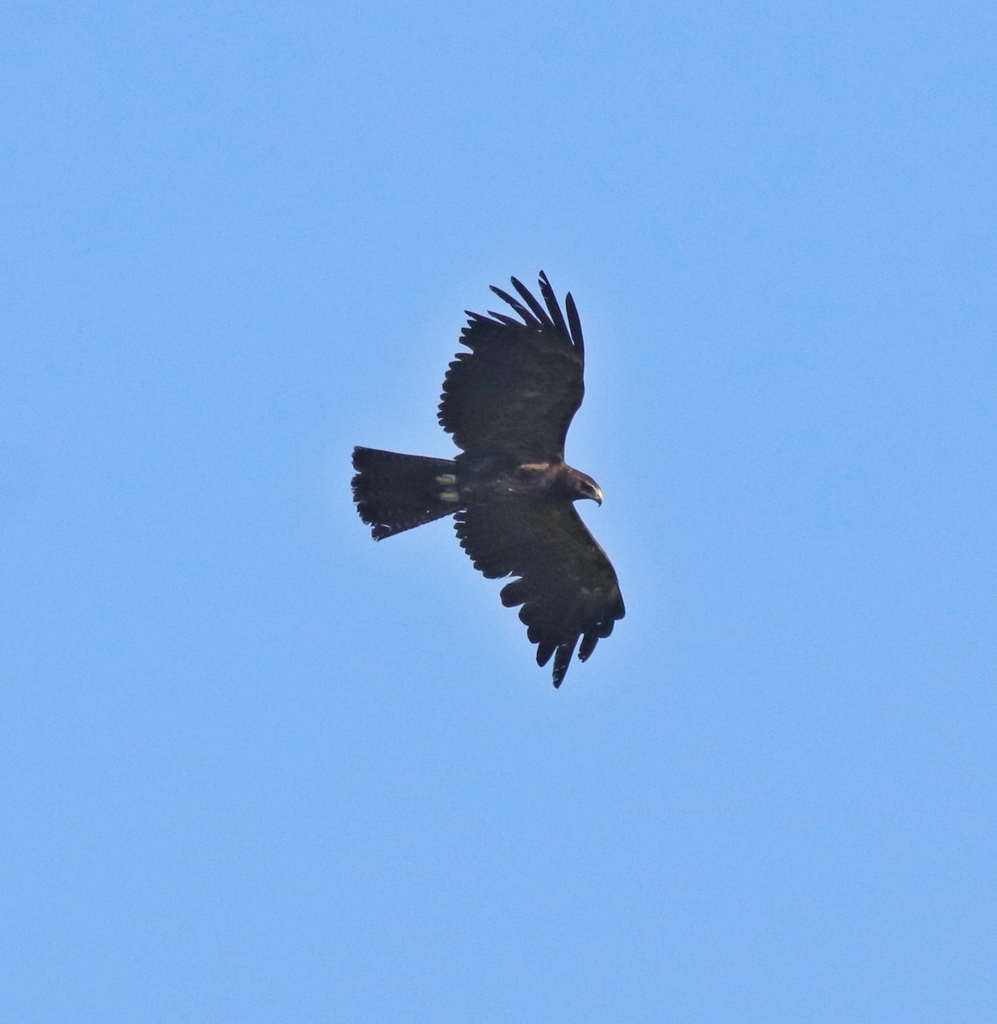
Black Eagle
Photo © Afsar Nayakkan
Photo © Afsar Nayakkan — CC BY 4.0 — Source: iNaturalist #161949312Identification
The Black Eagle is a large but slender raptor, measuring about 75 cm in length with a wingspan of 148 to 182 cm. Despite its imposing size—making it one of the largest eagles in its range—it is surprisingly lightweight at 1,000 to 1,600 grams. Adults are unmistakable in their all-black plumage, contrasting strikingly with a yellow bill base (cere) and yellow feet. The distinctive wing shape, pinched inward at the innermost flight feathers, is a key identifying feature. In flight, the Black Eagle holds its wings in a shallow V-formation and moves with a characteristic slow, deliberate pace, often just above the forest canopy. Young birds differ from adults, showing buff-colored heads, underparts, and underwing coverts. The long, slightly curved claws—particularly prominent on the inner toe—are adapted for snatching prey from nests and caves.
Range & Habitat
The Black Eagle is found across tropical and subtropical Asia, with two recognized subspecies dividing its range. The nominate race occurs from Myanmar, Bangladesh, and southern China through Southeast Asia and the Indonesian Archipelago, while the perniger race inhabits the Himalayan foothills, Nepal, and the forests of India and Sri Lanka, extending westward to Gujarat and the Aravalli range. The species is generally resident throughout its range, with no observed migration patterns. It strongly favors densely forested regions, showing a marked preference for areas with forest cover exceeding 50 percent. The bird thrives in hilly and mountainous terrain, particularly in the forested regions of southeastern and northeastern areas where it breeds and hunts regularly.
Behaviour & Diet
The Black Eagle is a prolific hunter, particularly specializing in raiding the nests of other birds for eggs and nestlings. Its diet encompasses mammals including bats, squirrels, and other small creatures, as well as birds and their eggs. Remarkably, it shares with swallow-tailed kites the unusual habit of carrying away entire nests with their nestlings to feeding perches. The eagle's hunting strategy involves slow, deliberate flight low over the forest canopy, allowing it to locate prey with precision. The Indian giant squirrel and young bonnet macaques have been documented as prey items. Its presence is unmistakable to other forest inhabitants—squirrels, macaques, and numerous bird species emit alarm calls when Black Eagles soar overhead. During breeding season, from January to April, pairs perform striking courtship displays featuring steep dives with folded wings followed by U-shaped swoops and vertical stalls. They construct platform nests 3 to 4 feet wide on tall trees overlooking steep valleys, typically laying one or two white eggs blotched with brown and mauve, often reusing the same nest site year after year.
Best Time & Places to See It
Black Eagles are best observed soaring over forested hilly regions during daylight hours, particularly on hot afternoons when they actively hunt. Key regions for viewing include the Himalayan foothills of Nepal, Bhutan, and northern India; the forested areas of the Western and Eastern Ghats in peninsular India; and the dense forests of southeastern and northeastern Bangladesh, particularly around Chittagong and Sylhet. Myanmar, southern China, and Southeast Asian countries also offer opportunities to encounter this species. Since the bird shows no seasonal migration, it can be located year-round in suitable habitat, though the breeding season (January to April) may offer the best chance to observe courtship displays and locate active nest sites.
Photography Tips
Photographing Black Eagles requires patience and an understanding of their behavior. Position yourself in elevated locations overlooking forested valleys where the birds hunt, as their slow, low flight over the canopy makes them relatively approachable compared to faster raptors. Early morning and hot afternoon hours offer the best opportunities for sightings. A telephoto lens of at least 400 to 600 mm is essential for capturing detailed images of soaring birds. The Black Eagle's distinctive silhouette—with splayed primary feathers creating "fingered" wingtips and wings held in a shallow V—makes for striking compositional elements. The contrast between the all-black plumage and the yellow cere and feet provides excellent color differentiation in photographs. Watch for the bird's characteristic slow flight, often just meters above the treetops, which can provide opportunities for dramatic backlit silhouettes against clearing skies.
No community photos yet. Log in to add the first one.
No community observations of this species yet.