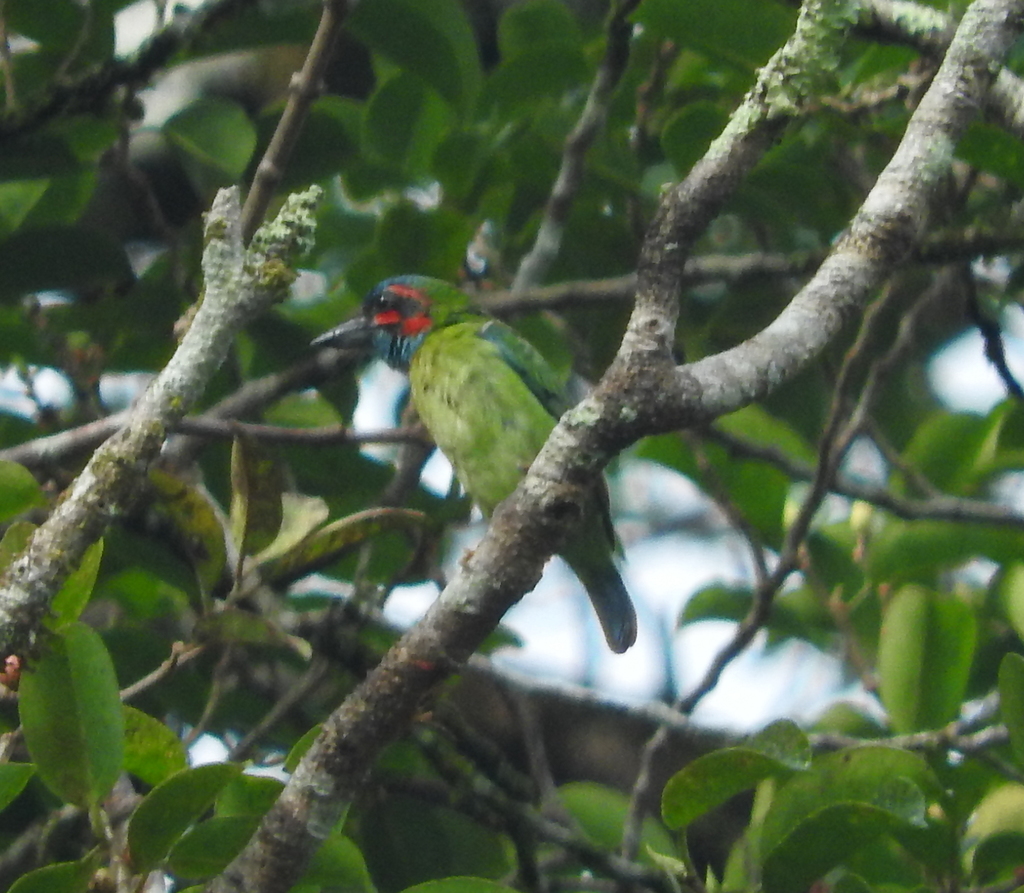
Black-eared Barbet
Photo © Subir B. Shakya
Photo © Subir B. Shakya — CC BY 4.0 — Source: iNaturalist #20152840Identification
The black-eared barbet is a compact songbird measuring 16–17 cm in length and weighing 26.3–37 g. Its most distinctive features are its olive-green plumage and striking facial markings: a vivid blue throat and nape, a prominent black streak running between the eyes, and characteristic red spots below the eyes that are encircled with black. The bird sports a sturdy black beak suited to its bark-foraging lifestyle. These bold markings make it relatively straightforward to identify once spotted, despite the overall modest size.
Range & Habitat
The black-eared barbet is native to Southeast Asia, with populations distributed across Peninsular Malaysia, Sumatra, and Borneo. Three recognized subspecies occur across this range: the nominate subspecies inhabits mainland areas plus several large islands including Bangka Island, while two island subspecies—gigantorhinus on Nias Island and tanamassae on the Batu Islands—show slight plumage variations. The species favors shrubland and forest environments at altitudes up to 1,200 m, making it accessible across a variety of elevations within its range.
Behaviour & Diet
Like other members of the barbet family, the black-eared barbet is a bark-gleaning forager, searching tree trunks and branches for invertebrate prey. While detailed behavioral accounts are limited in available literature, barbets are generally social birds, often seen in small groups or pairs. They are notably vocal, using their calls to maintain contact and defend territory. Their relatively robust bills are adapted for extracting insects from bark crevices, and some barbet species also consume fruit seasonally, though specific dietary details for this species remain understudied.
Best Time & Places to See It
The black-eared barbet's large geographical range and least-concern conservation status suggest it is reasonably common throughout suitable habitats. Birdwatchers visiting Peninsular Malaysia, Sumatra, or Borneo should search forest edges, secondary growth, and shrubland areas, particularly in foothill zones below 1,200 m elevation. Early morning hours typically offer the best viewing opportunities, when birds are most vocal and active. The presence of three distinct subspecies means that observers visiting different parts of the range may encounter populations with subtle plumage variations.
Photography Tips
The black-eared barbet's small size and habit of foraging on tree bark mean patience and a telephoto lens are essential. Position yourself quietly near fruiting or insect-rich trees during dawn hours when activity peaks. The striking facial pattern—particularly the blue throat and red facial spots—provides excellent photographic subjects if you can maneuver into good light. The bird's relatively dark plumage against tree bark can present metering challenges; expose for the face to capture detail in the facial markings. Video can be particularly rewarding, as capturing the bird's foraging movements and vocalizations adds behavioral context to still images.
Bako National Park
Kuching, Malaysia
+210 birds+17 mammals
Weathered sandstone cliffs rise dramatically from the South China Sea, their ochre faces sculpted by millennia of wind and tide into a landscape of extraordinary geological…
VIEW NATIONAL PARKKuching Wetlands National Park
Kuching, Malaysia
+103 birds+4 mammals
Where brackish waters meet mangrove stilts and freshwater swamps blend into coastal mudflats, one of Southeast Asia's most dynamic wetland ecosystems unfolds across Sarawak's northwestern coast.…
VIEW NATIONAL PARKTaman Negara National Park
Kampong Samas, Malaysia
+393 birds+48 mammals
Where ancient rainforest meets limestone peaks, one of Southeast Asia's oldest protected wilderness preserves sprawls across 4,343 square kilometers of primordial landscape. Dipterocarp giants tower overhead,…
VIEW NATIONAL PARKTaman Negara Bukit Lambir National Park
Miri, Malaysia
+153 birds+7 mammals
Rainforest cascades down sandstone ridges where crystal streams carve through ancient geology, creating a landscape of profound biological richness in Sarawak's interior. This 68-square-kilometre sanctuary protects…
VIEW NATIONAL PARKGunung Mulu National Park
Long Seridan, Malaysia
+280 birds+39 mammals
Where granite monoliths pierce the rainforest canopy of Sarawak, an ancient limestone karst landscape reveals one of Southeast Asia's most biodiverse strongholds. Soaring peaks cloaked in…
VIEW NATIONAL PARKKerinci Seblat National Park
Kerinci, Indonesia
+228 birds+16 mammals
Across nearly 67,000 square kilometres of Sumatra's spine, a mountainous realm of equatorial rainforest rises from steaming lowlands to volcanic peaks shrouded in cloud. Kerinci Seblat…
VIEW NATIONAL PARKWay Kambas National Park
Lampung Timur, Indonesia
+237 birds+20 mammals
Across the low swamplands of eastern Lampung, where freshwater wetlands merge into tidal mangrove forests along the Sunda Strait, sprawls one of Sumatra's most vital sanctuaries.…
VIEW NATIONAL PARKNo community photos yet. Log in to add the first one.
No community observations of this species yet.