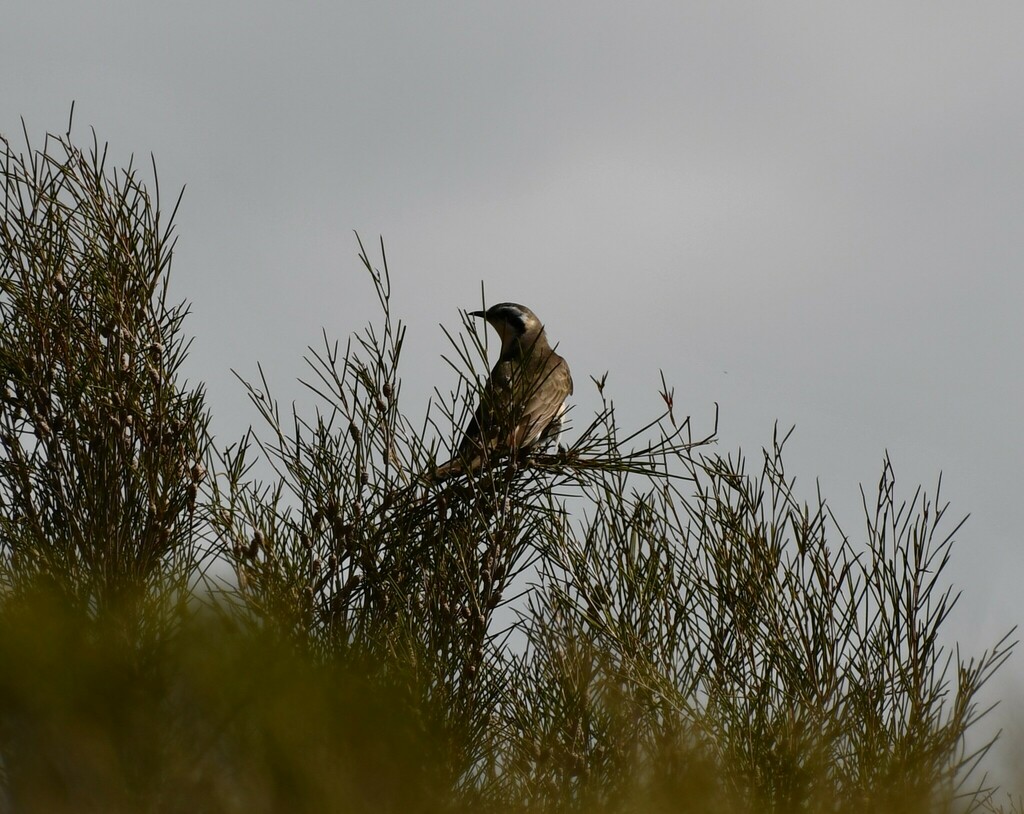
Black-eared Cuckoo
Photo © Thomas Mesaglio
Photo © Thomas Mesaglio — CC BY 4.0 — Source: iNaturalist #128391526Identification
The black-eared cuckoo is a small cuckoo, weighing around 30 grams and measuring 19 to 20 centimetres in length. Adults display a dull greyish-brown back with a distinctive black eye-stripe running from the bill to the neck—a key field mark that sets them apart from other small Australian cuckoos. The rump is pale white, and the breast area shows a pale salmon colouration. The tail is grey-brown above with white tips, and cream-coloured underneath with brownish barring. Legs and feet are black, the bill is black, and eyes are brown. Unlike some of their cuckoo relatives, black-eared cuckoos lack metallic feathering on the back. Juveniles are duller overall, with a more brownish eye-stripe.
Range & Habitat
The black-eared cuckoo is common across most of Australia, avoiding wet coastal forested areas and preferring the inland side of the Great Dividing Range in Victoria, New South Wales, and Queensland. Vagrants occasionally reach Tasmania. The species is migratory: some birds remain in southern Australia through winter, while many migrate northward to northern Australia, eastern Indonesia, and southern New Guinea.
These cuckoos favour dry open forests, scrublands, mallee, mulga, lignum, saltbush, and riverside thickets. They prefer flying directly between low trees and shrubs rather than through large trees and are rare in subhumid areas.
Behaviour & Diet
Black-eared cuckoos are typically observed alone or in pairs. They are brood parasites, laying eggs in the nests of other bird species rather than raising their own young. They show a particular preference for speckled warblers and redthroats, though eggs have also been found in nests of fieldwrens, thornbills, scrubwrens, and heathwrens. The female often removes one host egg before depositing her own dark brown egg into enclosed or domed nests. Remarkably, the cuckoo's eggs are coloured and sized to mimic those of the host species so precisely that they can only be distinguished by rubbing away the brown pigmentation. Host species then raise the black-eared cuckoo chicks, which fledge after at least 18 days.
These birds feed primarily on ground-dwelling insects, including beetles, diptera, hemiptera, sandflies, and hairy caterpillars, though they also forage in trees and shrubs. Males often call from high branches but may be found on lower perches. Their vocalisation is a descending feeeuw or pee-o-weer call in a lower, mournful tone, delivered singly or repeatedly, with a courtship call of pee-o-wit also heard during breeding.
Best Time & Places to See It
Breeding season varies by location and rainfall patterns. In western Australia, breeding begins around June and finishes in October, while in the east it typically runs from August to December. During breeding season, listen for males calling from branches in dry open forests and scrublands. Target inland areas on the inland side of the Great Dividing Range across Victoria, New South Wales, and Queensland. Birds are more active during their respective breeding seasons in their preferred regions.
Photography Tips
Photograph males calling from high branches where they are often observed vocalising. Focus on capturing the distinctive black eye-stripe, pale rump, and salmon-coloured breast. The bird's small size and preference for low trees and shrubs make them relatively accessible compared to larger cuckoo species. During courtship, watch for interactions between males and females, though remember these are generally observed singly or in pairs. Early morning is typically best for locating calling males in dry open forests and scrubland habitats.
Kakadu National Park
Kakadu, Australia
+273 birds+46 mammals
Kakadu National Park is Australia’s largest national park and one of the world’s most remarkable protected areas, covering nearly 20,000 square kilometres in the tropical north…
VIEW NATIONAL PARKChiltern-Mt Pilot National Park
Australia
+229 birds+12 mammals
Granite ridges and eucalyptus woodlands define this 869-square-kilometre park straddling the border between Victoria and New South Wales, where rugged terrain rises sharply from gentler foothill…
VIEW NATIONAL PARKIkara-Flinders Ranges National Park
Australia
+149 birds+10 mammals
Where ancient quartzite ridges rise across the semi-arid heart of South Australia, Ikara-Flinders Ranges National Park unfolds across nearly two thousand square kilometres of one of…
VIEW NATIONAL PARKNo community photos yet. Log in to add the first one.
No community observations of this species yet.