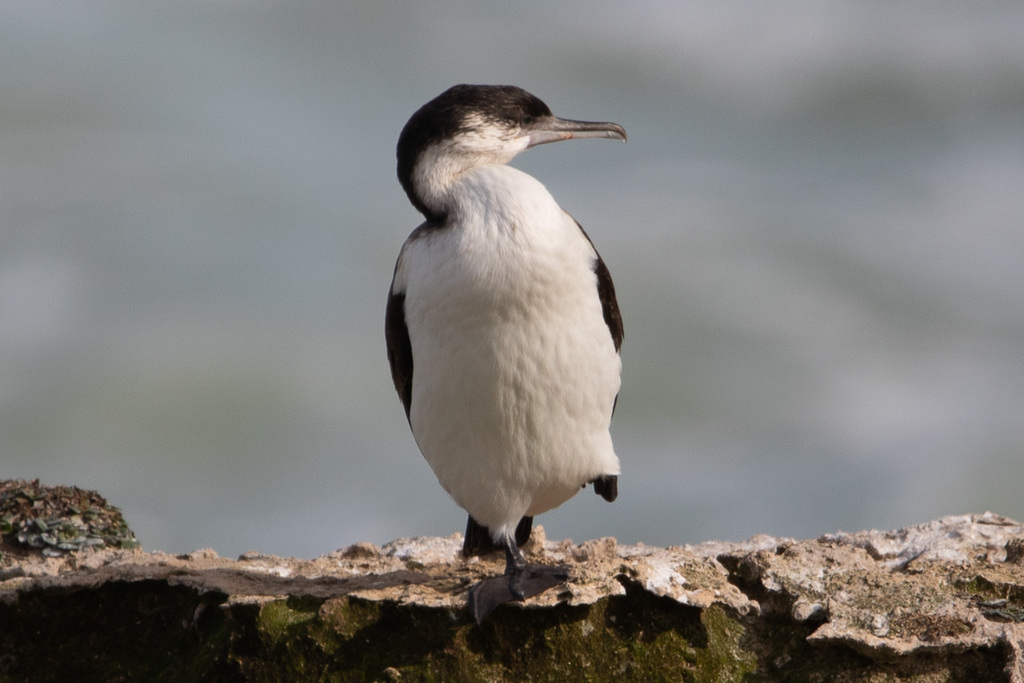
Black-faced Cormorant
Photo © Joshua S. Martin
Photo © Joshua S. Martin — CC0 1.0 — Source: iNaturalist photo #300078854Identification
The black-faced cormorant is a medium-sized member of the cormorant family, notable for its striking pied plumage: black upperparts contrasting sharply with white underparts. Its most distinctive feature is its naked black face, which gives the species its common name. The bird also displays a dark grey bill with a prominent hooked tip, black tail and thighs, and striking blue-green eyes. Back feathers are glossy, catching the light beautifully. When flying, it characteristically holds its head level or lower than its body and spreads its wings in a cross-shape, typical of cormorants.
Separating this species from similar cormorants requires attention to size: the pied cormorant is slightly larger, while the little pied cormorant is slightly smaller. During breeding season, fine white streaks appear along the neck. Juveniles are noticeably different, with dark-brown upper feathers and darker ear coverts, though they pale beneath with brown streaking. Males are slightly larger and more robust than females, with bills exceeding 77 millimeters compared to females' bills under 76 mm—a subtle distinction difficult to assess in the field.
Range & Habitat
Black-faced cormorants are endemic to coastal regions of southern Australia and Tasmania, with an estimated population in the tens of thousands. Two independent populations exist: one along the southern coast of Western Australia, and another distributed across South Australia, Victoria, and Tasmania, particularly concentrated in the Bass Strait and Spencer Gulf.
Unlike other Australian cormorants, this species is exclusively coastal and marine. It frequents coastal waters, inlets, rocky shores, and offshore islands, occasionally venturing into river estuaries. Breeding colonies are established on steep cliffs and rocky islands, where these birds nest in winter months to avoid disturbance during the breeding season.
Behaviour & Diet
The black-faced cormorant is superbly adapted to marine life, using pursuit-diving to capture fish with remarkable efficiency, diving to depths of up to 12 meters. After diving, it spreads its wings to dry its feathers in the sun—a characteristic cormorant behaviour easily observed by patient wildlife watchers. Birds occasionally forage together in flocks, and they consume their prey whole, later regurgitating non-digestible parts as pellets.
Its diet consists almost exclusively of fish, particularly benthic and demersal species, supplemented with occasional cephalopods. During breeding season, wrasse and silver trevally are preferred. After breeding, the diet shifts to silverbelly, wrasse, whiting, and hardyheads. The bird forages along the coast and at river mouths, making it predictable to observe in these locations. Away from breeding colonies, black-faced cormorants remain unusually silent, though males emit loud honks or guttural croaks at nesting sites, and females hiss when approached.
Best Time & Places to See It
Black-faced cormorants breed seasonally, with timing varying by population. In the Bass Strait, breeding occurs from June to September, peaking around late July, likely to avoid hot summer temperatures harmful to chicks. Western and southern Australian colonies breed later, from September to February. Winter months coincide with breeding activity, making coastal areas more productive for observation during these periods.
Seek them along rocky shores, offshore islands, and coastal inlets throughout southern Australia and Tasmania. The Bass Strait and Spencer Gulf are particularly rewarding regions. Because colonies are sensitive to human disturbance, observe from a respectful distance and respect protected breeding habitats. Foraging birds along coasts and river mouths offer excellent viewing opportunities year-round.
Photography Tips
The black-faced cormorant's striking pied plumage and glossy back feathers photograph beautifully in good light. Position yourself to capture the contrast between black upperparts and white underparts. The blue-green eyes and prominent hooked bill are compelling focal points worth isolating with telephoto lenses.
Early morning light is ideal for photographing these birds as they sun-dry their wings after diving—a characteristic pose that makes for compelling compositions. During breeding season, nesting pairs at colonies offer opportunities for behavioral shots, though maintain distance to avoid disturbing these sensitive birds. The cross-shaped wing posture in flight is distinctive; patience and fast shutter speeds will reward you with striking in-flight images.
Lincoln National Park
Australia
+149 birds+5 mammals
Across the mid-north of South Australia, where the landscape transitions from coastal lowlands toward semi-arid interior plains, sprawls a wilderness of 2,671 square kilometres where red-earth…
VIEW NATIONAL PARKCoffin Bay National Park
Australia
+143 birds+5 mammals
Across South Australia's Eyre Peninsula, where limestone headlands rise above turquoise shallows and eucalypt woodland gives way to coastal heath, lies a 1,319-square-kilometre sanctuary shaped by…
VIEW NATIONAL PARKInnes National Park
Barcelona, Australia
+141 birds+10 mammals
Granite ridges and weathered stone outcrops rise across South Australia's Fleurieu Peninsula, defining a landscape where ancient rock formations meet open eucalypt woodland and heathland scrub.…
VIEW NATIONAL PARKFlinders Chase National Park
Australia
+142 birds+14 mammals
Granite ridges and windswept mallee scrubland define this 1,630-square-kilometre expanse on Kangaroo Island, where ancient rock formations rise abruptly from coastal heathland and woodland mosaics. The…
VIEW NATIONAL PARKWilsons Promontory National Park
Australia
+210 birds+21 mammals
Where granite headlands plunge toward Bass Strait, Wilson's Promontory National Park sprawls across nearly 1,300 square kilometers of southeastern Victoria's most rugged coastal wilderness. The park's…
VIEW NATIONAL PARKFitzgerald River National Park
Fitzgerald River National Park, Australia
+209 birds+11 mammals
Where granite peaks rise above windswept heathlands and pristine river systems carve through untamed wilderness, one of Australia's most biodiverse landscapes unfolds across the southwestern corner…
VIEW NATIONAL PARKBen Boyd National Park
Eden, Australia
+255 birds+47 mammals
Where the temperate forests of the far south coast meet towering sea cliffs, Ben Boyd National Park unveils one of New South Wales' most dramatic coastal…
VIEW NATIONAL PARKGreat Otway National Park
Australia
+255 birds+42 mammals
Temperate rainforest and wet eucalyptus woodland cloak the ridges and gullies of Victoria's Great Otway National Park, where persistent moisture and mild year-round temperatures sustain a…
VIEW NATIONAL PARKPort Campbell National Park
Port Campbell, Australia
+170 birds+7 mammals
Dramatic sea cliffs rise from churning waters along Victoria's southwestern coast, where sandstone and limestone formations tower over a hundred metres above the Southern Ocean. Port…
VIEW NATIONAL PARKCoorong National Park
Australia
+217 birds+15 mammals
Where the Murray River meets the Southern Ocean, a chain of shallow lagoons stretches across the South Australian coast, separated from the sea by a ribbon…
VIEW NATIONAL PARKFreycinet National Park
Coles Bay, Australia
+115 birds+9 mammals
Granite peaks rise abruptly from the Tasmanian coast where Coles Bay opens into the Freycinet Peninsula, sculpting one of southeastern Australia's most dramatically vertical national parks.…
VIEW NATIONAL PARKTasman National Park
White Beach, Australia
+53 birds+3 mammals
Where the Tasman Peninsula's windswept coastline meets temperate rainforest, White Beach unfolds as one of Tasmania's most dramatic meeting points between land and sea. The park's…
VIEW NATIONAL PARKNo community photos yet. Log in to add the first one.
No community observations of this species yet.