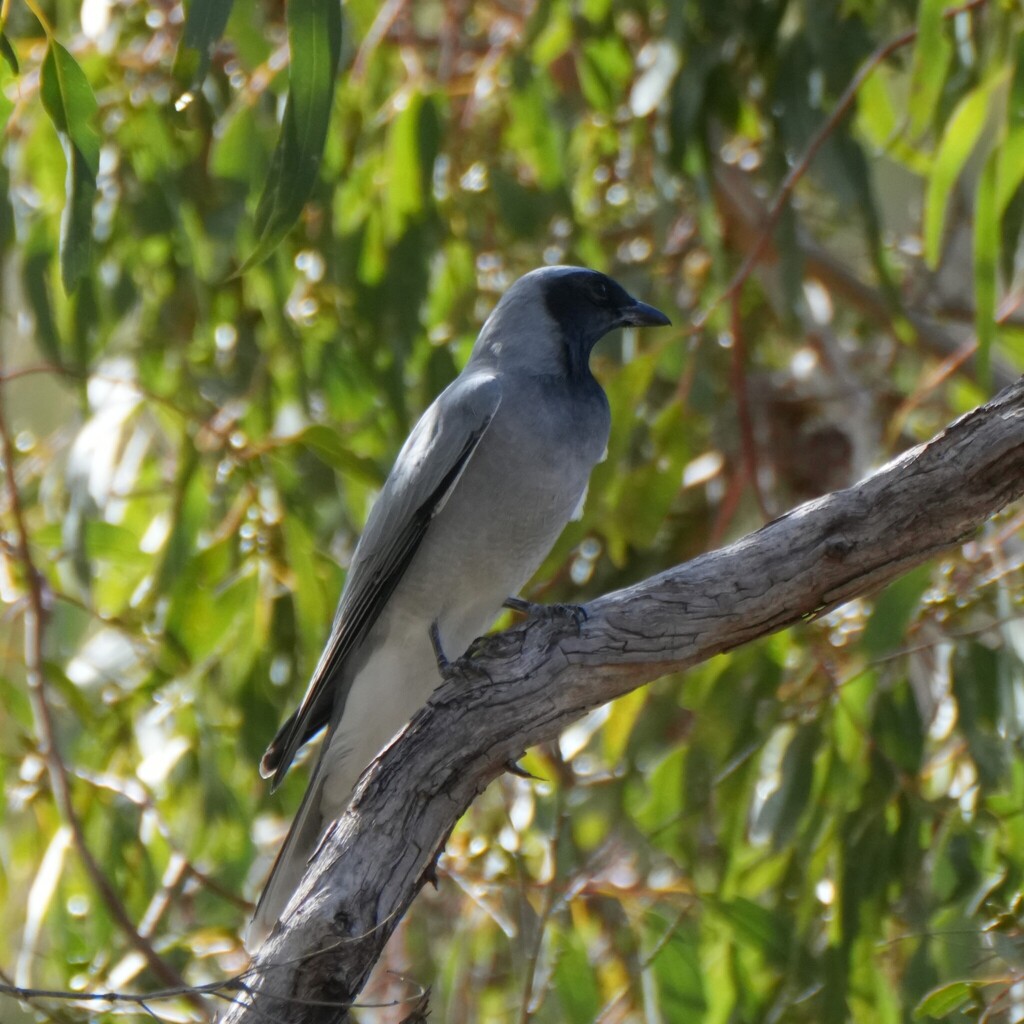
Black-faced Cuckooshrike
Photo © themaskedlapwing
Photo © themaskedlapwing — CC0 1.0 — Source: iNaturalist #278945458Identification
The black-faced cuckooshrike is unmistakable in the field, distinguished by its prominent black face and throat contrasting sharply with grey plumage and white underparts. Adults measure between 32 and 34 cm in length and possess a somewhat hooked bill. These are slow-moving, inconspicuous birds that often perch quietly, making visual identification easier than detection. Their most distinctive feature is undoubtedly the bold black facial mask, which is immediately recognizable even at a distance.
Young birds resemble adults but are noticeably different in one key respect: their black facial mask is reduced to just an eye stripe, making them distinguishable from fully mature birds. The species produces a distinctive shrill, screaming call that sounds like "creearck," which can aid identification even when the bird itself is hidden from view.
Range & Habitat
The black-faced cuckooshrike is native to Australia and southern New Guinea, where it is widely distributed across almost any wooded habitat throughout the region—with the notable exception of rainforests. Three recognized subspecies occupy different geographic ranges: one in central west Western Australia, another across southwestern, southern, northern, and eastern Australia plus the central south coast of southeast New Guinea, and a third in Tasmania and the Bass Strait Islands.
Remarkably adaptable, this species is not confined to pristine wilderness. It is a fairly common sight in urban areas, frequently perching on power lines in major Australian cities such as Sydney and Perth, making it accessible to travelers visiting these urban centers.
Behaviour & Diet
Black-faced cuckooshrikes are omnivorous, feeding on insects, their larvae, caterpillars, and other invertebrates, which they catch either in flight or by searching through foliage. They also supplement their diet with fruits and seeds. The species is notably social outside the breeding season, forming flocks of up to a hundred birds.
Breeding occurs chiefly from August to February, with both partners constructing a rather small nest together. Fledglings remain in the nest for approximately three weeks before departing. Some populations may be partially migratory or territorial year-round; the lack of significant differences between regional populations makes precise migration patterns difficult to determine.
Best Time & Places to See It
The black-faced cuckooshrike is common enough to be encountered in suitable habitat throughout much of Australia year-round. Urban visitors to Sydney, Perth, and other major cities stand an excellent chance of spotting them on power lines. Outside the breeding season (March to July), large flocking groups offer particularly good viewing opportunities.
Any wooded habitat away from rainforest provides potential sightings, though the species thrives in mixed woodlands and semi-urban environments alike. Patience and a keen ear for their distinctive "creearck" call will improve success rates significantly.
Photography Tips
The black-faced cuckooshrike's bold facial markings make it a rewarding photographic subject. Its habit of perching openly on power lines and branches, particularly in urban areas, allows photographers to approach relatively closely without heavy equipment. The strong contrast between the black face and pale underparts photographs well in bright daylight.
Large flocking groups outside the breeding season present opportunities to capture multiple birds in a single frame. Their slow, deliberate movements make focus-tracking less demanding than with more active species. Early morning light will best showcase the subtle grey tones of their plumage and the crisp definition of their facial mask.
Alpine National Park
Bald Rock National Park
Barrington Tops National Park
Belair National Park
Ben Boyd National Park
Blue Mountains National Park
Boodjamulla National Park
Bouddi National Park
Bribie Island National Park
Nothing matches these filters.
No community photos yet. Log in to add the first one.
No community observations of this species yet.