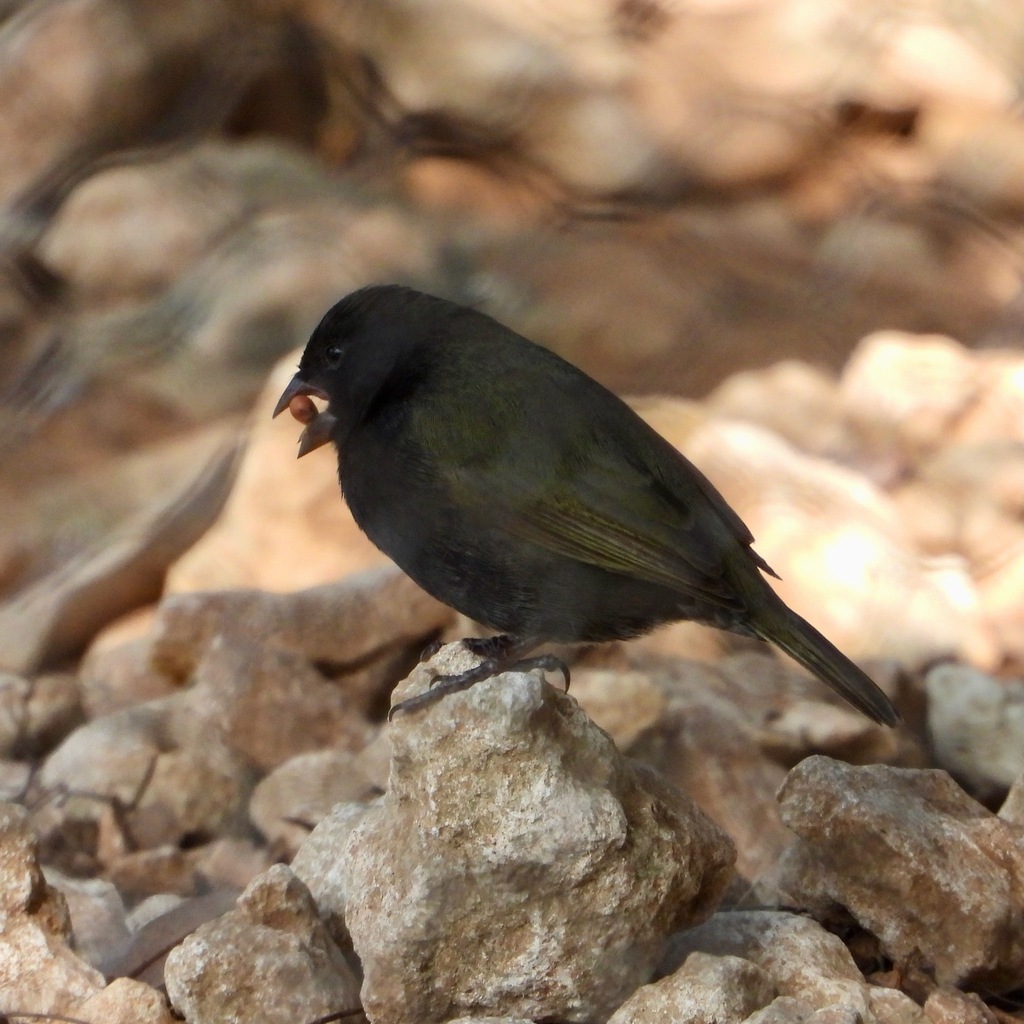
Black-faced Grassquit
Photo © Grete Pasch
Photo © Grete Pasch — CC BY 4.0 — Source: iNaturalist #334770930The black-faced grassquit (Melanospiza bicolor) is a small bird. It is recognized as a tanager closely related to Darwin's finches. It breeds in the West Indies except Cuba, on Tobago but not Trinidad, and along the northern coasts of Colombia and Venezuela. == Taxonomy == The first formal description of the black-faced grassquit was by the Swedish naturalist Carl Linnaeus in 1766 in the twelfth edition of his Systema Naturae. He introduced the binomial name Fringilla bicolor. Linnaeus based his description on the "Bahama Sparrow" that was described and illustrated by Mark Catesby in his The Natural History of Carolina, Florida and the Bahama Islands which was published between 1729 and 1732. The black-faced grassquit was traditionally placed in the genus Tiaris. A molecular phylogenetic study published in 2014 found that this genus was polyphyletic and that the black-faced grassquit was closely related to the Saint Lucia black finch in the monospecific genus Melanospiza. In the resulting reorganization of the genera, the black-faced grassquit was moved to Melanospiza. Eight subspecies are recognised: M. b. bicolor (Linnaeus, 1766) – Bahamas and islands off north Cuba M. b. marchii (Baird, SF, 1864) – Jamaica and Hispaniola M. b. omissa (Jardine, 1847) –…
Everglades National Park
Monroe County, United States
+345 birds+22 mammals
Where freshwater marsh meets subtropical sky, the Everglades sprawls across southwestern Florida as one of North America's most expansive wetland ecosystems. Spanning over 13,000 square kilometers,…
VIEW NATIONAL PARKMorrocoy National Park
Municipio Silva
+290 birds
Where the Caribbean coast of northwestern Venezuela meets protected coastal waters, a mosaic of mangrove forests, sandy beaches, and coral reef systems defines Morrocoy National Park.…
VIEW NATIONAL PARKVirgin Islands National Park
Cruz Bay, United States
+119 birds+3 mammals
Coral reef and mangrove ecosystems define the tropical maritime landscape of this national park, where St. John's mountainous spine rises sharply from turquoise bays fringed with…
VIEW NATIONAL PARKNo community photos yet. Log in to add the first one.
No community observations of this species yet.