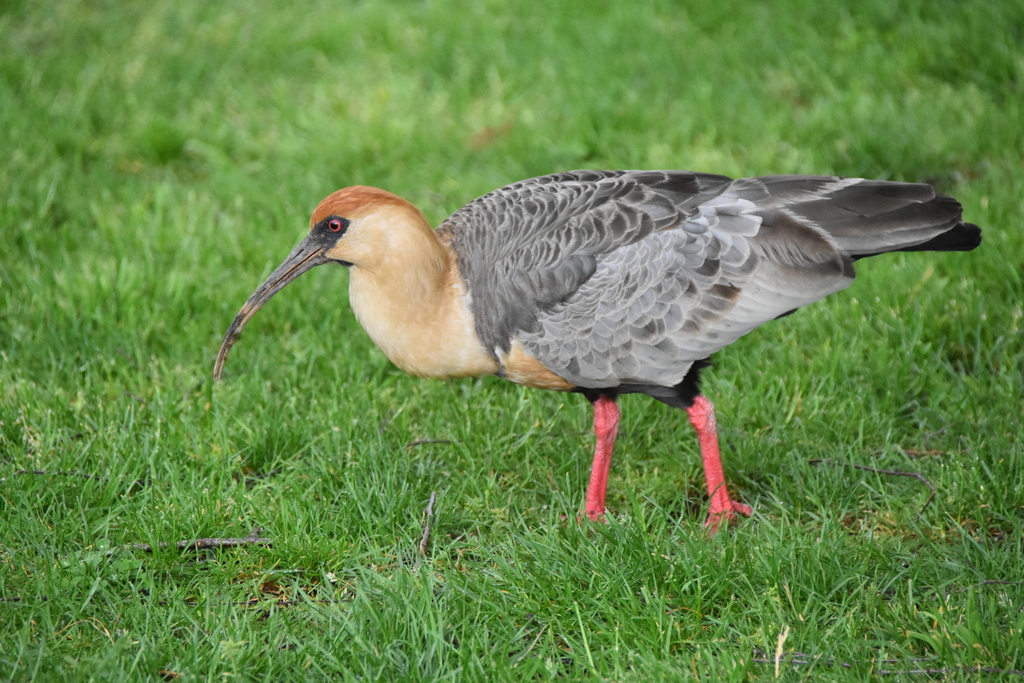
Black-faced Ibis
Photo © Loren Cassin Sackett
Photo © Loren Cassin Sackett — CC BY 4.0 — Source: iNaturalist photo #289510198Identification
The black-faced ibis is a medium-large wading bird approximately 75 centimetres in length. Its most distinctive features are the buffish head, neck, and lower chest contrasting with a cinnamon crown and nape. The upperparts and often-incomplete chest-band are grey, while the belly and flight feathers are black. The whitish wing-coverts provide subtle patterning against the grey back. The bare skin around the eyes, bill, and throat-wattle are blackish, and the legs are bright red—distinctive field marks that aid identification. When compared with the similar buff-necked ibis, the black-faced ibis has a warmer, more buff-toned lower chest (rather than dark grey), smaller white wing-patches that don't contrast strongly, and a more prominent throat-wattle.
Range & Habitat
This species is primarily a bird of southern South America, with its range centred in southern and central Argentina and Chile, occurring from sea-level to approximately 2,500 metres altitude. It is also found very locally on the coast of Peru, though it has been almost entirely extirpated from that country. The black-faced ibis favours open grassland and field habitats across this range. Despite historical pressures in Peru, the species remains fairly common throughout much of Argentina and Chile and is classified as Least Concern by the IUCN.
Behaviour & Diet
Like other ibises, the black-faced ibis is a gregarious wading bird that forages in open grassland and wetland margins, probing for food with its long, curved bill. These birds are typically observed singly or in small flocks as they work through damp fields and pastures. Their social nature and conspicuous colouring make them relatively easy to locate in suitable habitat. The species' preference for open country and its habit of foraging in the early morning and late afternoon make these the most productive times for observation.
Best Time & Places to See It
In Argentina and Chile, the black-faced ibis is reliably found in open grassland habitats, particularly in regions with wetlands or damp pastures. The species is present year-round across much of its range, though local movements may occur seasonally. Early morning and late afternoon visits to open fields and wetland margins offer the best chances of observation. While the species is very local in Peru, dedicated birders may attempt to find remnant populations on the coast, though success cannot be guaranteed.
Photography Tips
The black-faced ibis's striking facial markings, red legs, and contrasting plumage make it a rewarding photography subject. The best light is often found during early morning or late afternoon when the birds are most active and when lower sun angles enhance the subtle grey and buff tones of the plumage. Approach slowly and patiently through open ground, as these birds favour open habitats where they have good visibility and will flush if alarmed. A longer lens (400–600mm) is recommended for capturing detail from a respectful distance, particularly when photographing the characteristic black face and red legs that define this species.
Alerce Costero National Park
Antisana National Park
Cabo de Hornos National Park
Cerro Castillo National Park
Chiloé National Park
Corcovado National Park
Lago Puelo National Park
Laja National Park Lagoon
Lanín National Park
Nothing matches these filters.
No community photos yet. Log in to add the first one.
No community observations of this species yet.