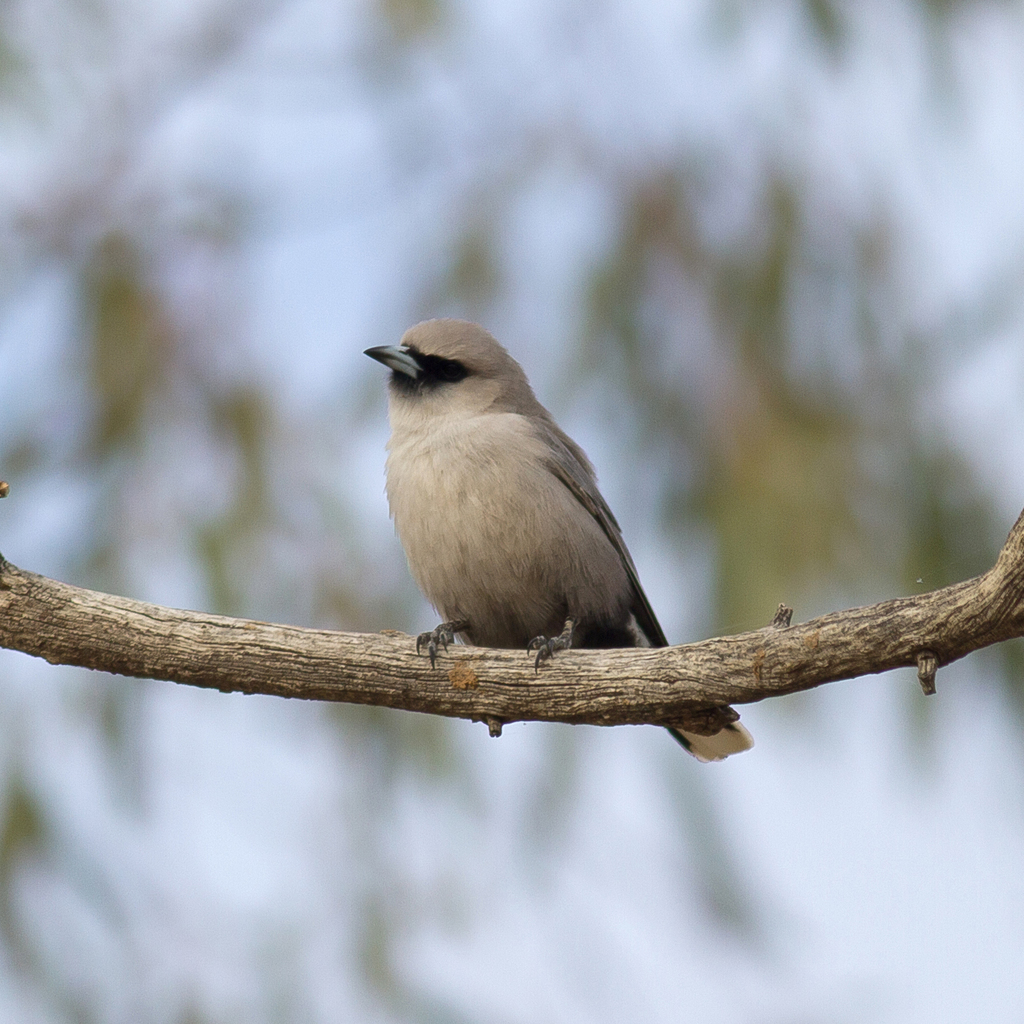
Black-faced Woodswallow
Photo © Kym Nicolson
Photo © Kym Nicolson — CC BY 4.0 — Source: iNaturalist #81535257Identification
The black-faced woodswallow is a compact bird measuring 18–19 cm in length, making it a relatively small passerine. Its most distinctive feature is the bold black face mask extending from the base of the bill around the eyes, contrasting sharply with its ash-grey plumage. The bird sports a blue-grey beak with a black tip, lighter grey underparts on the breast, darker wings, and striking silver underwings. The tail is black with a white tip. Males and females are similar in appearance, though juveniles are quite different, displaying brown body and wing coloration with buff streaks and a pale yellow beak. The species has a soft voice characterized by chiff, chap, and chattering calls, which occasionally include vocal mimicry.
Range & habitat
The black-faced woodswallow is the most widespread woodswallow species and is native to Australia, New Guinea, and the Sunda Islands, including Timor. Within Australia, it occupies most of the continent except for the southeastern coastal margin. Five recognized subspecies occur across this broad range, differentiated by plumage variations, particularly the black or white coloration of their tail vents. The species is mainly sedentary, preferring open eucalypt woodlands, scrub, and spinifex in arid and semi-arid conditions, though it also inhabits tropical savannah open woodlands and grasslands. It can tolerate dry conditions remarkably well and remains in its preferred habitats even during periods of aridity. The bird frequently flocks with other species, including finches and occasionally golden-shouldered parrots.
Behaviour & diet
Black-faced woodswallows are primarily insectivorous, employing an aerial feeding strategy in which they soar, hover, and dive to catch prey including moths and other insects. They are opportunistic foragers, supplementing their aerial hunting by feeding on the ground for ground-dwelling insects, and they will also dismantle prey caught in flight. Their brush-like tongues enable them to glean nectar from flowers, which they feed on occasionally. The species exhibits fascinating social behavior, including communal breeding where numerous birds feed the young—likely an adaptation to the erratic climate of arid and semi-arid regions. Black-faced woodswallows show a strong tendency to flock and cluster roost both day and night, behaviors that provide thermoregulation, wind protection, social benefits, and reduced predation risk.
Best time & places to see it
Breeding generally follows periods of rain when insects become abundant, typically occurring once a year between August and September. To maximize viewing opportunities, visit during or shortly after seasonal rainfall when breeding activity and insect availability peak. The species occurs across most of Australia except the southeastern coast, so numerous locations across the continent offer sighting opportunities. Look for them in open eucalypt woodlands, scrub areas, and grasslands, particularly in arid and semi-arid regions. Watch for their characteristic flocking behavior and their tendency to cluster roost, which can aid in locating populations.
Photography tips
The black-faced woodswallow's striking black face mask and contrasting ash-grey plumage make it visually distinctive and rewarding to photograph. Capture images during calm conditions to showcase the bird's silver underwings and the white-tipped tail, which are particularly striking in flight. The courtship display, occurring during the August–September breeding season, offers excellent photographic opportunities—watch for the characteristic wing-waving and tail-rotating displays performed by perched pairs positioned about a metre apart. Early morning or late afternoon light will best highlight the subtle grey tones and the contrast of the black facial mask. Since the species tends to flock and roost communally, group roosting behavior can provide interesting composition opportunities, though individual portraits will best showcase identification features.
Uluru-Kata Tjuta National Park
Petermann, Australia
+146 birds+10 mammals
Uluru-Kata Tjuta National Park is one of Australia’s most iconic protected areas, renowned for its breathtaking desert landscapes, extraordinary geological formations, and deep cultural significance. Located…
VIEW NATIONAL PARKKroombit Tops National Park
Valentine Plains, Australia
+152 birds+6 mammals
Where eucalypt woodlands rise into sandstone plateaus, Kroombit Tops unfolds across nearly 906 square kilometres of northeastern Queensland's most biodiverse terrain. The park's defining feature is…
VIEW NATIONAL PARKKakadu National Park
Kakadu, Australia
+273 birds+46 mammals
Kakadu National Park is Australia’s largest national park and one of the world’s most remarkable protected areas, covering nearly 20,000 square kilometres in the tropical north…
VIEW NATIONAL PARKDaintree National Park
Dedin, Australia
+362 birds+37 mammals
Daintree National Park is one of the world’s oldest and most biologically diverse tropical rainforests, protecting an extraordinary landscape where ancient forests meet the Great Barrier…
VIEW NATIONAL PARKIkara-Flinders Ranges National Park
Australia
+149 birds+10 mammals
Where ancient quartzite ridges rise across the semi-arid heart of South Australia, Ikara-Flinders Ranges National Park unfolds across nearly two thousand square kilometres of one of…
VIEW NATIONAL PARKLittle Desert National Park
Australia
+200 birds+11 mammals
Across northwestern Victoria's semi-arid interior, sandstone ridges and heathland plateaus rise from red earth in a landscape sculpted by fire and drought rather than water. Little…
VIEW NATIONAL PARKVulkathunha-Gammon Ranges National Park
Australia
+97 birds+8 mammals
Granite ridges and quartzite peaks rise abruptly from the red earth of South Australia's mid-north, their steep slopes carved into gorges where seasonal waterfalls cascade through…
VIEW NATIONAL PARKSundown National Park
Australia
+211 birds+9 mammals
Granite ridges and eucalypt woodlands define this 305-square-kilometre expanse of southeastern Queensland, where the landscape descends from sandstone plateaus into open forests and grassy clearings that…
VIEW NATIONAL PARKRinyirru National Park
Lakefield, Australia
+258 birds+7 mammals
Where the savanna grasslands of far north Queensland meet seasonal wetlands and eucalypt woodlands, Rinyirru National Park sprawls across more than 12,500 square kilometres of rugged,…
VIEW NATIONAL PARKFitzgerald River National Park
Fitzgerald River National Park, Australia
+209 birds+11 mammals
Where granite peaks rise above windswept heathlands and pristine river systems carve through untamed wilderness, one of Australia's most biodiverse landscapes unfolds across the southwestern corner…
VIEW NATIONAL PARKLitchfield National Park
Australia
+175 birds+15 mammals
Where weathered sandstone plateaus rise above the savanna woodlands of Australia's Top End, Litchfield National Park unfolds as a landscape of dramatic contrasts shaped by a…
VIEW NATIONAL PARKNitmiluk National Park
Australia
+186 birds+27 mammals
Dramatic sandstone gorges carved by the Katherine River slice through the tropical savanna of Australia's Top End, creating a landscape where escarpments tower above crystalline pools…
VIEW NATIONAL PARKGreat Sandy National Park
Australia
+306 birds+40 mammals
Where coastal dunes rise inland from the Queensland coastline, Great Sandy National Park encompasses a landscape of remarkable ecological diversity shaped by subtropical humid conditions year-round.…
VIEW NATIONAL PARKBoodjamulla National Park
Australia
+142 birds+3 mammals
Where red sandstone gorges carve through the semi-arid interior of far north Queensland, Boodjamulla National Park reveals a landscape shaped by seasonal water availability and ancient…
VIEW NATIONAL PARKMungo National Park
Australia
+135 birds+7 mammals
Across the semi-arid inland plains of New South Wales, where sparse shrubland and scattered grassland stretch beneath enormous skies, lies a landscape shaped by ancient geological…
VIEW NATIONAL PARKWarrumbungle National Park
Coonabarabran, Australia
+183 birds+22 mammals
Volcanic peaks and weathered ridges rise abruptly from the inland tablelands of central New South Wales, their exposed rock faces glowing ochre and rust in the…
VIEW NATIONAL PARKGrampians National Park
Australia
+214 birds+18 mammals
Where sandstone ridges rise above the Western District of Victoria, Grampians National Park unfolds across rolling terrain sculpted by ancient geology and sustained by a temperate…
VIEW NATIONAL PARKMurray-Sunset National Park
Australia
+205 birds+2 mammals
Across the semi-arid borderlands of northwestern Victoria, where the Murray River defines the state's edge, sprawls a landscape of remarkable resilience and subtle beauty. Murray-Sunset National…
VIEW NATIONAL PARKKarijini National Park
Australia
+117 birds+5 mammals
Ochre ridges and rust-coloured gorges slice through the Pilbara's ancient landscape, where Karijini National Park sprawls across a wilderness of iron-rich plateaus and plunging ravines carved…
VIEW NATIONAL PARKNambung National Park
Grey, Australia
+124 birds+2 mammals
Where limestone pinnacles rise like sharpened teeth from golden sand, Nambung National Park unveils one of Western Australia's most distinctive landscapes. The Pinnacles Desert, the park's…
VIEW NATIONAL PARKCape Range National Park
Australia
+159 birds+15 mammals
Where arid limestone ridges plunge toward turquoise waters, Cape Range National Park frames one of Australia's most dramatic desert-ocean interfaces. The park's spine—a stark, weathered range…
VIEW NATIONAL PARKPurnululu National Park
Australia
+114 birds
Towering sandstone domes and dramatic gorges carved by seasonal watercourses define this remote corner of the Kimberley, where ancient rock formations create a maze of narrow…
VIEW NATIONAL PARKStirling Range National Park
Australia
+149 birds+7 mammals
Where ancient quartzite ranges rise abruptly from the southwestern Australian plateau, Stirling Range National Park unfolds as a realm of dramatic escarpments, deep valleys, and surprising…
VIEW NATIONAL PARKNo community photos yet. Log in to add the first one.
No community observations of this species yet.