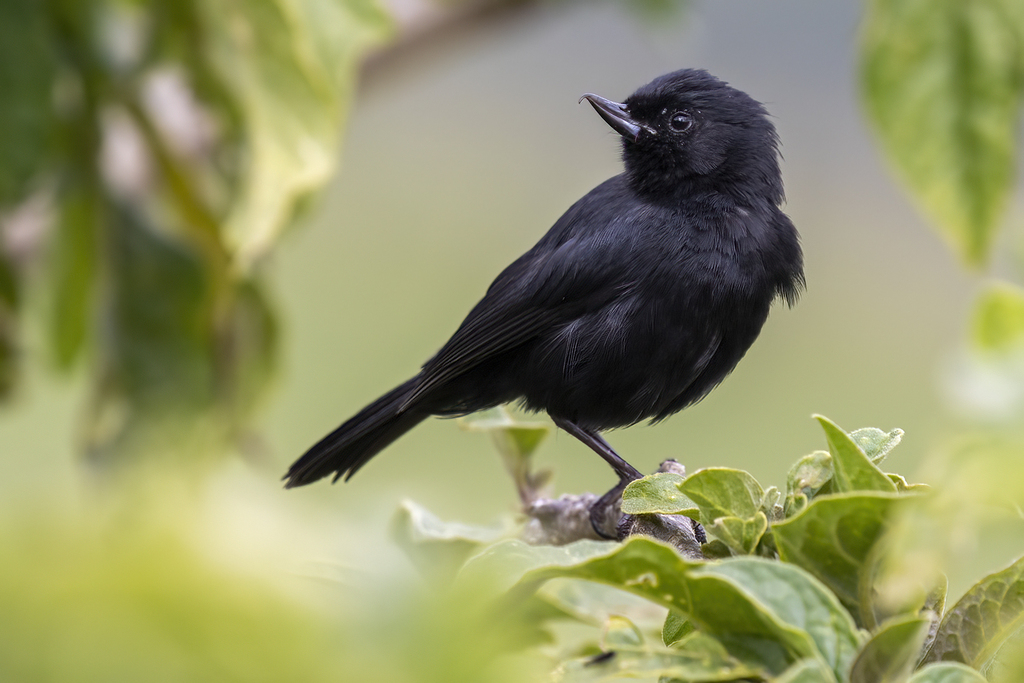
Black Flowerpiercer
Photo © Dan Vickers
Photo © Dan Vickers — CC BY 4.0 — Source: iNaturalist photo #478785996Identification
The black flowerpiercer is a small bird measuring 13–14 cm in length. Males are uniformly glossy black with a subtle blue gloss, while females are duller black with brownish wings and tail. Both sexes have brown eyes and a distinctive black bill with a grey base. Juvenile birds resemble females, showing duller plumage overall. Three subspecies show minor variations: D.h. aterrima from Ecuador and southern Colombia matches the standard description; D.h. humeralis from the East Andes has males with a bluish shoulder patch and greyish rump, while females are very dark brown; D.h. nocticolor from Santa Marta and Perija is all black with only slight gloss and a dark grey rump.
Range & Habitat
The black flowerpiercer is found in Colombia, Ecuador, Peru, and Venezuela, with populations distributed across the subtropical zone to páramo elevations between 2,175 and 4,000 metres, though most commonly between 2,700 and 3,400 metres. This species inhabits the edges of dense wet forests, scattered vegetation, and shrubby clearings. It has also adapted to human-modified landscapes, appearing in eucalyptus plantations, parks, and gardens where flowering plants provide food sources.
Behaviour & Diet
Black flowerpiercers are active, quick-moving birds that primarily feed on nectar and small invertebrates. They are characteristically solitary or found in pairs, preferring to forage in the lower portions of forests and vegetation. Their diet of nectar, obtained by piercing flowers rather than visiting them conventionally, makes them important pollinators in their mountain habitats.
Best Time & Places to See It
The black flowerpiercer is easiest to locate in flowering seasons when nectar sources are abundant. Look for them along the edges of montane forests, in scrubby clearings, and in cultivated areas with flowering plants between 2,700 and 3,400 metres elevation. Their rapid, squeaky trills and twitters—even faster than the glossy flowerpiercer—can help locate them aurally. Colombia, Ecuador, and Peru offer the best opportunities, particularly in their respective Andean regions.
Photography Tips
The black flowerpiercer's small size and preference for lower forest levels make it an accessible subject compared to canopy birds. Photograph males in good light to capture the subtle blue gloss on their black plumage; this iridescence is most apparent in direct sunlight. Early morning offers the best lighting and greatest activity levels. Focus on capturing the bird at flowering plants or in open perches where it briefly pauses between feeding bouts. A fast shutter speed helps freeze their quick, restless movements.
Antisana National Park
Cajas National Park
Cotopaxi National Park
El Tamá National Park
Llanganates National Park
Natural Chingaza National Park
Natural el Cocuy National Park
Natural Farallones de Cali National Park
Natural Munchique National Park
Nothing matches these filters.
No community photos yet. Log in to add the first one.
No community observations of this species yet.