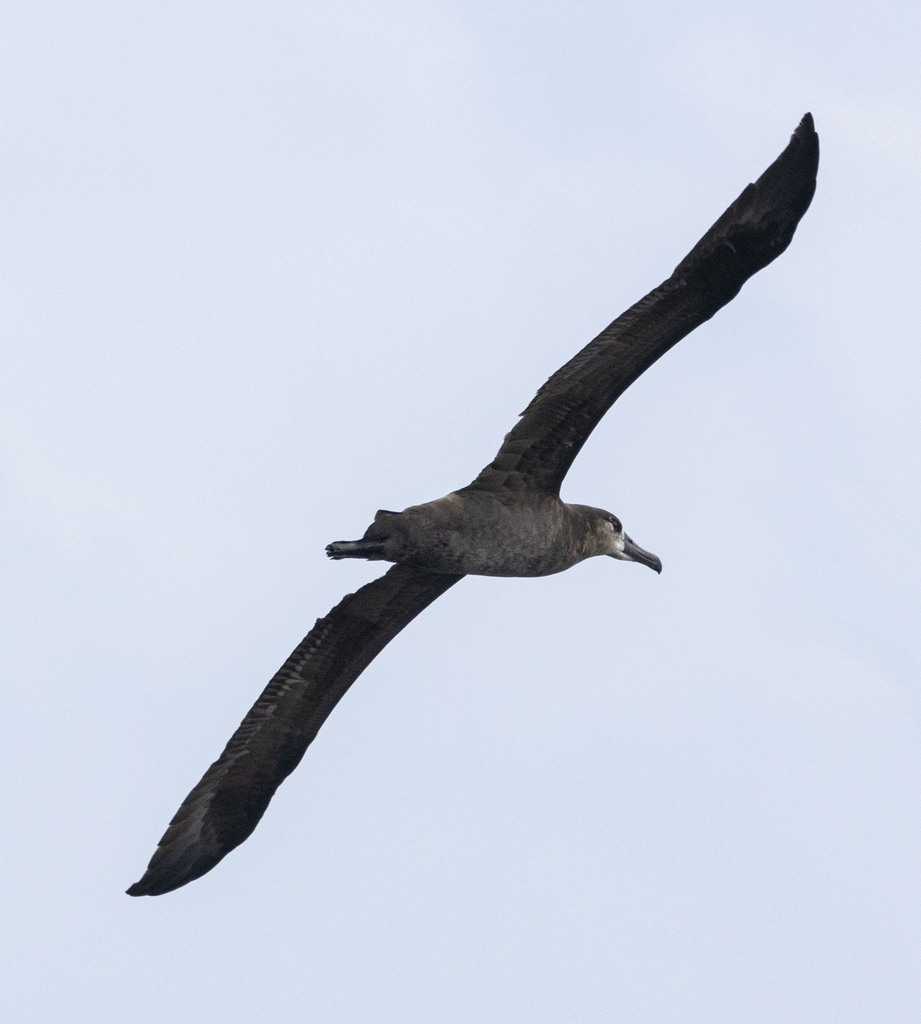
Black-footed Albatross
Photo © Brooke J.
Photo © Brooke J. — CC BY 4.0 — Source: iNaturalist #237822716The black-footed albatross (Phoebastria nigripes) is a large seabird of the albatross family Diomedeidae from the North Pacific. All but 2.5% of the population is found among the Northwestern Hawaiian Islands. It is one of three species of albatross that range in the Northern Hemisphere, nesting on isolated tropical islands. Unlike many albatrosses, it is dark plumaged. == Taxonomy == Black-footed albatrosses are a type of albatross that belong to family Diomedeidae of the order Procellariiformes, along with shearwaters, fulmars, storm petrels, and diving petrels. They share certain identifying features. First, they have nasal passages that attach to the upper bill called naricorns. Although the nostrils on the albatross are on the sides of the bill. The bills of Procellariiformes are also unique in that they are split into between seven and nine horny plates. Finally, they produce a stomach oil made up of wax esters and triglycerides that is stored in the proventriculus. This is used both against predators and as an energy rich food source for chicks and for the adults during their long flights. They also have a salt gland that is situated above the nasal passage that helps desalinate their bodies, to compensate for the high…
Glacier Bay National Park
Unorganized Borough, United States
+221 birds+15 mammals
Tidewater glaciers calving into fjords of impossible blue, where temperate rainforest rises steeply from the water's edge and alpine peaks pierce the clouds—this is the ecological…
VIEW NATIONAL PARKHawaiʻi Volcanoes National Park
Hawaiʻi County, United States
+84 birds+2 mammals
Where volcanic slopes descend toward the Pacific across more than five thousand square kilometers, Hawaiʻi Volcanoes National Park presents one of Earth's most dynamic laboratories of…
VIEW NATIONAL PARKOlympic National Park
Jefferson County, United States
+263 birds+35 mammals
Where temperate rainforest meets alpine wilderness, Olympic National Park sprawls across nearly 11,000 square kilometers of the Pacific Northwest's most pristine landscape. The park's three distinct…
VIEW NATIONAL PARKGwaii Haanas National Park Reserve and Haida Heritage Site
Area E (Moresby Island), Canada
+98 birds+8 mammals
Where temperate rainforest meets the Pacific's edge, the islands of southern Haida Gwaii rise as one of North America's most pristine coastal wilderness areas. Spanning approximately…
VIEW NATIONAL PARKEl Vizcaíno
Laguna San Ignacio, Mexico
+317 birds+29 mammals
Where the Baja California peninsula thins into a tapestry of salt lagoons and coastal desert, one of Mexico's most biodiverse reserves sprawls across half a million…
VIEW BIOSPHERE RESERVEKodiak National Wildlife Refuge
United States
+221 birds+22 mammals
Where temperate rainforest meets subarctic coast, Kodiak National Wildlife Refuge sprawls across Alaska's largest island, a sanctuary defined by steep valleys carved by tidewater glaciers and…
VIEW WILDLIFE SANCTUARYAlaska Maritime National Wildlife Refuge
Alaska, United States
+391 birds+58 mammals
Where the North Pacific collides with Alaska's rugged coastline, a sprawling archipelago of islands, rocky outcrops, and coastal headlands forms one of North America's most remote…
VIEW WILDLIFE SANCTUARYFarallon National Wildlife Refuge
San Francisco, United States
+384 birds+16 mammals
Windswept granite peaks rising abruptly from the Pacific, the Farallon Islands form a wildlife sanctuary of extraordinary seabird abundance and ecological significance just twenty-seven miles west…
VIEW WILDLIFE SANCTUARYKīlauea Point National Wildlife Refuge
Kilauea, United States
+79 birds+1 mammals
At the northernmost tip of Kauai, where the Pacific trades collide with volcanic rock, Kīlauea Point National Wildlife Sanctuary crowns a dramatic headland overlooking one of…
VIEW WILDLIFE SANCTUARYMidway Atoll National Wildlife Refuge
United States
+91 birds+1 mammals
Straddling the international date line roughly midway between North America and Asia, this atoll sanctuary rises from the North Pacific as a cluster of coral and…
VIEW WILDLIFE SANCTUARYNo community photos yet. Log in to add the first one.
No community observations of this species yet.