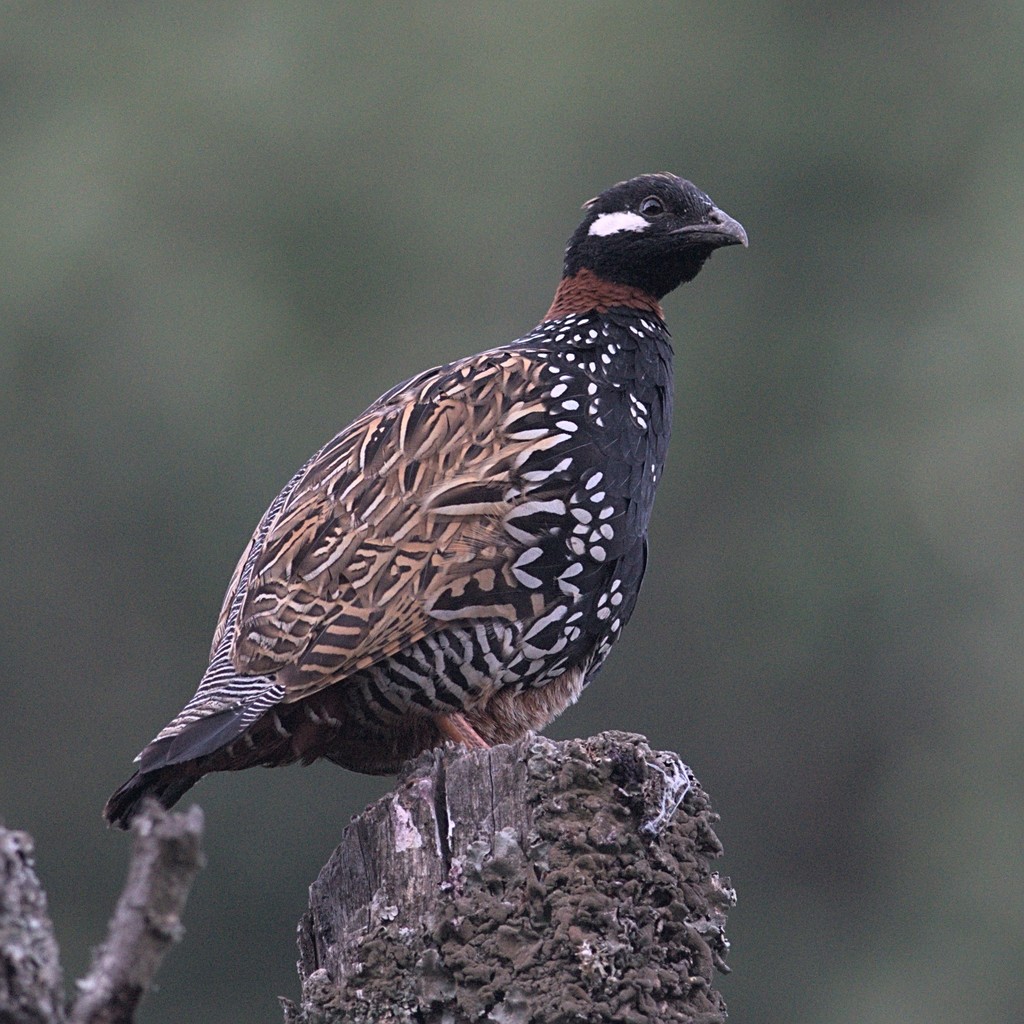
Black Francolin
Photo © Ramnarayan K
Photo © Ramnarayan K — CC BY 4.0 — Source: iNaturalist #112996789Identification
The black francolin is a compact gamebird measuring 33 to 36 centimetres in length and weighing around 453 grams. Sexual dimorphism is striking: males are predominantly black with a distinctive white cheek patch, chestnut collar, and white spots on the flanks. The back and wings display intricate scalloping in golden brown with tawny-buff bands and pale edges, while the rounded tail is black with narrow white or greyish bars. The legs and neck are reddish-brown to red. Females are considerably duller, with mainly brown plumage, a chestnut hind neck, and a brown crown with black throat. The white flank spotting varies substantially across the species' range. Distinguished from the similar grey francolin by the black francolin's rufous collar, black throat in males, and overall darker colouration.
Range & Habitat
The black francolin is a resident breeder from southeastern Turkey eastwards through Iran to southwest Turkmenistan and northeast India, with populations also occurring in Bangladesh. Six recognised subspecies are distributed across this range. Historically more widespread, the species' distribution has been fragmented by over-hunting, with populations now reduced across much of the western portion of its range. Introduced populations exist in southwestern Louisiana, southern Florida, Guam, and the Hawaiian Islands.
These birds favour scrubby habitats with cultivated crops tall enough to provide shelter yet open enough beneath for escape routes and easy ground travel. They show strong preference for areas of thick vegetation, typically near water sources, and are not forest birds, though they frequent scrubland and forest edges adjacent to grassland. They are more closely associated with water than chukars in drier regions.
Behaviour & Diet
Black francolins are reluctant fliers, preferring to creep away unseen when disturbed, though when forced to take flight they exhibit the explosive, short direct flight typical of pheasants, punctuated by glides on rounded wings. They are monogamous birds with breeding seasons typically occurring from late March to May, though this varies by range. Males attract mates with an extraordinary creaking call described as a loud ringing "klik cheek-cheek-cheerakik" or variations thereof, delivered while standing on earth mounds, bunds, rocks, or low tree branches. These calls intensify during the breeding season from April onwards and can be heard throughout the day. Both parents tend chicks after hatching, with young remaining with parents through their first winter.
The species forages on the ground for plant material and small invertebrates, including grain, grass seeds, fallen berries, shoots, tubers, termites, and ants. Clutch sizes typically range between 10 and 14 white-spotted olive or pale brown eggs, with incubation lasting 18 to 19 days performed solely by the female.
Best Time & Places to See It
The breeding season from April to June offers the best opportunity to locate black francolins, particularly in the early mornings and evenings when males call persistently from elevated perches. Savanna, grassland, and scrub vegetation areas—especially those featuring cultivated crops—are prime habitat. Focus your search in regions near water sources within the species' range spanning southeastern Turkey through Iran to northeast India and Bangladesh. The loud, distinctive calls are your greatest asset in locating these otherwise elusive birds.
Photography Tips
Patience and early morning visits will reward photographers seeking to capture this species. Males standing on exposed perches during the breeding season offer excellent opportunities for portrait photography. The striking contrast between the male's black plumage and white cheek patch, combined with the intricate scalloping on the back and wings, provides compelling subject matter. Use the bird's preference for creeping unseen to your advantage by positioning yourself quietly near suitable habitat and waiting for birds to emerge. The rufous collar and leg colouration are diagnostic field marks worth emphasising in images. Wide-angle shots capturing males on their calling perches against grassland backgrounds effectively convey the bird's habitat and behaviour.
Langtang National Park
Helambu, Nepal
+364 birds+14 mammals
Where the southern slopes of the Himalayan highlands descend toward the subtropical valleys of central Nepal, Langtang National Park sprawls across one of the subcontinent's most…
VIEW NATIONAL PARKOrang National Park
Rangagarapathar, India
+298 birds+1 mammals
Where the Brahmaputra's floodplains meet the foothills of Assam, Orang National Park unfolds across a mosaic of riverine grasslands, forests and wetlands that pulse with the…
VIEW NATIONAL PARKValmiki National Park
Ramnagar, India
+66 birds+6 mammals
Along Bihar's western frontier, where the Gandak River winds through subtropical forest and grassland, Valmiki National Park sprawls across terrain shaped by monsoon rains and seasonal…
VIEW NATIONAL PARKHawaiʻi Volcanoes National Park
Hawaiʻi County, United States
+84 birds+2 mammals
Where volcanic slopes descend toward the Pacific across more than five thousand square kilometers, Hawaiʻi Volcanoes National Park presents one of Earth's most dynamic laboratories of…
VIEW NATIONAL PARKKaziranga National Park
Kohora, India
+422 birds+26 mammals
Dawn breaks over the floodplains of the Brahmaputra, where tall grasslands stretch endlessly beneath monsoon-heavy skies. This sprawling wilderness of northeastern Assam is a mosaic of…
VIEW NATIONAL PARKNanda Devi National Park
Garpak, India
+218 birds+5 mammals
Where the Himalayas surge into their most dramatic alpine amphitheater, a wilderness of raw geological power unfolds across 624 square kilometers of pristine terrain. Nanda Devi,…
VIEW NATIONAL PARKKeoladeo National Park
Shreenagar Rural, India
+326 birds+14 mammals
Where shallow wetlands shimmer beneath vast Rajasthani skies, one of Asia's finest bird sanctuaries pulses with extraordinary life. This former maharaja's hunting reserve, now spanning 29…
VIEW NATIONAL PARKHaleakalā National Park
Maui County, United States
+66 birds+4 mammals
Ascending from sea level to over 10,000 feet across a mere thirty miles, Haleakalā National Park commands one of the Pacific's most dramatic elevation gradients, where…
VIEW NATIONAL PARKKīlauea Point National Wildlife Refuge
Kilauea, United States
+79 birds+1 mammals
At the northernmost tip of Kauai, where the Pacific trades collide with volcanic rock, Kīlauea Point National Wildlife Sanctuary crowns a dramatic headland overlooking one of…
VIEW WILDLIFE SANCTUARYNo community photos yet. Log in to add the first one.
No community observations of this species yet.