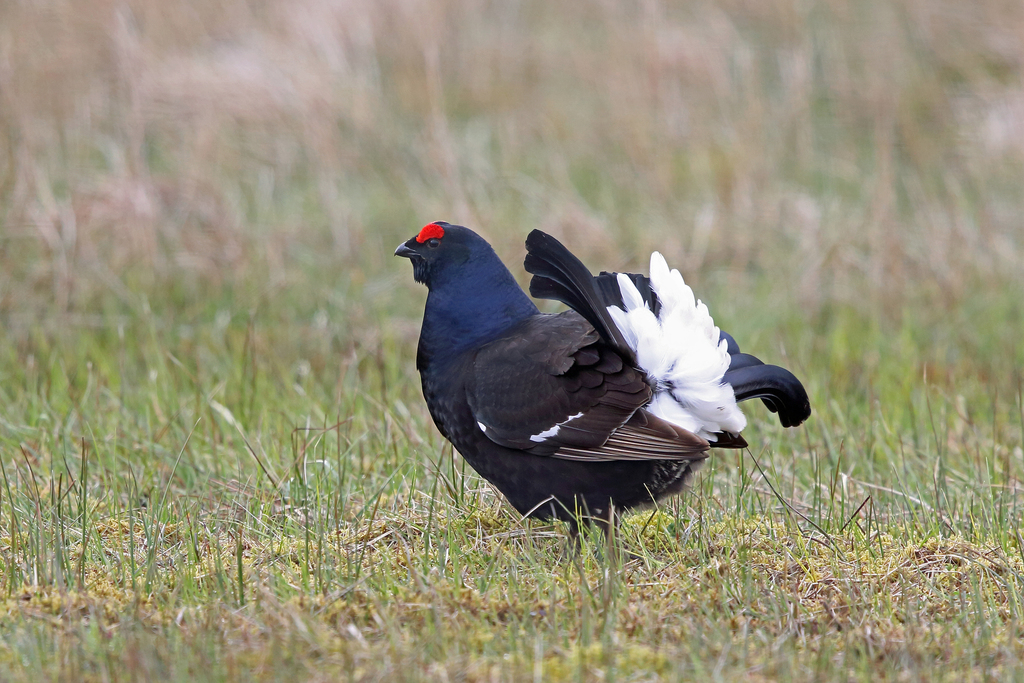
Black Grouse
Photo © Nigel Voaden
Photo © Nigel Voaden — CC BY 4.0 — Source: iNaturalist photo #7137220Identification
The black grouse is a large bird with striking sexual dimorphism. Males, known as blackcocks, measure roughly 60 centimetres in length and display predominantly black plumage with deep-blue hues on the neck and back, contrasting sharply with white winglines and undertail coverts. A distinctive feature is the red bare skin above each eye. Females, or greyhens, are considerably smaller at approximately 45 centimetres and have much drabber, cryptically coloured greyish-brown plumage designed to blend with dense undergrowth during nesting. Both sexes are characterized by long outer tail feathers that curl outward, arranged in a lyre-like shape that gives the genus Lyrurus its name.
Range & Habitat
Black grouse are found across the Palearctic, spanning from Great Britain through Scandinavia, Estonia, and across Russia to Asia. In Europe, populations occur in the Swiss-Italian-French Alps, Hungary, Latvia, Lithuania, Poland, Belarus, Romania, and Ukraine, with isolated remnants in Germany, France, Belgium, and the Netherlands. Historically present in Ireland and Denmark, they have since been extirpated from these regions. In Asia, substantial populations inhabit Russia, particularly southern Siberia, with additional birds in Kazakhstan, Mongolia, and China.
These birds favour transitional zones between forests and open clearings, including steppe, heathland, grassland, and moorland, especially near wooded areas. Seasonally, their habitat preferences shift: during breeding season they favour open spaces, while winter finds them perched in dense forests. They avoid extreme desert and polar regions.
Behaviour & Diet
Black grouse are sedentary birds with notable seasonal dietary changes. In winter, they feed almost exclusively on conifer needles whilst roosting in dense forests, often gathering in large flocks. During spring and summer, their diet broadens to include berries, shoots, and stems of Vaccinium shrubs such as cranberries and bog bilberries. The females are responsible for all nesting duties and chick care, as is typical among galliforms. The female's call is a distinctive cackling or warbling sound. Males gather at traditional lek sites during the breeding season for competitive displays.
Best Time & Places to See It
In the United Kingdom, black grouse are best found in upland areas of north Wales, the Pennines, and most of Scotland, particularly on farmland and moorland with nearby forestry or scattered trees. The species has experienced significant declines in England and has disappeared from many former haunts. A reintroduction programme began in 2003 in the Upper Derwent Valley area of the Peak District. Males can be observed at traditional lek sites during the breeding season when they engage in competitive displays.
Photography Tips
Photographing black grouse requires patience and attention to their seasonal patterns and habitat preferences. During spring and summer, when males are most active at lek sites and females are visible in open moorland and grassland habitats, opportunities are greatest. The contrast between the male's striking black plumage with white and blue highlights and red eye patches provides excellent photographic subjects, particularly in early morning light when they are most active. In winter, locating birds requires accessing dense forest areas where they roost, though this is more challenging for photography. Always approach quietly and maintain distance to avoid disturbing these sensitive birds, particularly during breeding season.
Åsnens National Park
Berwyn National Nature Reserve
Biebrza National Park
Cairngorms National Park
Chartreuse Regional Nature Park
De Hoge Veluwe National Park
Écrins National Park
Eryri National Park
Färnebofjärden National Park
Nothing matches these filters.
No community photos yet. Log in to add the first one.
No community observations of this species yet.