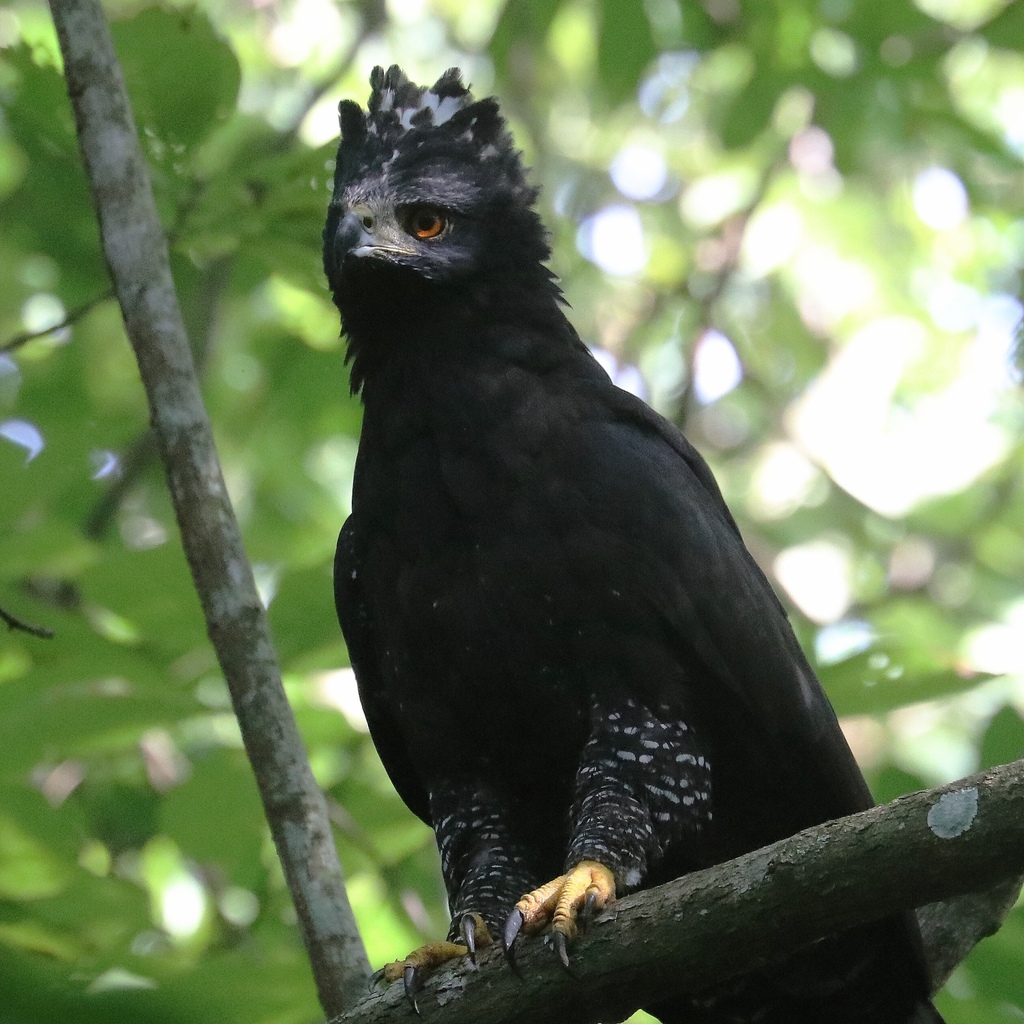
Black Hawk-Eagle
Photo © Aitor
Photo © Aitor — CC BY 4.0 — Source: iNaturalist photo #51557024Identification
The black hawk-eagle is a powerful but relatively compact eagle, measuring 58–70 cm in length and weighing 900–1,300 grams. Its most distinctive feature is its largely black plumage with white speckling and striking markings: four grey bars cross the tail, and a characteristic white line appears just above the eye. The wings are broad and short, appearing distinctly elliptical in shape, while the long, narrow tail is typically kept closed in flight and rarely fanned. These proportions—broad wings and short tail—are particularly apparent when the bird is airborne.
Range & Habitat
This species ranges from central Mexico through Central America and into South America, occurring from southeastern Brazil and northeastern Argentina through Colombia, eastern Peru, and intermediate regions. Two subspecies are recognized: S. t. tyrannus inhabits southeastern Brazil and northeastern Argentina, while the slightly smaller S. t. serus is found throughout the rest of the range. The black hawk-eagle is uncommon to fairly common across most of its distribution, preferring humid and moist forests near rivers and various types of woodland habitat. Its closest relative, the ornate hawk-eagle, is similar in size and behaviour but occupies lower elevations.
Behaviour & Diet
Despite its modest size compared to other eagles, the black hawk-eagle is a formidable predator capable of taking surprisingly large prey. Its diet includes large rodents such as lowland pacas and squirrels, opossums, and various monkey species including howler monkeys, marmosets, and squirrel monkeys. It also hunts bats, birds ranging from small social flycatchers and passerine nestlings to large species like toucans, macaws, guans, and chachalacas, as well as reptiles including large lizards, iguanas, and snakes. The species is solitary, coming together only during territorial disputes or the breeding season. When hunting, it typically perches and scans for movement; if unsuccessful, it flies to another vantage point. Once prey is spotted, the eagle captures it by pouncing or engaging in tail-chasing pursuits.
Best Time & Places to See It
Look for this eagle in humid forests near rivers and varied woodland habitats throughout its range from Mexico to northern Argentina. The bird may be more active during heavy rainfall periods, when breeding activity increases. Patience and keen observation from forest edges or river margins offer the best chances of sighting this typically solitary species.
Photography Tips
Photographing the black hawk-eagle requires patience and positioning near suitable habitat such as river corridors or forest edges. The bird's preference for perching before hunting means scanning leafy branches carefully. In flight, capture the distinctive broad, short wings and closed tail—key identifying features. The white eyebrow stripe and grey tail bars are diagnostic details worth highlighting. Early morning or during and after rainfall may increase your chances of encountering this elusive predator.
Amacayacu National Park
Amazônia National Park
Anavilhanas National Park
Arenal Volcano National Park
Bahuaja Sonene National Park
Barbilla National Park
Barra del Colorado National Wildlife Refuge
Baru Volcano National Park
Braulio Carrillo National Park
Nothing matches these filters.
No community photos yet. Log in to add the first one.
No community observations of this species yet.