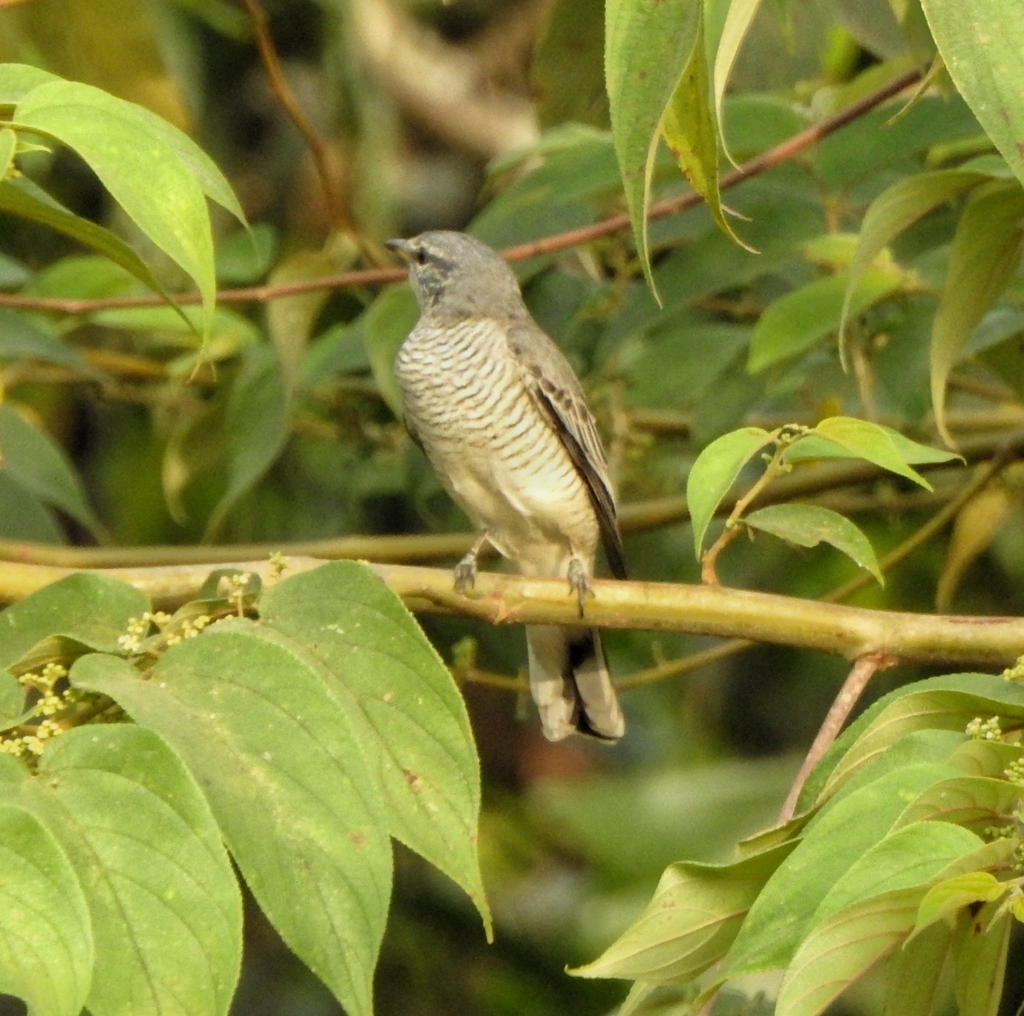
Black-headed Cuckooshrike
Photo © Afsar Nayakkan
Photo © Afsar Nayakkan — CC BY 4.0 — Source: iNaturalist #151465231Identification
The Black-headed Cuckooshrike is a slender, 18–20 cm passerine with striking sexual dimorphism that makes identification straightforward once you know what to look for. Males are particularly distinctive, displaying a dark slaty-grey hood, neck, and upper breast that contrasts sharply with a pale grey back and white belly. Their wings are blackish with grey edges, and the tail feathers are white-tipped, creating a clean pattern in flight. Females are considerably duller, with brownish-grey upperparts, a whitish supercilium (eyebrow stripe), and heavily barred underparts. Both sexes have a dark grey bill.
Range & habitat
This resident and partially migratory species is distributed across the Indian subcontinent and Southeast Asia, including India, Bangladesh, Sri Lanka, Nepal, Bhutan, and Myanmar. It shows flexible seasonal movement, remaining resident in much of its range but acting as a summer breeding visitor in the Himalayan foothills and North India, often retreating to southern regions or lower altitudes during winter.
The species favors open, dry-deciduous, and semi-evergreen forests, secondary growth, bamboo patches, and importantly, human-modified landscapes including urban gardens, orchards, and agricultural plantations. It typically inhabits lower altitudes but ranges up to 2,100 meters. Rather than dense, thick forests, it prefers open wooded habitats, scrub-jungle, wooded suburban areas, and mixed deciduous woodlands, making it accessible to birdwatchers visiting cultivated regions.
Behaviour & diet
The Black-headed Cuckooshrike is primarily arboreal, methodically foraging in the canopy of tall trees and moving from tree to tree while searching foliage for prey. It frequently joins mixed-species foraging flocks, which is typical cuckooshrike behavior. In flight, it displays a characteristic undulating, "dipping" pattern, and upon landing exhibits the family's distinctive habit of shuffling or rearranging its wings.
Generally quiet, the species produces a song consisting of clear, mellow, whistled notes ("twit-wit-wit-wee-twéé-twéé-twy-twy-twy") and also utters rapid, high-pitched calls. It is primarily insectivorous, actively hunting caterpillars, beetles, ants, and cicadas from the foliage. However, it supplements its diet with fruits, particularly Lantana berries and figs, adding an important frugivorous component to its feeding ecology.
Best time & places to see it
Timing your visit according to regional breeding seasons increases your chances of encountering this species. In South India and Sri Lanka, search during April to May; in North India and Nepal, focus on June to September. Outside breeding season, winter movements bring birds to lower altitudes and southern regions, expanding viewing opportunities.
Look for this species in open wooded areas, gardens, and orchards rather than dense forests. It is common in scrub-jungle, wooded suburban areas, and mixed deciduous woodlands across the Indian subcontinent. Urban gardens and agricultural plantations, particularly those with scattered tall trees, offer accessible viewing opportunities without requiring remote trekking.
Photography tips
Patience is essential when photographing this species, as it is often quiet and can be elusive despite frequenting gardens and orchards. Males are far more photogenic than females, with their striking grey hood and contrasting white belly providing excellent subject matter against foliage. Their undulating flight pattern and characteristic wing-shuffling behavior when landing offer dynamic photographic opportunities if you can anticipate their movements.
Focus on mixed-species foraging flocks, where Black-headed Cuckooshrikes are most active and visible. Early morning sessions in gardens and orchards tend to be most productive. The bird's preference for canopy foraging means you may need to compose upward, so positioning yourself at a slight elevation or near taller trees will improve your angles and reduce harsh backlighting.
Lunugamvehera National Park
Sri Lanka
+204 birds+14 mammals
Dry scrubland and shallow wetlands converge in Sri Lanka's southeastern lowlands, where Lunugamvehera National Park anchors one of the island's most ecologically vital landscapes. The park's…
VIEW NATIONAL PARKMinneriya National Park
Sri Lanka
+158 birds+9 mammals
Across the dry zone of Sri Lanka's North Central Province spreads a landscape of shallow tanks, grassland margins, and scattered dry forest—a mosaic of water and…
VIEW NATIONAL PARKWasgamuwa National Park
Sri Lanka
+156 birds+8 mammals
Dry deciduous forest and open grassland sweep across the North Central lowlands where Wasgamuwa National Park protects one of Sri Lanka's largest remaining tracts of this…
VIEW NATIONAL PARKValmiki National Park
Ramnagar, India
+66 birds+6 mammals
Along Bihar's western frontier, where the Gandak River winds through subtropical forest and grassland, Valmiki National Park sprawls across terrain shaped by monsoon rains and seasonal…
VIEW NATIONAL PARKRanthambhore National Park
Sawai Madhopur, India
+294 birds+20 mammals
Granite ridges and ravines carved through the Aravalli Range frame this protected landscape in eastern Rajasthan, where deciduous forest mingles with open scrubland and seasonal water…
VIEW NATIONAL PARKKanha Tiger Reserve
Kanha Kisli F.V., India
+321 birds+23 mammals
Where sal forests give way to emerald meadows and crystalline streams carve through ancient valleys, one of India's finest wilderness reserves unfolds across the Maikal Range.…
VIEW NATIONAL PARKTadoba National Park
Palasgaon Singru, India
+270 birds+20 mammals
Where sal forests meet open grasslands and rocky outcrops rise from red laterite soil, central India's landscape unfolds in raw, untamed beauty. Ancient teak woodlands and…
VIEW NATIONAL PARKBandhavgarh National Park
Garhpuri, India
+285 birds+17 mammals
Where granite ridges rise dramatically above sal and bamboo forests, one of India's most pristine tiger reserves unfolds across the Vindhyan plateau. Ancient rock formations tower…
VIEW NATIONAL PARKPanna National Park
Badgadi Kalan, India
+271 birds+17 mammals
Where granite gorges slice through central India's Vindhyan plateau, a landscape of stark beauty unfolds across nearly six hundred square kilometers. The Ken River carves through…
VIEW NATIONAL PARKKeoladeo National Park
Shreenagar Rural, India
+326 birds+14 mammals
Where shallow wetlands shimmer beneath vast Rajasthani skies, one of Asia's finest bird sanctuaries pulses with extraordinary life. This former maharaja's hunting reserve, now spanning 29…
VIEW NATIONAL PARKPeriyar National Park
Mlappara, India
+232 birds+4 mammals
Dawn breaks over mist-shrouded ridges where the Western Ghats tumble toward Kerala's spice-scented lowlands. Here, ancient tropical forests envelope a glittering artificial lake, creating a mosaic…
VIEW NATIONAL PARKPampadum Shola National Park
Vattavada, India
+258 birds+14 mammals
Where misty shola forests cling to the high plateaus of the Nilgiri Mountains, ancient evergreen remnants create a world apart. This 2,316-hectare reserve protects one of…
VIEW NATIONAL PARKBandipur National Park
Hirehalli, India
+302 birds+19 mammals
Where the Western Ghats descend into the Deccan plateau, ancient deciduous forests blanket a landscape carved by the Nugu River. Bandipur unfolds across 880 square kilometres…
VIEW NATIONAL PARKNagarahole Tiger Reserve
Nalkeri Forest, India
+323 birds+23 mammals
Where granite escarpments rise above dense deciduous forests and the Kabini River carves through pristine wilderness, one of India's most biodiverse landscapes unfolds across the Western…
VIEW NATIONAL PARKGir National Park
Asundrali, India
+258 birds+13 mammals
Dry deciduous forests cloak the rolling hills of western Gujarat where the Gir landscape rises as a final sanctuary for one of the world's rarest felids:…
VIEW NATIONAL PARKNo community photos yet. Log in to add the first one.
No community observations of this species yet.