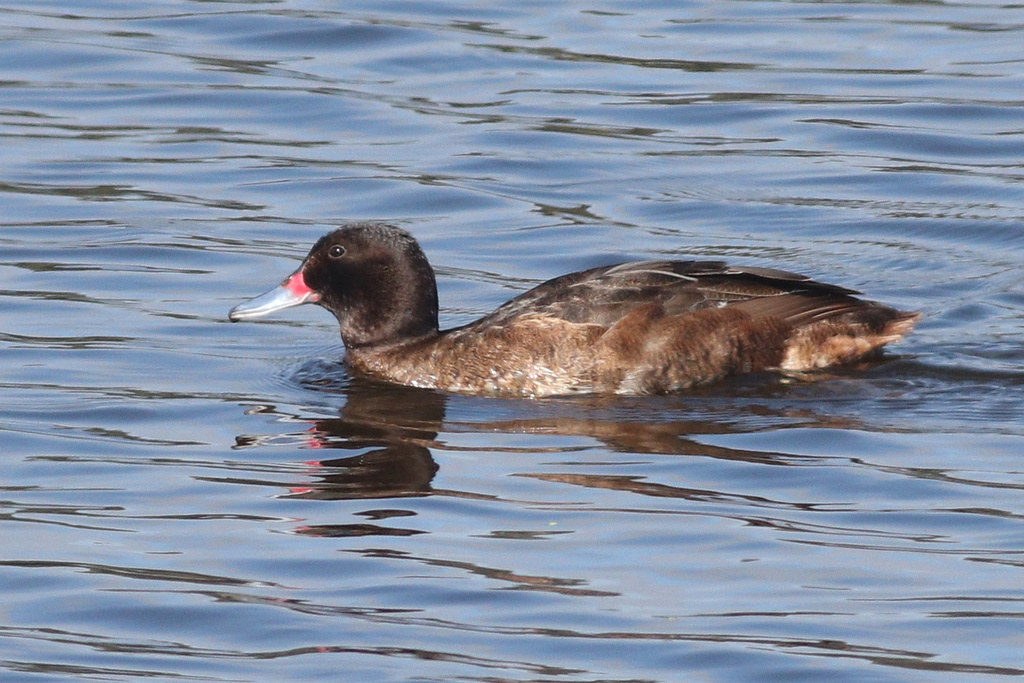
Black-headed Duck
Photo © Jan Ebr & Ivana Ebrová
Photo © Jan Ebr & Ivana Ebrová — CC BY 4.0 — Source: iNaturalist photo #117507900Identification
The black-headed duck is a distinctive South American waterfowl, measuring about 35 cm (14 inches) in length. Males are notably smaller than females, averaging 510 grams compared to females at 565 grams. The species has a characteristic elongated body paired with disproportionately short wings, giving it a unique silhouette among diving ducks. Adult males display a glossy black head and upper neck with a contrasting white chin, while their upperparts are deep brownish black adorned with cinnamon or pale rufous speckles and vermiculation. Two white bars are visible on the folded wing, and the underparts appear whitish with brown mottling, creating a silvery effect. The bill is distinctive, featuring a black maxilla and orange mandible; during breeding season, males develop a rosy patch at the base of the maxilla. Adult females are similar to males but with a dark brown head and neck instead of glossy black. Immature birds resemble females but display more rufous upperparts, yellower underparts, and a pale eye stripe.
Range & habitat
The black-headed duck is found across much of southern South America, with a discontinuous range spanning Argentina, Bolivia, Brazil, Chile, Paraguay, and Uruguay. One population inhabits the western side of central Chile, while the second and larger range extends from extreme southern Bolivia southward through central Paraguay to central Argentina, continuing east through southern Uruguay into southernmost Brazil. The species shows a preference for freshwater marshes dominated by the sedge Scirpus californicus, which provides essential food resources. Outside the breeding season, birds may venture into lakes, water-filled ditches, and occasionally flooded fields in search of suitable feeding grounds.
Behaviour & diet
This remarkable duck is partially migratory, remaining year-round in most of its range but appearing in Paraguay and Bolivia only during the non-breeding season. The black-headed duck feeds by diving, extracting seeds of Scirpus californicus as its primary food source, supplemented by snails. Most remarkably, this species is unique among all waterfowl in being an obligate brood parasite, never building its own nest but instead laying eggs in the nests of other bird species. Known hosts include the rosy-billed pochard and both the red-fronted and red-gartered coots, with at least 18 additional species documented as hosts, ranging from other waterfowl to rails, gulls, and even raptors. Unlike some parasitic birds, neither the ducklings nor adults harm their hosts' eggs or young. The precocial ducklings are independent within hours of hatching and leave the nest immediately, completing their approximately 25-day incubation period. Black-headed ducks are typically silent but produce a low "quah quah" during courtship and a two-note vocalization—"gr-rump-freet"—with females making clucking notes.
Best time & places to see it
The black-headed duck can be encountered year-round in its core Argentinian range and throughout most of its South American distribution. The species is most reliably found in freshwater marshes where Scirpus californicus sedges dominate. Birders and wildlife travellers should concentrate their efforts in Argentina, southern Brazil, and Uruguay for the highest likelihood of encounters. During non-breeding season, populations expand into Paraguay and southern Bolivia, offering additional opportunities. The species' stable population and Least Concern conservation status suggest it remains relatively accessible to patient observers throughout its range.
Photography tips
Photographing the black-headed duck presents moderate challenges due to its preference for freshwater marshes and tendency to dive for food. Early morning light in marshy habitats will best illuminate the male's glossy black head and distinctive facial markings. The species' short wings and elongated body profile offer distinctive silhouettes worth capturing, particularly in flight. Approach cautiously and remain at a distance, as these ducks are wary. Since black-headed ducks are usually silent, locating them relies on careful observation of marsh vegetation and water surfaces. The contrast between the male's black head and white chin provides excellent compositional opportunities, while females' more subtle plumage demands careful exposure metering to preserve detail in their brown tones.
Peixe National Park Lagoon
Torres del Paine National Park
Campos del Tuyú National Park
El Rey National Park
No community photos yet. Log in to add the first one.
No community observations of this species yet.