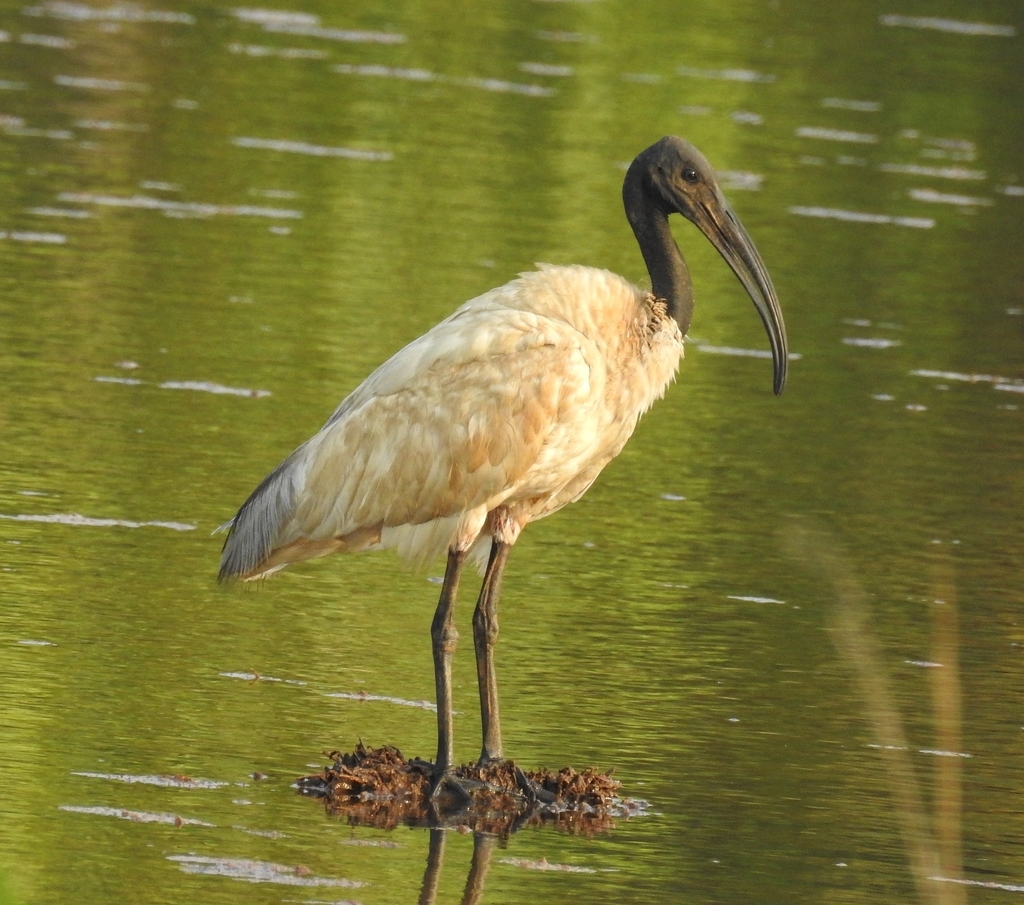
Black-headed Ibis
Photo © Afsar Nayakkan
Photo © Afsar Nayakkan — CC BY 4.0 — Source: iNaturalist #82531093Identification
The black-headed ibis is a large wading bird measuring 65–76 cm in length, unmistakable in its range for its striking white plumage contrasted against a conspicuous naked black head and neck. The down-curved beak and legs are also black. The tail feathers are light grey, though they turn jet black during the breeding season. Juveniles differ from adults in having greyish feathering on the neck and speckled brown-grey feathering on the wings and back.
During the breeding season, adults undergo remarkable transformations: bare patches under the wing flush blood-red, and some individuals develop a blueish tinge on the head, or rarely a pink or bright red patch behind the neck. White feather tufts may appear behind the neck, and occasionally a yellowish colouration appears on the breast and back. Despite these variations, the sexes are identical. Like storks and spoonbills, the black-headed ibis is silent except for ventriloquistic grunts uttered by pairs at the nest.
Range & Habitat
The black-headed ibis is native to South and Southeast Asia, with populations breeding across India, Sri Lanka, Nepal, Myanmar, and Cambodia. The species is found from India in the west to Japan in the east, occurring throughout Bangladesh, China, Hong Kong, Indonesia, Malaysia, Pakistan, the Philippines, Thailand, and Vietnam. While migratory or vagrant in Japan, Korea, Laos, and Mongolia, the species has undergone considerable declines in recent decades, particularly in Cambodia, Indonesia, Malaysia, Thailand, and Vietnam. The most rapid decline is suspected to be in the population in Sumatra.
Despite its reputation as a wetland species, the black-headed ibis is remarkably versatile, foraging across freshwater and salt-water marshes, lakes, ponds, rice fields, ploughed crop fields, irrigation canals, riversides, and reservoirs. It also adapts to urban environments, using open sewage gutters, grazing lands, garbage dumping sites, and urban lakes. Seasonal habitat preferences vary with geography and agricultural patterns. It nests in heronry colonies near wetlands, building platform nests of sticks lined with grass and threads, and uses old city trees for night roosting and nesting.
Behaviour & Diet
The black-headed ibis is primarily a forager, spending nearly half its daily activity budget—approximately 48%—feeding, followed by resting at 23%. The species' habitat use varies seasonally and geographically. In agricultural landscapes, summer feeding often focuses on natural marshes and fallow fields, spreading across a wider range of agricultural fields during the monsoon. In more forested, rocky terrain, wetlands remain the preferred habitat year-round. In urban landscapes, crop fields, wetlands, and open areas support the highest abundance of birds, with a shift toward grazing lands during the monsoon and increased use of open sewage lines during dry summers.
The species is strictly seasonal in its breeding behaviour, nesting only during the rainy season. Birds gather in colonies near wetlands, where they construct their stick nests and raise their young communally. This concentration of breeding activity during the monsoon season synchronizes reproduction with peak food availability and water levels.
Best Time & Places to See It
The black-headed ibis is best observed during the rainy season when breeding colonies are active and birds are most concentrated. India, Sri Lanka, Nepal, and Myanmar support widespread breeding populations and are the most reliable locations. The species' versatility means it can be found in diverse habitats: freshwater wetlands, rice paddies, marshes, and even urban lakes make productive viewing spots. Agricultural regions undergoing seasonal flooding are particularly rewarding during the monsoon.
Early morning is ideal for observation, when birds are most active in feeding. Look for them in small to large flocks in open feeding areas, and check heronry colonies near wetlands during breeding season for congregated birds.
Photography Tips
The black-headed ibis's stark white plumage and black head create excellent contrast for photography, but take care with exposure metering to avoid blown-out whites. Breeding plumage—particularly the blood-red patches under the wings and the occasional blue, pink, or red head markings—offers dramatic compositional opportunities. Photograph breeding birds from a distance to avoid disturbance to colonies.
Early morning light accentuates the white plumage beautifully. The bird's curved beak and feeding posture in shallow water provide strong subjects. Capture the characteristic silhouette in flight against dawn or dusk skies, or document flocking and roosting behaviour in trees. During monsoon breeding season, look for adults with developing decorative plumage and juvenile birds alongside parents.
Lunugamvehera National Park
Sri Lanka
+204 birds+14 mammals
Dry scrubland and shallow wetlands converge in Sri Lanka's southeastern lowlands, where Lunugamvehera National Park anchors one of the island's most ecologically vital landscapes. The park's…
VIEW NATIONAL PARKMinneriya National Park
Sri Lanka
+158 birds+9 mammals
Across the dry zone of Sri Lanka's North Central Province spreads a landscape of shallow tanks, grassland margins, and scattered dry forest—a mosaic of water and…
VIEW NATIONAL PARKWasgamuwa National Park
Sri Lanka
+156 birds+8 mammals
Dry deciduous forest and open grassland sweep across the North Central lowlands where Wasgamuwa National Park protects one of Sri Lanka's largest remaining tracts of this…
VIEW NATIONAL PARKAngamedilla National Park
Polonnaruwa, Sri Lanka
+40 birds+2 mammals
Ancient tanks and sal forests define this water-rich sanctuary in Sri Lanka's North Central heartland, where seasonal wetlands and dry deciduous woodland create a mosaic of…
VIEW NATIONAL PARKOrang National Park
Rangagarapathar, India
+298 birds+1 mammals
Where the Brahmaputra's floodplains meet the foothills of Assam, Orang National Park unfolds across a mosaic of riverine grasslands, forests and wetlands that pulse with the…
VIEW NATIONAL PARKRanthambhore National Park
Sawai Madhopur, India
+294 birds+20 mammals
Granite ridges and ravines carved through the Aravalli Range frame this protected landscape in eastern Rajasthan, where deciduous forest mingles with open scrubland and seasonal water…
VIEW NATIONAL PARKKanha Tiger Reserve
Kanha Kisli F.V., India
+321 birds+23 mammals
Where sal forests give way to emerald meadows and crystalline streams carve through ancient valleys, one of India's finest wilderness reserves unfolds across the Maikal Range.…
VIEW NATIONAL PARKTadoba National Park
Palasgaon Singru, India
+270 birds+20 mammals
Where sal forests meet open grasslands and rocky outcrops rise from red laterite soil, central India's landscape unfolds in raw, untamed beauty. Ancient teak woodlands and…
VIEW NATIONAL PARKBandhavgarh National Park
Garhpuri, India
+285 birds+17 mammals
Where granite ridges rise dramatically above sal and bamboo forests, one of India's most pristine tiger reserves unfolds across the Vindhyan plateau. Ancient rock formations tower…
VIEW NATIONAL PARKPanna National Park
Badgadi Kalan, India
+271 birds+17 mammals
Where granite gorges slice through central India's Vindhyan plateau, a landscape of stark beauty unfolds across nearly six hundred square kilometers. The Ken River carves through…
VIEW NATIONAL PARKKaziranga National Park
Kohora, India
+422 birds+26 mammals
Dawn breaks over the floodplains of the Brahmaputra, where tall grasslands stretch endlessly beneath monsoon-heavy skies. This sprawling wilderness of northeastern Assam is a mosaic of…
VIEW NATIONAL PARKKeoladeo National Park
Shreenagar Rural, India
+326 birds+14 mammals
Where shallow wetlands shimmer beneath vast Rajasthani skies, one of Asia's finest bird sanctuaries pulses with extraordinary life. This former maharaja's hunting reserve, now spanning 29…
VIEW NATIONAL PARKPeriyar National Park
Mlappara, India
+232 birds+4 mammals
Dawn breaks over mist-shrouded ridges where the Western Ghats tumble toward Kerala's spice-scented lowlands. Here, ancient tropical forests envelope a glittering artificial lake, creating a mosaic…
VIEW NATIONAL PARKPampadum Shola National Park
Vattavada, India
+258 birds+14 mammals
Where misty shola forests cling to the high plateaus of the Nilgiri Mountains, ancient evergreen remnants create a world apart. This 2,316-hectare reserve protects one of…
VIEW NATIONAL PARKBandipur National Park
Hirehalli, India
+302 birds+19 mammals
Where the Western Ghats descend into the Deccan plateau, ancient deciduous forests blanket a landscape carved by the Nugu River. Bandipur unfolds across 880 square kilometres…
VIEW NATIONAL PARKNagarahole Tiger Reserve
Nalkeri Forest, India
+323 birds+23 mammals
Where granite escarpments rise above dense deciduous forests and the Kabini River carves through pristine wilderness, one of India's most biodiverse landscapes unfolds across the Western…
VIEW NATIONAL PARKGir National Park
Asundrali, India
+258 birds+13 mammals
Dry deciduous forests cloak the rolling hills of western Gujarat where the Gir landscape rises as a final sanctuary for one of the world's rarest felids:…
VIEW NATIONAL PARKNo community photos yet. Log in to add the first one.
No community observations of this species yet.