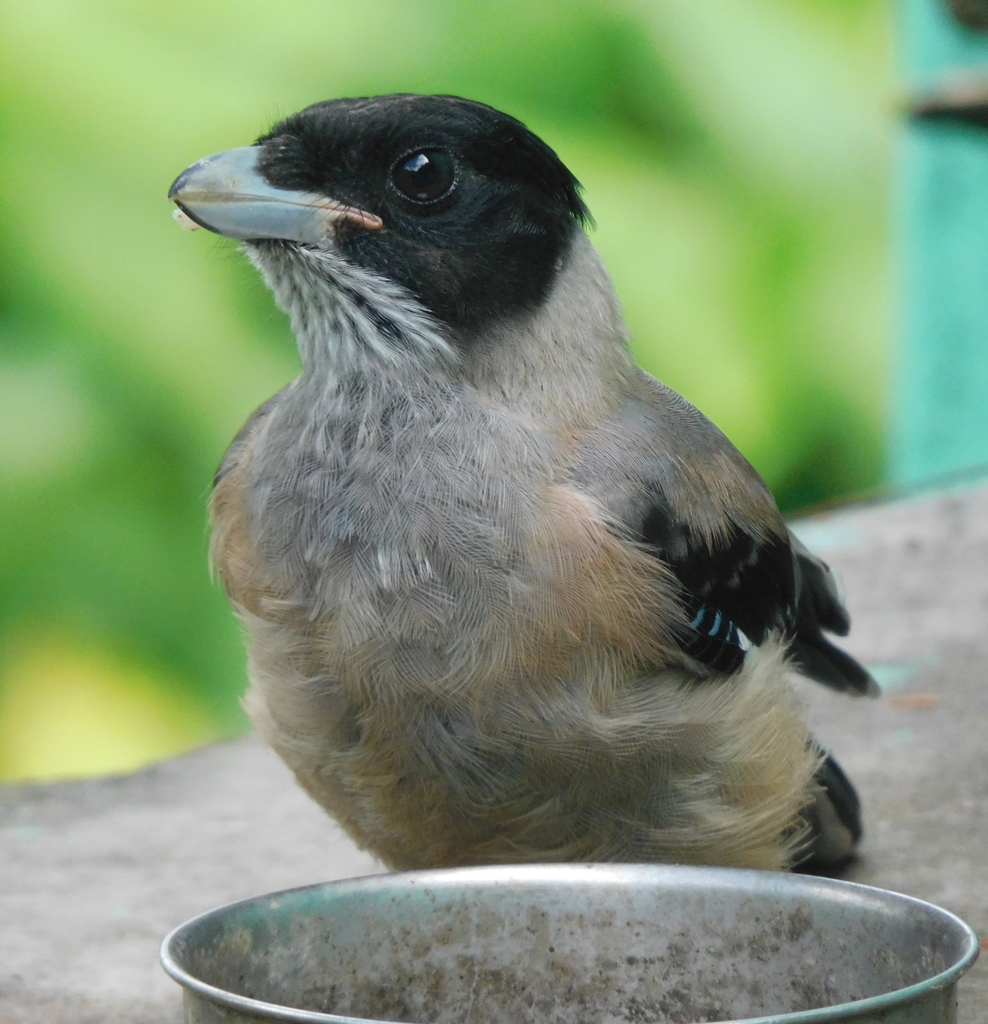
Black-headed Jay
Photo © Jagdish Singh Negi
Photo © Jagdish Singh Negi — CC BY 4.0 — Source: iNaturalist #176598600Identification
The black-headed jay is a relatively large songbird in the crow family, roughly the same size as the Eurasian jay but noticeably more slender in overall build. Its most striking feature is its mostly black head, which contrasts sharply with a largely grey body. White streaks accent the throat, and an untidy, prominent crest crowns the head—more obvious than that of its Eurasian relative. The pale bill is slightly shorter and thicker than the Eurasian jay's, while the tail is comparatively longer.
The black-headed jay's voice is very similar to the Eurasian jay's, though distinguished by longer pauses between calls. Its most common vocalization is a harsh "kraaa" that may sound either raspy or more nasal depending on the individual bird.
Range & Habitat
This non-migratory species ranges across the Himalayas from eastern Afghanistan eastwards through India, Nepal, and Bhutan. Rather than dense forests, black-headed jays prefer open wooded country with large expanses of open ground, occupying elevations from 570 to 4000 metres. They are adaptable birds that also frequent cultivated areas and village outskirts, provided sufficient trees and scrubland remain nearby.
Their tolerance for human-modified landscapes extends to agricultural land and even garbage dumps, where they readily forage alongside more traditional natural habitats.
Behaviour & Diet
Black-headed jays are omnivores with remarkably catholic tastes in food. They forage both on the ground and in trees, consuming the same wide range of plant and animal foods as the Eurasian jay—including eggs and nestlings of other birds. Their bold nature allows them to frequent human habitations without apparent fear, and they readily exploit agricultural land and refuse sites as supplementary food sources.
Breeding resembles that of the Eurasian jay in all respects. Nests are constructed of sticks plastered together with mud and lined with weeds and rootlets, built in trees or suitable bushes. Clutches typically contain 3–5 eggs, which are incubated for 16 days, with both parents participating in feeding the young.
Best Time & Places to See It
Black-headed jays are relatively common across their Himalayan range, making them accessible to travellers exploring suitable habitat in Afghanistan, India, Nepal, and Bhutan. Their tolerance for cultivated areas and village peripheries means they may be encountered even in semi-developed settings, not solely in wilderness. The species is non-migratory, so it can be found year-round throughout its range, though it is reportedly less common in Nepal than elsewhere.
Photography Tips
The black-headed jay's striking contrast between its black head and grey body, combined with its prominent crest and white throat streaks, makes it visually rewarding for photographers. Look for them in open woodland and scrubland, particularly near agricultural areas or settlements where they may be more habituated to human presence. Their boldness can work in your favour, allowing closer approach than many other wild birds, though patience is still required to capture their characteristic crest fully raised or to photograph their distinctive pale bill clearly against their dark plumage.
Langtang National Park
Helambu, Nepal
+364 birds+14 mammals
Where the southern slopes of the Himalayan highlands descend toward the subtropical valleys of central Nepal, Langtang National Park sprawls across one of the subcontinent's most…
VIEW NATIONAL PARKSagarmatha National Park
Khumjung, Nepal
+219 birds+7 mammals
Soaring peaks and deep glacial valleys define this alpine wilderness in northeastern Nepal, where the terrain rises from forested foothills into a realm of high-altitude tundra…
VIEW NATIONAL PARKNanda Devi National Park
Garpak, India
+218 birds+5 mammals
Where the Himalayas surge into their most dramatic alpine amphitheater, a wilderness of raw geological power unfolds across 624 square kilometers of pristine terrain. Nanda Devi,…
VIEW NATIONAL PARKValley of Flowers National Park
Ghangaria, India
+117 birds+1 mammals
Where alpine meadows explode with color each monsoon season, the Himalayan slopes of Uttarakhand rise to create one of Earth's most extraordinary floral displays. Perched between…
VIEW NATIONAL PARKNo community photos yet. Log in to add the first one.
No community observations of this species yet.