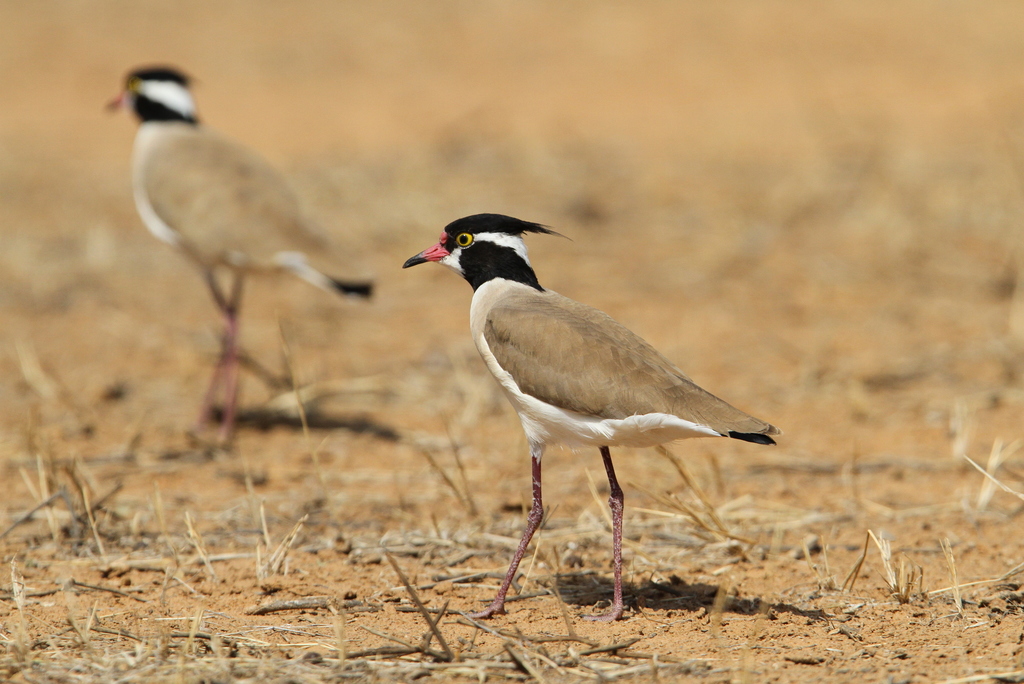
Black-headed Lapwing
Photo © Christoph Moning
Photo © Christoph Moning — CC BY 4.0 — Source: iNaturalist photo #95338703Identification
The black-headed lapwing is a conspicuous and unmistakable large wader with striking plumage. Its most distinctive feature is a jet-black head contrasting sharply with a white forehead, lower face, and bands across the rear head and nape. A wispy black crest, reminiscent of the northern lapwing, adorns the crown. The bill and legs are a bright red, making this bird particularly eye-catching in the field. The tail is white with a black tip, providing excellent identification markers when the bird is in flight or at rest.
In flight, the black-headed lapwing reveals additional diagnostic features. The upperwings display black flight feathers and brown coverts separated by a clean white bar—a striking pattern visible even at distance. The underwings are predominantly white with black flight feathers, creating an elegant two-tone appearance that aids identification when the bird is airborne.
Range & Habitat
The black-headed lapwing is a resident breeder across sub-Saharan Africa, with its range extending from Senegal in the west to Ethiopia in the east. Two subspecies are recognised: the nominate V. t. tectus occupies the southwestern Mauritania to Ethiopia region, southward to Ivory Coast and Uganda, while V. t. latifrons inhabits the area from southern Somalia to eastern Kenya. Although primarily resident throughout this vast range, the species exhibits seasonal movements.
These birds are common breeders in wet lowland habitats close to water, where they build their simple nests as ground scrapes and lay two or three eggs. However, they are highly adaptable feeders and frequently venture into drier habitats such as golf courses and grassy scrub to forage for food, demonstrating their ability to exploit diverse environments across the African landscape.
Behaviour & Diet
The black-headed lapwing is an active and energetic forager, feeding by picking insects and other invertebrates directly from the ground. This ground-feeding behaviour, typical of plovers, makes them relatively easy to observe as they work across open areas, pausing frequently to probe and peck at the soil surface. They possess a distinctive metallic "tink-tink" call that is often heard before the bird is seen, particularly during breeding season or when alarmed.
Best Time & Places to See It
The black-headed lapwing's sub-Saharan African range from Senegal to Ethiopia offers numerous opportunities for sightings. Look for this species in wet lowland habitats near water bodies, where it breeds most commonly. During non-breeding periods, scan golf courses, grassy scrub, and open ground near wetland margins, as birds often move to these drier feeding areas. Listen for its characteristic metallic call, which will often alert you to a bird's presence before you spot it visually.
Photography Tips
The black-headed lapwing's bold black-and-white head pattern and bright red bill and legs make it an exceptionally photogenic subject. Photograph birds in good light to capture the metallic sheen of the plumage and the vivid red coloration of the bill and legs. When birds are in flight, try to capture the distinctive white bar across the upperwings and the contrast between black flight feathers and brown coverts—these aerial shots showcase the species' elegant in-flight silhouette. Ground-feeding birds offer excellent opportunities for natural behaviour photography, particularly as they probe and move through grassland and scrub habitats.
Kidepo Valley National Park
Uganda
+478 birds+24 mammals
Where the Narus and Kidepo rivers carve through northeastern Uganda's semi-arid lowlands, a landscape of sparse acacia woodland, grassland, and riverine thickets creates one of East…
VIEW NATIONAL PARKMurchison Falls National Park
Uganda
+608 birds+33 mammals
Where the Victoria Nile compresses through a narrow gorge and explodes across a 45-meter precipice, the landscape speaks in thunder. Murchison Falls National Park sprawls across…
VIEW NATIONAL PARKTsavo East National Park
Athi ward, Kenya
+468 birds+50 mammals
Across the semi-arid lowlands of southeastern Kenya, where acacia woodland fragments into scrubland and the landscape rolls toward the Indian Ocean horizon, lies one of Africa's…
VIEW NATIONAL PARKAmboseli National Park
Etonet/Lenkism ward, Kenya
+501 birds+43 mammals
Where the Amboseli basin opens toward the Tanzanian frontier, a shallow alkaline lake mirrors vast skies across one of East Africa's most iconic savanna landscapes. The…
VIEW NATIONAL PARKToro-Semliki Proposed National Park
Uganda
+474 birds+5 mammals
Where the Albertine Rift's western escarpment rises above the Semliki River valley, a vast mosaic of forest, savanna and wetland converges to create one of East…
VIEW NATIONAL PARKQueen Elizabeth National Park
Uganda
+672 birds+30 mammals
Across the southwestern escarpment of Uganda, where the Western Rift Valley descends through ancient volcanic terrain, Queen Elizabeth National Park sprawls across more than 8,300 square…
VIEW NATIONAL PARKAbijata-Shalla Lakes National Park
Ethiopia
+438 birds+7 mammals
Two crater lakes of contrasting chemistry define this remote corner of Ethiopia's Rift Valley, where soda lakes and freshwater basins create a mosaic of distinct aquatic…
VIEW NATIONAL PARKMago National Park
Ethiopia
+128 birds+3 mammals
Where the Omo River cuts through southern Ethiopia's arid borderlands, Mago National Park sprawls across a landscape of dramatic escarpments, riverine forests, and semi-arid savanna that…
VIEW NATIONAL PARKAwash National Park
Didiga, Ethiopia
+473 birds+23 mammals
Where the Ethiopian Rift Valley carves through volcanic plateaus, a ribbon of riverine forest winds through acacia scrubland and grassland, creating a mosaic of habitats that…
VIEW NATURAL PARKMeru National Park
Igembe Central, Kenya
+408 birds+38 mammals
Granite outcrops and acacia woodland rise across the northern reaches of Meru, where semi-arid savanna transitions into drier scrubland under the fierce equatorial sun. The park's…
VIEW NATIONAL PARKArabuko Sokoke Forest Reserve
Kilifi, Kenya
+383 birds+29 mammals
Coastal forest rises from the Indian Ocean plains of Kilifi County, where sandy soils and seasonal rainfall have sculpted a woodland ecosystem unlike anywhere else on…
VIEW NATURE RESERVEWatamu Marine National Park
Dabaso ward, Kenya
+328 birds+12 mammals
Where mangrove channels meet coral gardens and sandy shallows blend into the warm waters of the Indian Ocean, Watamu Marine National Park unfolds across the Kilifi…
VIEW NATIONAL PARKNo community photos yet. Log in to add the first one.
No community observations of this species yet.