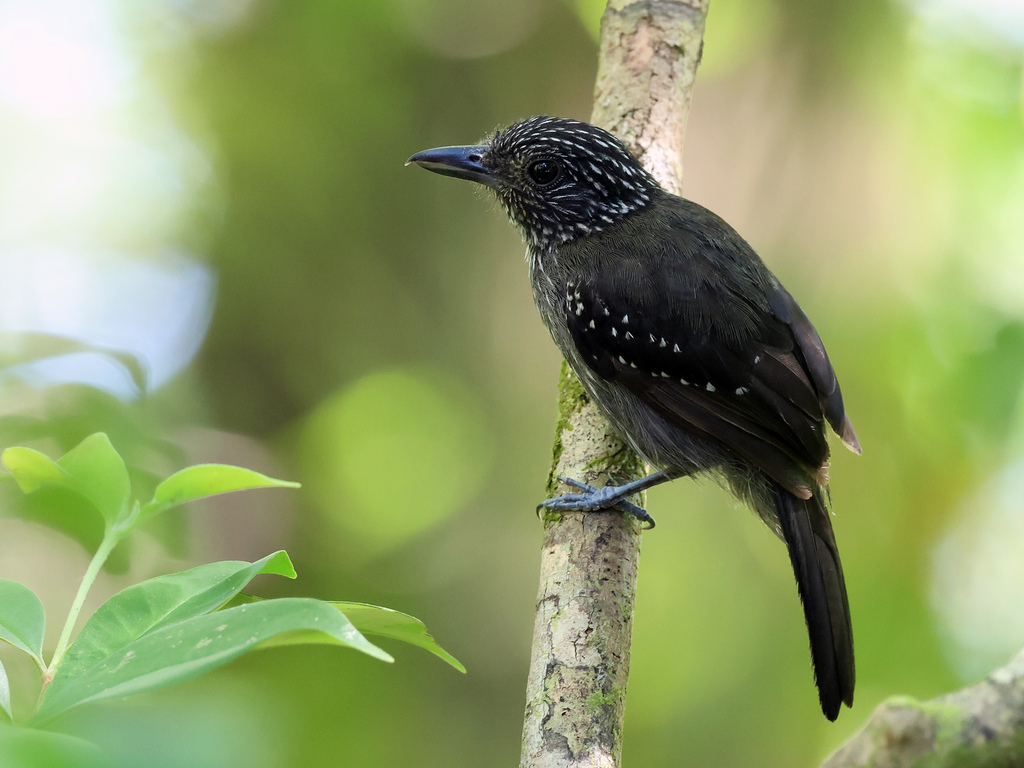
Black-hooded Antshrike
Photo © Daniel Ghyselinck
Photo © Daniel Ghyselinck — CC BY 4.0 — Source: iNaturalist photo #621520795Identification
The black-hooded antshrike is a small but sturdy antbird measuring 15–17 cm in length, weighing just 26–27 g. Like all members of its genus, it possesses the characteristic stout, hooked bill typical of antbirds. Males are unmistakable: predominantly black plumage with a distinctive white patch between the scapulars, small white dots scattered across the wing coverts, and dark gray underparts. Females present a different appearance, with blackish-gray heads marked by narrow white streaks, very dark grayish-brown upperparts featuring white-edged scapulars and white-spotted wing coverts, and olive underparts with white streaking on the throat, breast, and belly. Juveniles resemble females but are browner with more prominent white spots on the wings, while subadult males show brownish tones and white breast streaking.
Range & Habitat
This species is endemic to Central America, occurring from southern Guanacaste Province in Costa Rica south through the Pacific slope of western Panama to Los Santos Province. It inhabits the understorey and mid-storey levels of lowland evergreen forest, semi-deciduous forest, gallery forest, secondary woodland, and mangrove edges, with a particular preference for shrubby areas and dense vine tangles. It typically remains below 1,000 m elevation, though occasionally ranges up to 1,200 m in Costa Rica. The species appears to be a year-round resident throughout its range.
Behaviour & Diet
The black-hooded antshrike forages sluggishly through dense vegetation, from near ground level to about 15 m high, usually alone or in pairs, and frequently joins mixed-species feeding flocks. It gleans insects and other arthropods including spiders from leaves, stems, branches, and trunks with quick pecks and lunges. In drier areas, it regularly hops on the ground, probing and flipping leaf litter for prey, and occasionally follows army ant swarms to capture fleeing arthropods. Breeding occurs from February to September in Costa Rica, with nest construction undertaken in a fairly large cup made of fine rootlets and fibers, often decorated with green moss, and suspended by cobwebs in a branch fork 0.6–3.6 m above ground. Clutches contain two eggs; both parents share incubation duties during the day, with the female continuing alone at night, and both provision the nestlings.
Best Time & Places to See It
The black-hooded antshrike is rare in northern Costa Rica but common in the southern portion of the country, making the Pacific slope of southern Costa Rica and western Panama the most reliable locations. The species is a year-round resident, so it can be encountered in any season. Protected areas in Costa Rica provide the best opportunities for observation. Look for this bird in lowland forest edges and secondary growth, particularly in areas with dense shrubby vegetation and vine tangles along forest margins and gallery forests.
Photography Tips
Patience and careful positioning are essential for photographing this sluggish, vegetation-loving antbird. Males are more visually striking than females, with their black plumage and white patches providing good contrast, though they often remain concealed in dense cover. Early morning often brings increased activity and better visibility. Position yourself quietly near forest edges and mixed-species feeding flocks, as the bird may emerge briefly while gleaning prey from vegetation. The species' habit of foraging in vine tangles and dense understorey means you may need to wait for it to move to slightly more open perches. Focus on capturing the male's distinctive scapular patch and wing spotting, or the female's characteristic head pattern and streaking.
Corcovado National Park
Puerto Jiménez, Costa Rica
+444 birds+48 mammals
Where the Osa Peninsula juts into the Pacific, rainforest descends almost to the tide line, and Corcovado National Park protects one of Central America's most intact…
VIEW NATIONAL PARKManuel Antonio National Park
Quepos, Costa Rica
+426 birds+22 mammals
Where tropical rainforest descends steeply to a rocky Pacific coastline, Manuel Antonio National Park distills Central American biodiversity into one of Costa Rica's most compressed and…
VIEW NATIONAL PARKPiedras Blancas National Park
Golfito, Costa Rica
+386 birds+24 mammals
Where the Golfo Dulce meets the southwestern Pacific coast of Costa Rica, Piedras Blancas National Park protects a dramatic transition zone where lowland rainforest descends toward…
VIEW NATIONAL PARKCoiba National Park
Montijo, Panama
+260 birds+10 mammals
An archipelago of volcanic and sedimentary islands rises from the Pacific waters off Panama's southwestern coast, its densest rainforest canopy unbroken for millennia. Coiba National Park…
VIEW NATIONAL PARKBaru Volcano National Park
Cerro Punta, Panama
+402 birds+6 mammals
Where the land rises sharply toward the Caribbean's western spine, Baru Volcano National Park sprawls across roughly 220 square kilometres of southwestern Panama, anchored by the…
VIEW NATIONAL PARKCarara National Park
Tárcoles, Costa Rica
+397 birds+19 mammals
Where the Pacific coastal plain meets transitional forest, Carara National Park straddles one of Central America's most dynamic ecological boundaries. The park's landscape encompasses lowland deciduous…
VIEW NATIONAL PARKLa Amistad International Park
Crorina, Costa Rica
+532 birds+20 mammals
Where the Caribbean slopes of Costa Rica's Talamanca Mountains rise steeply inland from Limón, the boundary between two nations dissolves into an unbroken expanse of rainforest.…
VIEW NATIONAL PARKVolcán Tenorio National Park
Guatuso, Costa Rica
+480 birds+12 mammals
Where volcanic slopes rise through Costa Rica's northwestern borderlands, Volcán Tenorio National Park sprawls across terrain shaped by ancient lava flows and mineral-rich springs. The park's…
VIEW NATIONAL PARKMarino Ballena National Park
Bahía Ballena, Costa Rica
+336 birds+8 mammals
Where mangrove forests meet coral-fringed shorelines along Costa Rica's southern Pacific coast, Marino Ballena National Park encompasses a marine and terrestrial mosaic that ranks among Central…
VIEW NATIONAL PARKNo community photos yet. Log in to add the first one.
No community observations of this species yet.