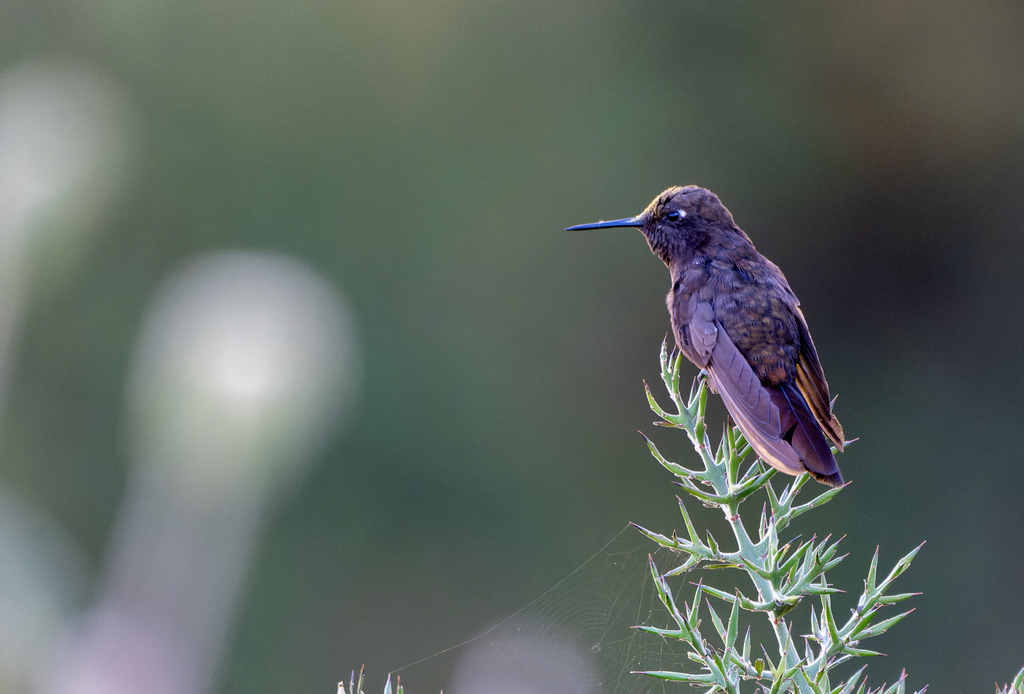
Black Metaltail
Photo © David F. Belmonte
Photo © David F. Belmonte — CC BY 4.0 — Source: iNaturalist photo #541849794Identification
The Black Metaltail is a small hummingbird measuring 11.5 to 12.5 cm in length, with a weight of approximately 6 grams. Males are striking birds with overall black plumage displaying a purplish or rosy gray sheen. Their most distinctive features include a glittering turquoise-green gorget, a conspicuous white spot behind the eye, and a slightly forked tail that is iridescent bronzy gold and rosy gray above, with a glittering golden-orange underside. The bill is medium-length and straight, colored black. Females are considerably more subdued, appearing overall dark smoky gray with a noticeably smaller gorget than males. Juveniles resemble females but lack a gorget entirely.
Range & Habitat
This species is endemic to Peru, found exclusively on the western slope of the Andes from southern Cajamarca Department southward almost to the Chilean border, with populations also occurring in some inter-Andean valleys. Though unconfirmed, its range may extend into northern Chile. The Black Metaltail inhabits montane scrublands, woodlands, and canyons, with a marked preference for areas dominated by Polylepis and Puya plants. Elevational range spans from 1,500 to 4,500 meters, though the species is most commonly encountered above 2,700 meters.
Behaviour & Diet
The Black Metaltail is believed to be largely sedentary, though some seasonal elevational movement may occur. It feeds primarily on nectar from a diverse array of low flowers and flowering bushes, shrubs, and trees, supplemented with small insects. While the bird typically hovers to feed, it will also cling directly to flowers and occasionally engage in nectar robbery by piercing the base of flowers. Males are notably territorial, actively defending feeding territories from rivals. The vocalizations include a repeated high-pitched single note described as "tsee.....tsee.....tsee...", a descending chase call of 4–6 high-pitched notes, and various dry trills and chatters.
Best Time & Places to See It
The Black Metaltail is fairly common throughout much of its range and can be found in several protected areas within its Peruvian distribution. The egg-laying season spans from July to January, potentially offering opportunities to observe breeding behavior and territorial displays during these months. Travelers should focus their search on montane habitats between 2,700 and 4,500 meters elevation on the western Andean slopes, particularly in areas with abundant flowering Polylepis and Puya vegetation.
Photography Tips
The male's iridescent gorget and tail feathers are most dramatically displayed in direct sunlight, making morning light ideal for capturing the brilliant turquoise-green and golden-orange coloration. The bird's small size and hovering behavior demand fast shutter speeds and precise focus. The white eye-spot provides excellent contrast against the male's black head and serves as a useful focusing point. Female birds, being more subdued in coloration, require careful exposure metering to reveal detail in their smoky gray plumage. Patient observation near flowering patches of Polylepis or Puya at higher elevations will yield the best opportunities for close-range photography.
Nothing matches these filters.
No community photos yet. Log in to add the first one.
No community observations of this species yet.