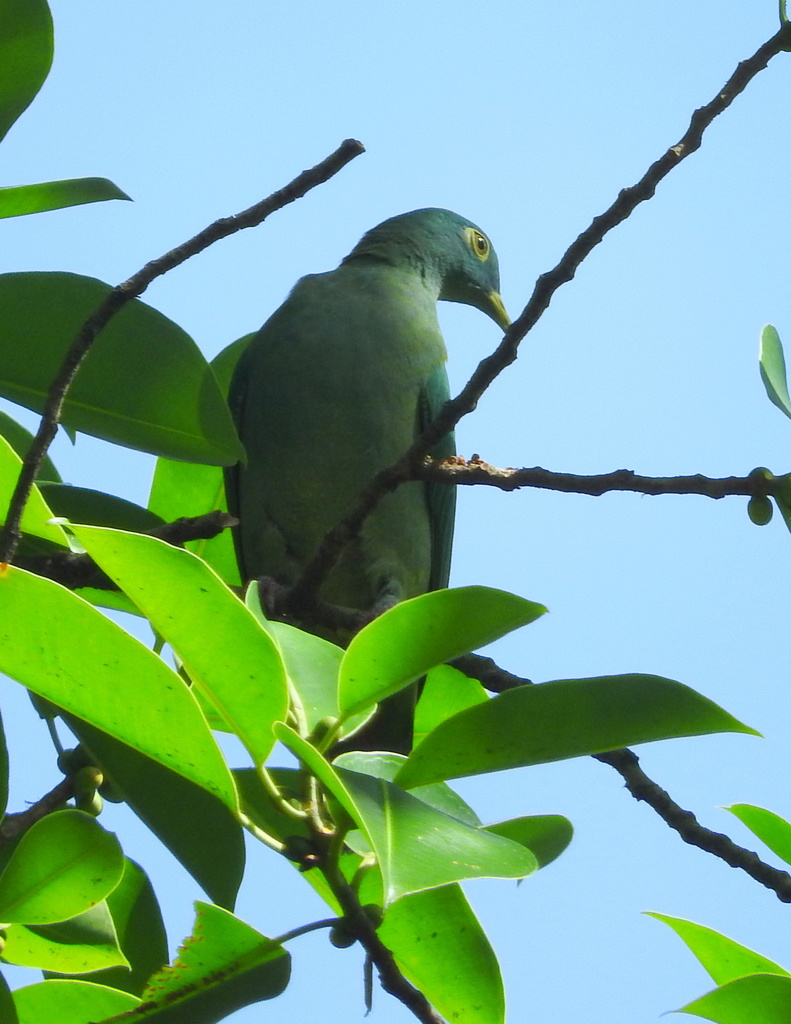
Black-naped Fruit Dove
Photo © Subir B. Shakya
Photo © Subir B. Shakya — CC BY 4.0 — Source: iNaturalist #17841163The black-naped fruit dove (Ptilinopus melanospilus), also known as the black-headed fruit dove, is a medium-sized, up to 24 cm (9.4 in) long, green fruit dove with yellowish bill and iris. The male has a pale grey head with a black nape, yellow throat, and golden yellow and pink undertail coverts. The plumage of the female and the young is entirely green. == Distribution and habitat == The black-naped fruit dove is distributed in Indonesia, Malaysia and the Philippines. In Indonesia, it is found in Java, Lesser Sunda Islands and Sulawesi, where it inhabits the lowland and hill forests. The diet consists mainly of various fruits, figs and berries. The female usually lays one single white egg. Widespread and common throughout its large range, the black-naped fruit dove is evaluated as Least Concern on the IUCN Red List of Threatened Species.
Taman Nasional Meru Betiri
Jember, Indonesia
+93 birds+1 mammals
Across East Java's southeastern coast, where the Indian Ocean meets a landscape of volcanic soils and monsoon-fed forests, sprawls a national park that epitomizes the ecological…
VIEW NATIONAL PARKWest Bali National Park
Gerokgak, Indonesia
+240 birds+8 mammals
Across West Bali's northwestern reaches, where the Indian Ocean meets volcanic slopes and limestone cliffs plunge toward turquoise shallows, sprawls a protected realm of roughly 325…
VIEW NATIONAL PARKBogani Nani Wartabone National Park
Bolaang Mongondow, Indonesia
+154 birds+4 mammals
Across North Sulawesi's rugged interior, where tectonic uplift has carved steep ridges and deep valleys through ancient volcanic terrain, Bogani Nani Wartabone National Park sprawls across…
VIEW NATIONAL PARKMount Merapi National Park
Hargobinangun, Indonesia
+150 birds+3 mammals
Where the volcanic slopes of central Java rise into mist and montane forest, Mount Merapi National Park guards one of Indonesia's most dynamic landscapes. Spanning roughly…
VIEW NATIONAL PARKLore Lindu National Park
Indonesia
+177 birds+4 mammals
Across the mountainous spine of Central Sulawesi spreads a wilderness of montane forest, rolling ridges, and deep valleys that rises from the island's volcanic bedrock to…
VIEW NATIONAL PARKNo community photos yet. Log in to add the first one.
No community observations of this species yet.