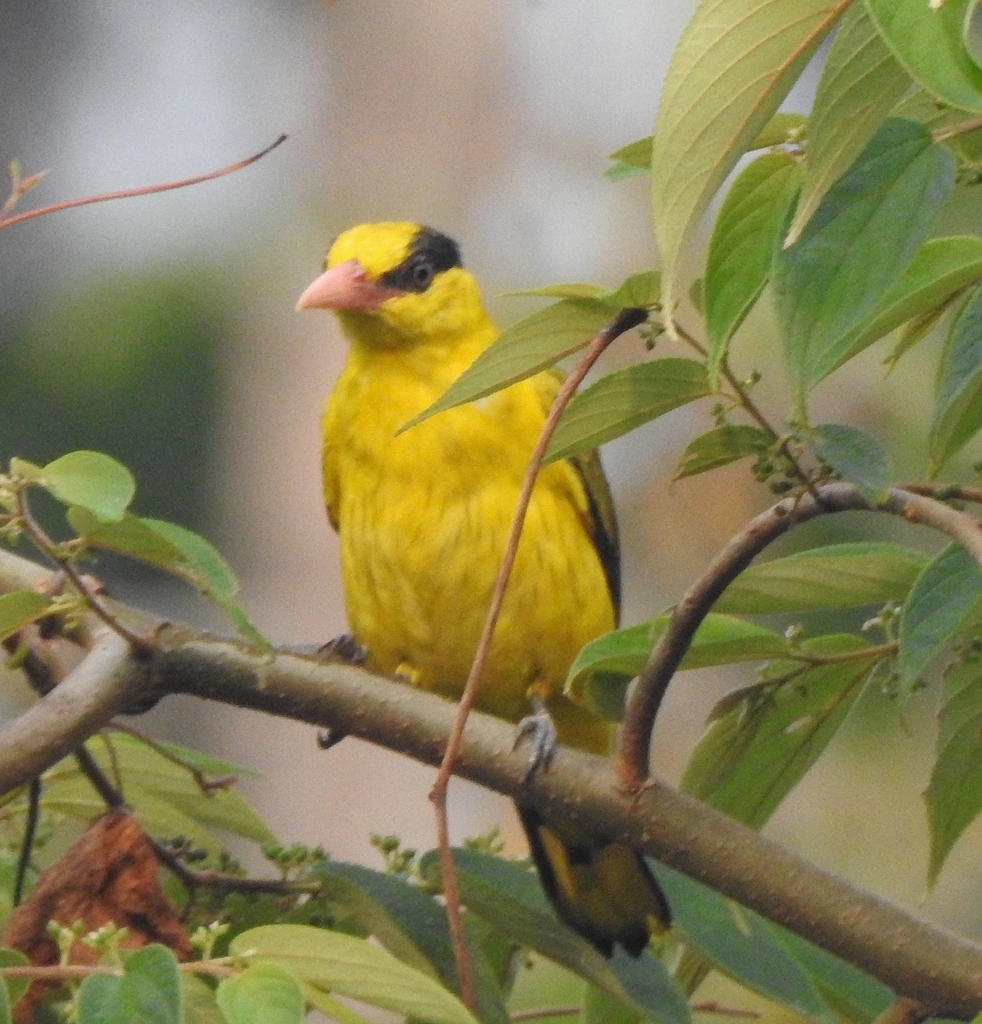
Black-naped Oriole
Photo © Afsar Nayakkan
Photo © Afsar Nayakkan — CC BY 4.0 — Source: iNaturalist #167496013Identification
The black-naped oriole is a medium-sized passerine with striking plumage that makes it unmistakable in the field. Overall golden yellow, it is distinguished by a strong pinkish bill, a broad black mask, and a distinctive black nape that broadens and joins at the back of the neck—a key feature separating it from the related Indian golden oriole. Males and females are very similar, though females display more greenish tones on the mantle and have more greenish wing linings. The adult male shows yellow tips on the central tail feathers, with lateral feathers more broadly yellow. Juveniles are streaked below and more dull greenish with brown markings, while the head and nape remain more yellowish.
Geographic variation is considerable across the species' range. The Andaman subspecies, O. c. andamanensis, features all-black wings, while the Nicobar form, O. c. macrourus, displays a very broad nape band leaving only the crown yellow, paired with black wings and a yellow primary covert patch. Across Southeast Asian populations, yellow on the forehead tends to reduce from north to south, and plumage brightness decreases accordingly. Northern populations show yellow spots on secondary wing feathers that are absent in southern birds.
Range & Habitat
The black-naped oriole has an extensive distribution across many parts of Asia, with twenty recognized subspecies reflecting its wide range and complex evolutionary history. Subspecies diffusus breeds in eastern Siberia, Ussuriland, northeastern China, Korea, Japan, and northern Vietnam, wintering widely across India—particularly in the northeastern parts and peninsular regions—as well as Bangladesh. The species is also found across the Philippines, the Andaman and Nicobar Islands, Sulawesi, the Lesser Sunda Islands, and numerous island groups throughout the Indonesian archipelago, from Sumatra and Borneo to islands such as Lombok, Flores, and Sumbawa.
Behaviour & Diet
The black-naped oriole has a distinctive dipping flight and produces characteristic vocalizations. The usual call is a nasal niee or myaa, while the song of subspecies diffusus is a fluty iwee wee wee-leeow. The calls of island populations vary geographically; the Andaman and Nicobar subspecies are reported to have quite different calls, with the Nicobar form producing a more modulated call note than its Andaman relative.
Best Time & Places to See It
The black-naped oriole's occurrence varies by location. Northern populations, such as subspecies diffusus, are migratory, breeding in northeastern Asia and wintering in India and Bangladesh. Island populations throughout Southeast Asia and the Indian Ocean offer year-round viewing opportunities, making the Philippines, Sulawesi, Sumatra, Java, and the Andaman and Nicobar Islands prime destinations for encountering this species.
Photography Tips
The bold black nape and mask contrasting sharply with golden plumage make the black-naped oriole a rewarding photographic subject. Watch for the species' characteristic dipping flight, which offers dynamic shooting opportunities. Geographic variation is significant, so photographing multiple subspecies across the range—from the all-black-winged Andaman form to the broader-naped Nicobar population—provides excellent documentation of intraspecific diversity. Early morning vocalizations offer audio recording opportunities to capture the fluty song and nasal calls that aid field identification.
Kanha Tiger Reserve
Bandipur National Park
Bogani Nani Wartabone National Park
Eravikulam National Park
Gaoligong Mountain National Nature Reserve
Giant Panda National Park
Gunung Ciremai National Park
Hat Noppharat Thara-Mu Ko Phi Phi National Park
Jiuzhai Valley
Nothing matches these filters.
No community photos yet. Log in to add the first one.
No community observations of this species yet.