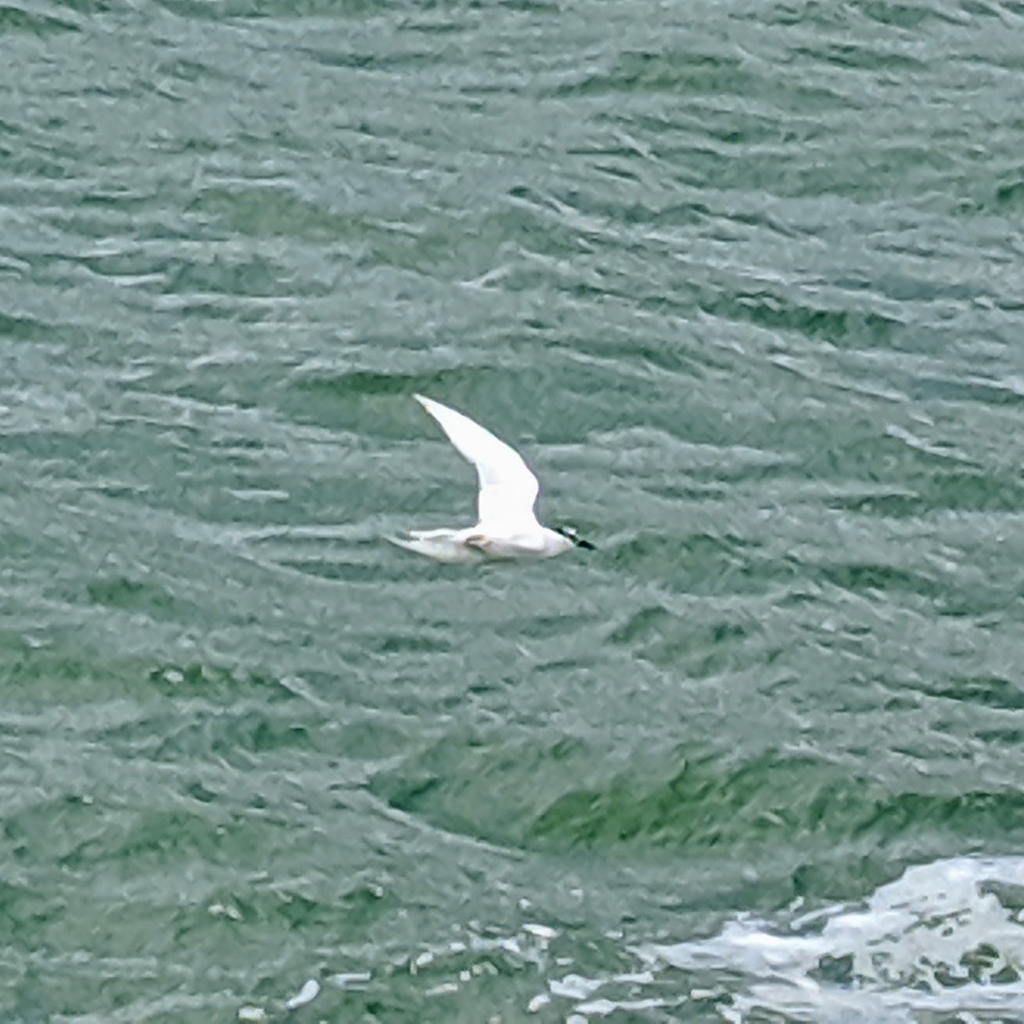
Black-naped Tern
Photo © Attila Oláh
Photo © Attila Oláh — CC BY 4.0 — Source: iNaturalist #30406659Identification
The black-naped tern is a small, elegant oceanic tern easily identified by the distinctive black band that begins at its eyes, connects behind the head, and descends down the back of the neck—the feature from which it takes its name. The remainder of its plumage is pristine white, with pale silvery-grey wings and mantle; notably, the outermost primary feather bears a narrow black outer web. The tail is white and deeply forked, extending beyond the wingtips when the bird is perched, a characteristic it shares with its closest relatives, the roseate and white-fronted terns. Adults display black beaks and legs, measure 30–35 cm in body length, and have a wingspan of 66 cm, weighing between 97 and 120 g. Hatchlings present a mottled brown plumage quite different from the striking adult appearance.
Range & Habitat
The black-naped tern inhabits the tropical and subtropical waters of the Indian Ocean and western Pacific Ocean, where it is most closely associated with rocky shores. Two subspecies are recognized: one ranges across the islands of the eastern Indian Ocean through the western Pacific, extending north to Taiwan and south to Queensland in Australia, while the other inhabits the islands of the western Indian Ocean. These oceanic terns are rarely found inland, instead migrating yearly to islets and islands that serve as breeding grounds.
Behaviour & Diet
Like most terns, the black-naped tern hunts by diving, partially breaching the water's surface to directly capture small fish horizontally in its beak. Most individuals hunt alone at sea, though they shift to hunting closer to shore in the surf when provisioning nestlings and mates. Their diet comprises small fish up to 10 cm long, including hardyheads, sprats, anchovies, garfish, flying fish, mullet, barracudas, trevally, and tuna.
Black-naped terns breed in small colonies of 5–20 pairs, occasionally reaching 200 individuals, nesting on oceanic islands in simple depressions in sand or rock with minimal preparation. Laying periods vary geographically from May through December. Both parents incubate eggs for 21–23 days in alternating shifts, then share feeding and brooding duties. Young chicks remain vulnerable to gull predation until reaching approximately 65 g, a developmental milestone reached around 10.5 days of age. Parents employ sophisticated defence strategies, including nest camouflage and mobbing behaviour against aerial predators. Chicks fledge after 21–23 days but remain dependent on parents for at least two months.
Best Time & Places to See It
The timing for observing black-naped terns varies with location due to their staggered breeding schedule across their range. Breeding activity begins in May in Indian and Polynesian colonies, shifts to July in the Philippines, September in north-east Australia, September to November in oceanic Indian colonies, and November to December on the Great Barrier Reef. Visiting rocky islands and islets during these breeding seasons offers the best opportunities to encounter these terns, particularly at their traditional breeding sites which may be returned to yearly.
Photography Tips
Photographers should listen for the black-naped tern's distinctive calls—short, high-pitched, repeated sharp notes including "chit," "chip," "chrrut," and "tsip"—which can help locate birds in their habitat. The species' small size (30–35 cm), striking facial markings, and deeply forked tail provide excellent subjects for identifying shots. During breeding season, colonies on islands offer opportunities to photograph both adults and developing chicks, though photographers should maintain respectful distances to avoid disturbing nesting birds or exposing eggs and young to predation risk.
Mu Ko Ang Thong National Park
Thailand
+47 birds+1 mammals
Forty-two limestone islands rise from the Gulf of Thailand, their weathered karst peaks piercing emerald waters in a landscape of stunning geological drama. Mu Ko Ang…
VIEW NATIONAL PARKHat Noppharat Thara-Mu Ko Phi Phi National Park
Ao Nang, Thailand
+253 birds+9 mammals
Where limestone karsts rise dramatically from turquoise waters, Hat Noppharat Thara-Mu Ko Phi Phi National Park unfolds across a mosaic of beach, mangrove forest, and island…
VIEW NATIONAL PARKMu Ko Similan National Park
Lam Kaen, Thailand
+82 birds+1 mammals
Granite islands rise from the Andaman Sea in a scattered archipelago where limestone cliffs meet turquoise shallows, their steep faces weathered into caves and overhangs that…
VIEW NATIONAL PARKKhao Laem Ya-Mu Ko Samet National Park
Mueang Rayong District, Thailand
+159 birds+3 mammals
Where limestone hills meet the Gulf of Thailand, Khao Laem Ya–Mu Ko Samet National Park stitches together a mosaic of terrestrial and marine worlds that few…
VIEW NATIONAL PARKDaintree National Park
Dedin, Australia
+362 birds+37 mammals
Daintree National Park is one of the world’s oldest and most biologically diverse tropical rainforests, protecting an extraordinary landscape where ancient forests meet the Great Barrier…
VIEW NATIONAL PARKWhitsunday Islands National Park
Whitsundays, Australia
+163 birds+9 mammals
Crystalline waters lap against seventy-four islands where rainforest canopies tumble down to pristine beaches and coral gardens flourish in the shallows. This archipelago off Queensland's coast…
VIEW NATIONAL PARKBako National Park
Kuching, Malaysia
+210 birds+17 mammals
Weathered sandstone cliffs rise dramatically from the South China Sea, their ochre faces sculpted by millennia of wind and tide into a landscape of extraordinary geological…
VIEW NATIONAL PARKKuching Wetlands National Park
Kuching, Malaysia
+103 birds+4 mammals
Where brackish waters meet mangrove stilts and freshwater swamps blend into coastal mudflats, one of Southeast Asia's most dynamic wetland ecosystems unfolds across Sarawak's northwestern coast.…
VIEW NATIONAL PARKTaman Nasional Baluran
Situbondo, Indonesia
+189 birds+9 mammals
Across the northeastern tip of East Java, where monsoon winds sweep down from the Bali Strait, a landscape of contrasts unfolds within 374 square kilometres of…
VIEW NATIONAL PARKWest Bali National Park
Gerokgak, Indonesia
+240 birds+8 mammals
Across West Bali's northwestern reaches, where the Indian Ocean meets volcanic slopes and limestone cliffs plunge toward turquoise shallows, sprawls a protected realm of roughly 325…
VIEW NATIONAL PARKAketajawe Lolobata National Park
Oba Tengah, Indonesia
+123 birds+2 mammals
Across the northeastern arm of Halmahera, where the Wallace Line once marked the boundary between Asian and Australasian fauna, lies a sprawling wilderness of over 13,800…
VIEW NATIONAL PARKManusela National Park
Maluku Tengah, Indonesia
+112 birds+3 mammals
Across the Maluku Tengah district of Indonesia's eastern archipelago, a sprawling expanse of 4,175 square kilometers of largely intact tropical forest rises from coastal lowlands toward…
VIEW NATIONAL PARKKomodo National Park
Komodo, Indonesia
+155 birds+14 mammals
Where volcanic peaks rise dramatically from turquoise waters, a primordial landscape unfolds across three main islands and countless smaller ones scattered throughout the Lesser Sunda archipelago.…
VIEW NATIONAL PARKGreat Sandy National Park
Australia
+306 birds+40 mammals
Where coastal dunes rise inland from the Queensland coastline, Great Sandy National Park encompasses a landscape of remarkable ecological diversity shaped by subtropical humid conditions year-round.…
VIEW NATIONAL PARKNo community photos yet. Log in to add the first one.
No community observations of this species yet.