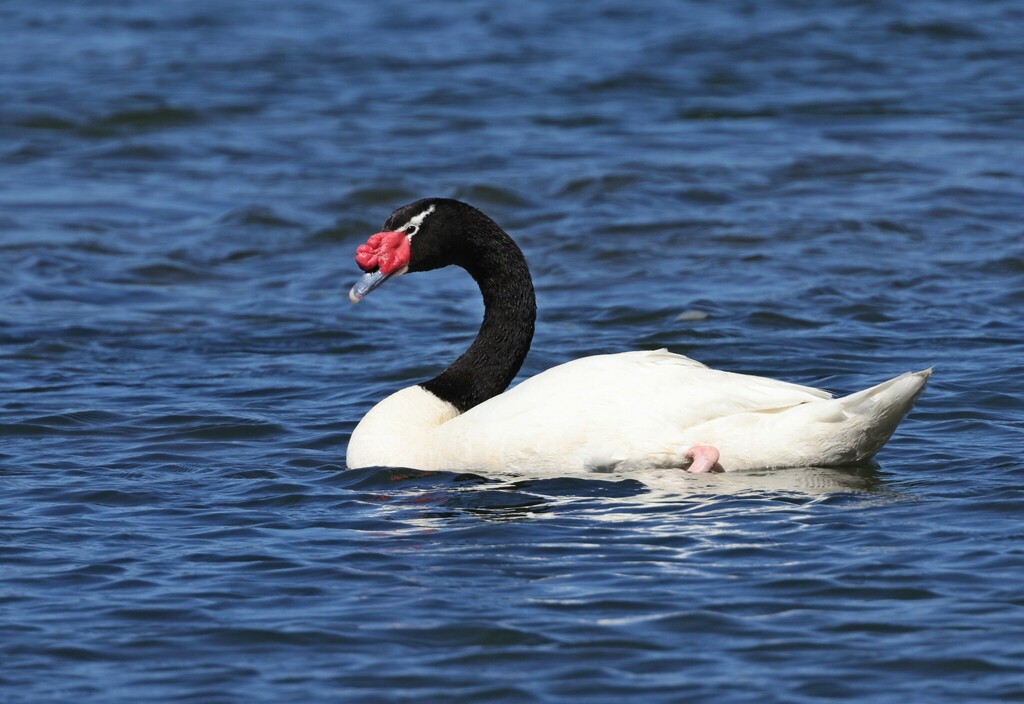
Black-necked Swan
Photo © ivesklein
Photo © ivesklein — CC BY 4.0 — Source: iNaturalist photo #340731725Identification
The black-necked swan is South America's largest native waterfowl and one of the most striking swans in the world. Adults are 102 to 124 cm long with a wingspan of 135 to 177 cm, with males weighing 4.6 to 8.7 kg and females slightly smaller at 3.5 to 4.4 kg. The plumage is unmistakable: a pure white body contrasts dramatically with a black neck and head, typically marked by a distinctive white stripe behind the eye. A prominent red knob at the base of the bill adds to their elegant appearance. Males and females look identical. Juveniles are grayish rather than white and lack the characteristic red knob until their third or fourth year, making them readily distinguishable from adults.
Range & habitat
Black-necked swans inhabit the southern tier of South America, with their breeding range extending from Tierra del Fuego north through central Chile, Uruguay, and Rio Grande do Sul in extreme southern Brazil. They are year-round residents of the Falkland Islands but withdraw from southern Argentina during winter, dispersing as far north as São Paulo state in Brazil. The species prefers freshwater marshes, swamps, and shallow lakes, as well as brackish lagoons and sheltered coastal sites. On mainland South America, they often inhabit areas near human settlements, though they avoid built-up zones in the Falklands. While typically found at low elevations, non-breeding flocks occasionally reach 900 to 1,250 metres in the Andes of southern Argentina.
Behaviour & diet
Black-necked swans are almost entirely vegetarian, feeding on aquatic plants such as Chara, Potamogeton, and Typha, as well as algae species. In parts of Chile, the aquatic plant Egeria densa forms their principal food source. They forage by immersing their heads and necks, surface feeding, and upending to reach deeper vegetation; during droughts they graze in meadows and pastures. The breeding season varies geographically, occurring from July to November in the far south but ending by September in northern areas, with timing dependent on rainfall. Pairs construct large vegetation mounds on small islets or in floating reeds, typically laying clutches of four to eight eggs. Males guard females during the 34- to 36-day incubation period, with nestlings fledging approximately 100 days after hatching. Outside breeding season, black-necked swans are mostly silent, but both sexes produce soft, musical calls during breeding to challenge intruders and maintain pair contact.
Best time & places to see it
The black-necked swan is widespread and generally common throughout its range, with an estimated population of around 50,000 in Argentina alone. Key locations include Carlos Anwandter Nature Sanctuary on the Cruces River in Chile, which has become an important population center, particularly for photographing large congregations. The Falkland Islands offer year-round viewing opportunities. The breeding season, varying from July to November depending on location and rainfall, offers the best chance to observe pair bonding behaviour and hear their distinctive vocalizations. Winter months may provide opportunities to see larger flocks as birds disperse northward from southern regions.
Photography tips
The striking contrast between white body plumage and black neck makes black-necked swans highly photogenic subjects. Their elegant red knob and white eye-stripe provide excellent focal points for close-up portraits. Wetland habitats with clear water allow photographers to capture reflections, while open water backgrounds emphasize their distinctive colouration. Early morning light during breeding season, when birds are most vocal and active, offers optimal shooting conditions. Nesting birds on floating vegetation present unique compositional opportunities, though photographers should maintain respectful distance to avoid disturbing breeding pairs. The dramatic landscapes of southern South America—from Patagonian lakes to coastal marshes—provide compelling backdrops for environmental portraits.
Schleswig-Holsteinisches Wattenmeer National Park
Germany
+378 birds+49 mammals
Where the North Sea ebbs and flows across a vast expanse of exposed mud and sand, the Schleswig-Holsteinisches Wattenmeer National Park reveals one of Europe's most…
VIEW NATIONAL PARKPeixe National Park Lagoon
Brazil
+293 birds+4 mammals
Where the coastal plains of Rio Grande do Sul meet the Atlantic, Peixe National Park Lagoon sprawls across nearly 2,200 square kilometres of shallow waters, reed…
VIEW NATIONAL PARKSea Lion Island
Sealion Island Settlement, Falkland Islands
+74 birds+3 mammals
Windswept tussock grasslands roll across volcanic terrain where Southern Ocean swells crash against rocky shores, creating one of the Falkland Islands' most dramatic wildlife theatres. This…
VIEW ISLAND & ARCHIPELAGOMurrell Farm
falskland islands, Falkland Islands
+54 birds
Rolling grasslands sweep across windswept plateaux where the South Atlantic exerts its relentless influence on the vegetation, sculpting tussock grassland into a tapestry of browns and…
VIEW NATURE RESERVECape Dolphin
falskland islands, Falkland Islands
+54 birds+1 mammals
Where windswept grasslands meet dramatic coastal cliffs, the Falkland Islands' northern reaches reveal one of the Southern Hemisphere's most compelling seabird sanctuaries. The terrain here is…
VIEW NATURE RESERVEVolunteer Point
Stanley, Falkland Islands
+70 birds+3 mammals
Windswept grasslands meet volcanic black sand beaches where three penguin species converge in the South Atlantic's most theatrical wildlife theatre. This remote peninsula on East Falkland…
VIEW NATURE RESERVEWest Point Island
West Point, Falkland Islands
+67 birds+3 mammals
Windswept cliffs plunge dramatically into the South Atlantic, their rust-coloured rock faces sculpted by millennia of gales and spray. This northwestern outpost of the Falkland Islands…
VIEW ISLAND & ARCHIPELAGOChiloé National Park
Dalcahue, Chile
+122 birds+6 mammals
Temperate rainforest cloaks the Chiloé archipelago's northwestern reaches, where granite ridges thrust through dense, moisture-laden canopy and freshwater streams carve ravines toward the Pacific. Across approximately…
VIEW NATIONAL PARKCabo de Hornos National Park
Cape Horn, Chile
+88 birds+9 mammals
Where the Andes plunge into the Southern Ocean and the Drake Passage churns between two continents, Cabo de Hornos National Park sprawls across one of Earth's…
VIEW NATIONAL PARKCorcovado National Park
Chaitén, Chile
+39 birds+1 mammals
Where temperate rainforest meets the raw Pacific coastline of Chilean Patagonia, Corcovado National Park sprawls across 6,585 square kilometres of some of South America's most pristine…
VIEW NATIONAL PARKTorres del Paine National Park
Torres del Paine, Chile
+143 birds+10 mammals
Where granite spires pierce the Patagonian sky, Torres del Paine commands one of South America's most dramatic landscapes. Across 4,106 square kilometres of southern Chile, jagged…
VIEW NATIONAL PARKPuyehue National Park
Puyehue, Chile
+110 birds+4 mammals
Across the volcanic spine of the Los Lagos Region, where the Andes descend toward temperate rainforest, Puyehue National Park encompasses nearly 2,600 square kilometers of one…
VIEW NATIONAL PARKVicente Pérez Rosales National Park
Puerto Varas, Chile
+109 birds+8 mammals
Where the Andes descend toward the temperate rainforests of Chile's Lake District, nearly 4,641 square kilometers of pristine wilderness unfolds across Vicente Pérez Rosales National Park.…
VIEW NATIONAL PARKCerro Castillo National Park
Coyhaique, Chile
+89 birds+3 mammals
Granite peaks and windswept steppe converge across this vast Patagonian landscape, where the Andes' eastern flank drops into terrain sculpted by ice age glaciers and relentless…
VIEW NATIONAL PARKPatagonia National Park
Cochrane, Chile
+133 birds+8 mammals
Where the Andes meet the Patagonian steppe, vast grasslands and shrublands sweep across rolling terrain carved by ancient glaciation, their contours softened by distance and dramatic…
VIEW NATIONAL PARKReserva Nacional Magallanes
Punta Arenas, Chile
+78 birds+2 mammals
Where windswept steppe meets sub-Antarctic forest near the southern tip of continental South America, Reserva Nacional Magallanes unfolds across roughly 352 square kilometres of profound ecological…
VIEW NATIONAL PARKParque Provincial Península de Magallanes
Argentina
+125 birds+4 mammals
Granite peaks and windswept steppe converge across this 415-square-kilometre peninsula jutting into the cold Atlantic waters of southern Patagonia, where the Magallanes landscape embodies the raw,…
VIEW NATIONAL PARKMonte León National Park
Argentina
+100 birds+4 mammals
Where the Patagonian steppe meets the Atlantic, Monte León National Park protects a landscape of windswept coastal cliffs, rocky outcrops, and semi-arid grassland spanning over 1,200…
VIEW NATIONAL PARKLos Glaciares National Park
Argentina
+121 birds+3 mammals
Where granite peaks and sprawling ice fields dominate the landscape, Los Glaciares National Park encompasses over ten thousand square kilometres of Patagonian wilderness in southern Argentina.…
VIEW NATIONAL PARKEl Palmar National Park
Distrito Sexto, Argentina
+244 birds+14 mammals
Across the Paraná River floodplain in northeastern Argentina, palms rise from wetland and grassland in a landscape shaped by water and time. El Palmar National Park…
VIEW NATIONAL PARKCampos del Tuyú National Park
Argentina
+169 birds+5 mammals
Subtropical forest graces the borderlands where Misiones Province meets Paraguay, a landscape shaped by the Paraná Plateau's weathered topography and the warm, humid climate of northeastern…
VIEW NATIONAL PARKPerito Moreno National Park
Argentina
+78 birds
Where the Patagonian steppe descends into a landscape carved by ancient ice, Perito Moreno National Park sprawls across nearly 1,590 square kilometres of some of South…
VIEW NATIONAL PARKNahuel Huapi National Park
Argentina
+124 birds+11 mammals
Where the Andes descend toward Patagonia, vast glacial lakes cut through a landscape of southern beech forest and granite peaks, creating one of South America's most…
VIEW NATIONAL PARKLanín National Park
Argentina
+128 birds+7 mammals
Where the volcanic spine of the Andes plunges into Patagonian steppe, Lanín National Park sprawls across nearly 4,700 square kilometers of one of Argentina's most visually…
VIEW NATIONAL PARKLago Puelo National Park
Argentina
+109 birds+1 mammals
Where temperate forests descend to crystalline waters in the foothills of the Andes, Lago Puelo National Park sprawls across nearly 300 square kilometers of pristine wilderness…
VIEW NATIONAL PARKLos Alerces National Park
Argentina
+84 birds+3 mammals
Where the temperate rainforests of southern Patagonia sweep down towards crystalline lakes, Los Alerces National Park unfolds across nearly 3,000 square kilometres of one of South…
VIEW NATIONAL PARKNo community photos yet. Log in to add the first one.
No community observations of this species yet.