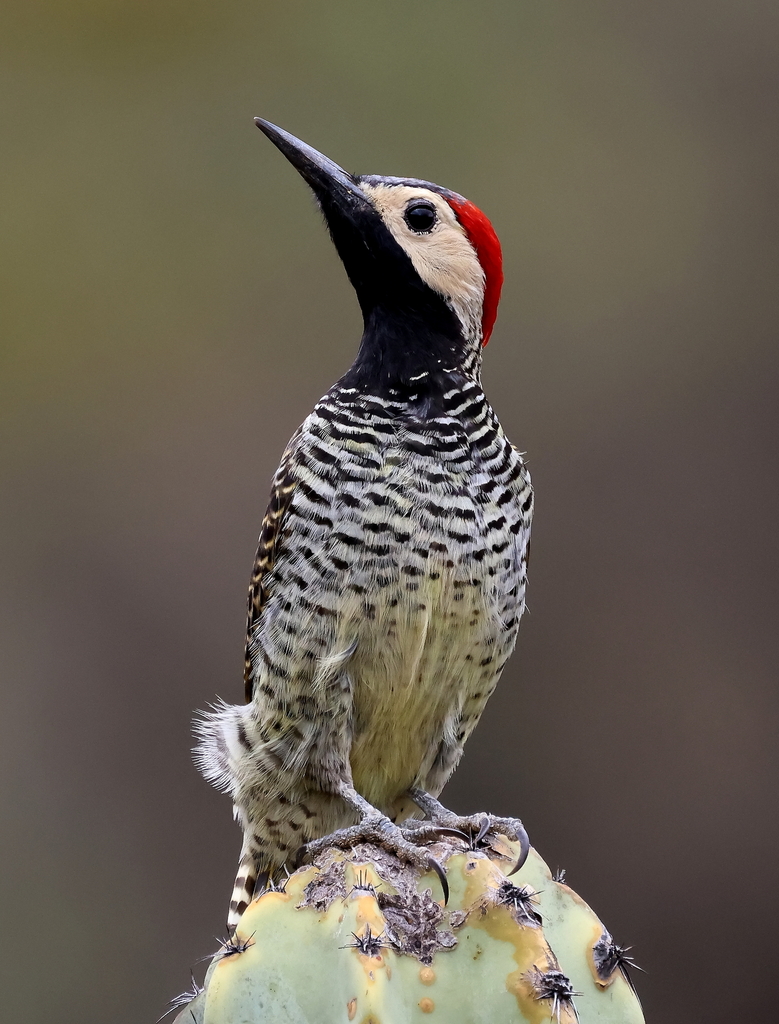
Black-necked Woodpecker
Photo © Manuel Roncal
Photo © Manuel Roncal — CC0 1.0 — Source: iNaturalist #181647865Identification
The black-necked woodpecker is a medium-sized woodpecker measuring 26 to 27 cm in length and weighing 73 to 90 grams. The most distinctive features are its black breast, pale yellow underparts with black barring, and bronze-green upperparts with narrow blackish bars. Males display dark gray plumage from forehead to forecrown with red on the hindcrown and upper nape, yellowish-white around the eye and nape, a striking red malar stripe, and a black chin and throat. Females are similar but lack the red malar stripe, instead showing blackish markings in this area, and have red only on the hindcrown. Both sexes possess a longish black bill with a paler base, brown to chestnut-brown iris, and green-gray legs. Juveniles are duller overall with a darker face and more diffuse barring on the upper- and underparts.
Range & Habitat
This species is endemic to Peru, where it occupies two distinct populations. The nominate subspecies inhabits the western slope of the Andes from La Libertad to Tacna departments, while the smaller subspecies C. a. peruvianus is found on the eastern slope, from the Marañón River valley south into Huánuco Department. Elevations range from 500 to 2,800 meters on the western slope, with local occurrences as high as 4,000 meters, and 1,700 to 4,300 meters in the Marañón Valley.
The black-necked woodpecker thrives in semi-arid to arid landscapes including drier cloudforests, montane scrublands with cacti, desert scrublands, and deciduous woodlands. It also adapts well to riparian woodlands, orchards, plantations, and gardens, making it relatively accessible to travelers exploring Peru's Andean regions.
Behaviour & Diet
The black-necked woodpecker feeds almost exclusively on adult ants and their larvae and pupae, gleaning and probing for food at all levels from ground to treetops. It typically forages singly or in pairs and is mostly a year-round resident, though some seasonal elevational movements are suspected.
This species breeds during a season centered around June and July, nesting in tree cavities, cacti, utility poles, and even dry river banks. Clutches contain two to four eggs with an incubation period of 14 days and fledging occurring approximately 28 days after hatching. Both adults share incubation and nestling duties. The bird's vocalizations include a distinctive "loud clear 'wic' in long series," along with alarm calls of "peah" and "chypp."
Best Time & Places to See It
The black-necked woodpecker is generally uncommon throughout its range, though it becomes locally more common in certain areas. The breeding season centered on June and July offers opportunities to locate nesting birds and observe parental behavior. Both the western and eastern Andean slopes of Peru provide suitable habitat, with elevations between 1,700 and 2,800 meters typically offering the most reliable encounters.
The species' preference for semi-arid scrublands, cacti-studded montane areas, and riparian woodlands, combined with its use of human-modified landscapes like orchards and gardens, makes it potentially approachable in accessible Peruvian valleys and foothills where these habitat types occur.
Photography Tips
The black-necked woodpecker's striking plumage—particularly the contrasting black breast, red malar stripe (in males), and barred yellow underparts—makes for compelling photography. Position yourself to capture the distinctive head markings and the bold black-and-yellow pattern of the underparts. The species forages at various heights, so be prepared to adjust your positioning from ground level to higher in trees and cacti.
Early morning hours during the breeding season (June and July) may increase your chances of locating active birds. Since the species often forages in semi-open scrubland and desert habitats with sparse vegetation, you may find relatively good sightlines for photography compared to woodland specialists, though the harsh Andean sunlight at higher elevations requires careful exposure management.
No community photos yet. Log in to add the first one.
No community observations of this species yet.