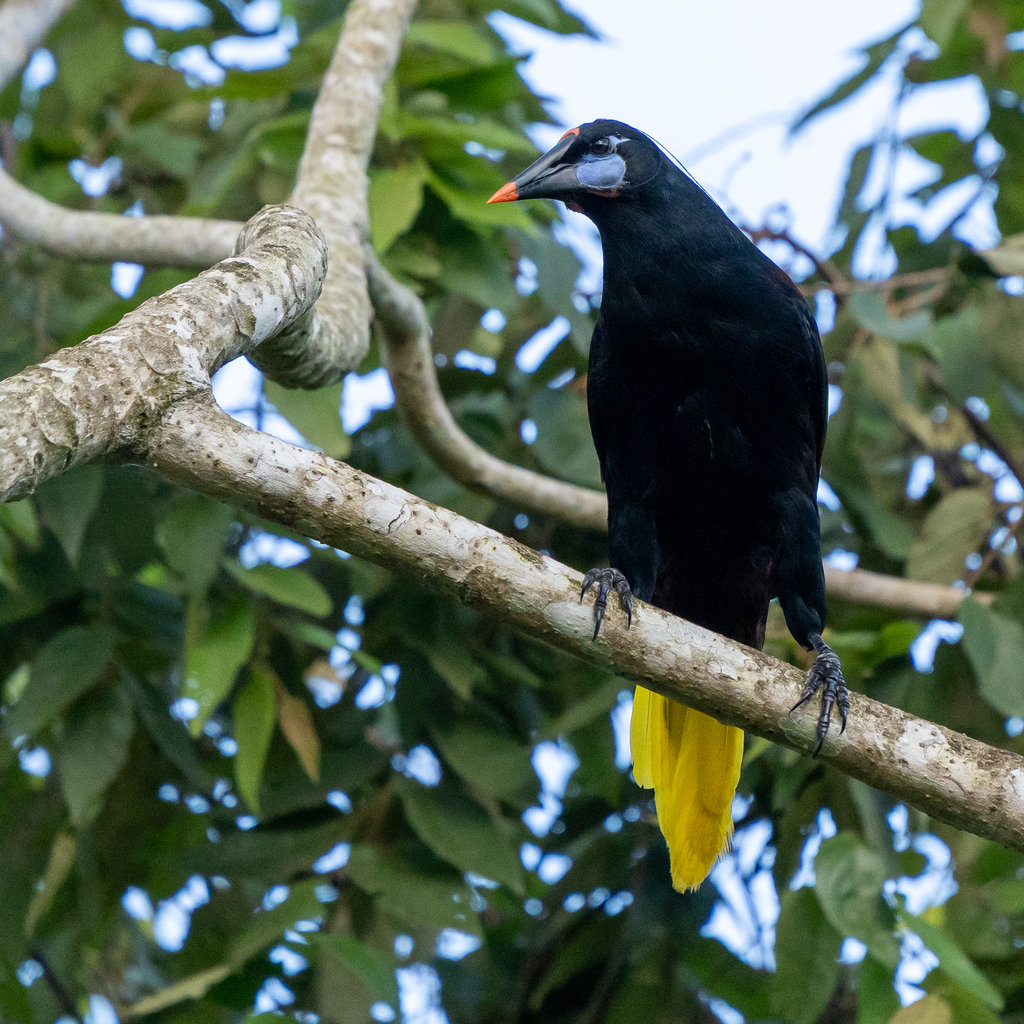
Black Oropendola
Photo © Anthony Batista
Photo © Anthony Batista — CC BY 4.0 — Source: iNaturalist #234245486Identification
The black oropendola is a large passerine, with males reaching 47 cm and females 39 cm in length. Both sexes are predominantly black, with males distinguished by an impressive long-feathered crest on the nape. Adults display striking bare pale blue facial skin and a pink wattle at the base of a large, powerful bill tipped with orange. The most colorful markings are found on the wings and tail: dark chestnut scapulars, upperwing coverts, lower back, and rump contrast with a distinctive tail featuring black central feathers and bright yellow outer feathers. This yellow is particularly visible from below, often making the tail appear entirely yellow in flight. The species has a brown iris and blackish legs.
Range & Habitat
The black oropendola is endemic to northwestern South America, found from eastern Panama's Panamá and Darién provinces into Colombia's Chocó, Antioquia, and Caldas departments, with its Colombian range bounded by the Magdalena River valley. This species inhabits the canopy and edges of humid forests, as well as nearby plantations, at elevations up to 800 meters. It appears to be a year-round resident throughout its range, making it a reliable subject for visiting birders during any season.
Behaviour & Diet
Black oropendolas typically forage singly or in small groups, working through the forest's higher levels in search of food. While detailed dietary studies remain limited, they are believed to consume insects, arthropods, small vertebrates, fruit, and nectar. Notably, they have been observed using their powerful bills to pry apart flowers from the inside while foraging. During breeding season, males perform spectacular displays, deeply bowing while singing from exposed perches with loud, gurggling vocalizations interspersed with high-pitched metallic notes. The species is polygynous and nests colonially, sometimes with up to 20 nests clustered in a small area. Females construct distinctive woven bag-like nests with open tops from plant fibers lined with leaves, hanging them from tree branch tips. Breeding occurs from February in Panama through at least June in Colombia, with clutches believed to number two eggs.
Best Time & Places to See It
The black oropendola is uncommon to locally common, though described as rare and local in parts of Colombia. Panama's Darién National Park offers confirmed sightings. The best viewing opportunities align with the breeding season from February through June, when males are most vocal and visible during their characteristic display performances. Early morning visits to humid forest canopies and edges offer the highest chance of encounters.
Photography Tips
Photograph this species from below to capture the brilliant yellow tail display against the sky. Focus on males during breeding season when they perform their deep-bowing displays—these dramatic postures combined with their striking coloration provide compelling images. The contrast between black plumage and chestnut wing coverts photographs well in diffused canopy light. Position yourself to capture the colorful facial markings and ornate bill detail, which are key identification features.
No community photos yet. Log in to add the first one.
No community observations of this species yet.