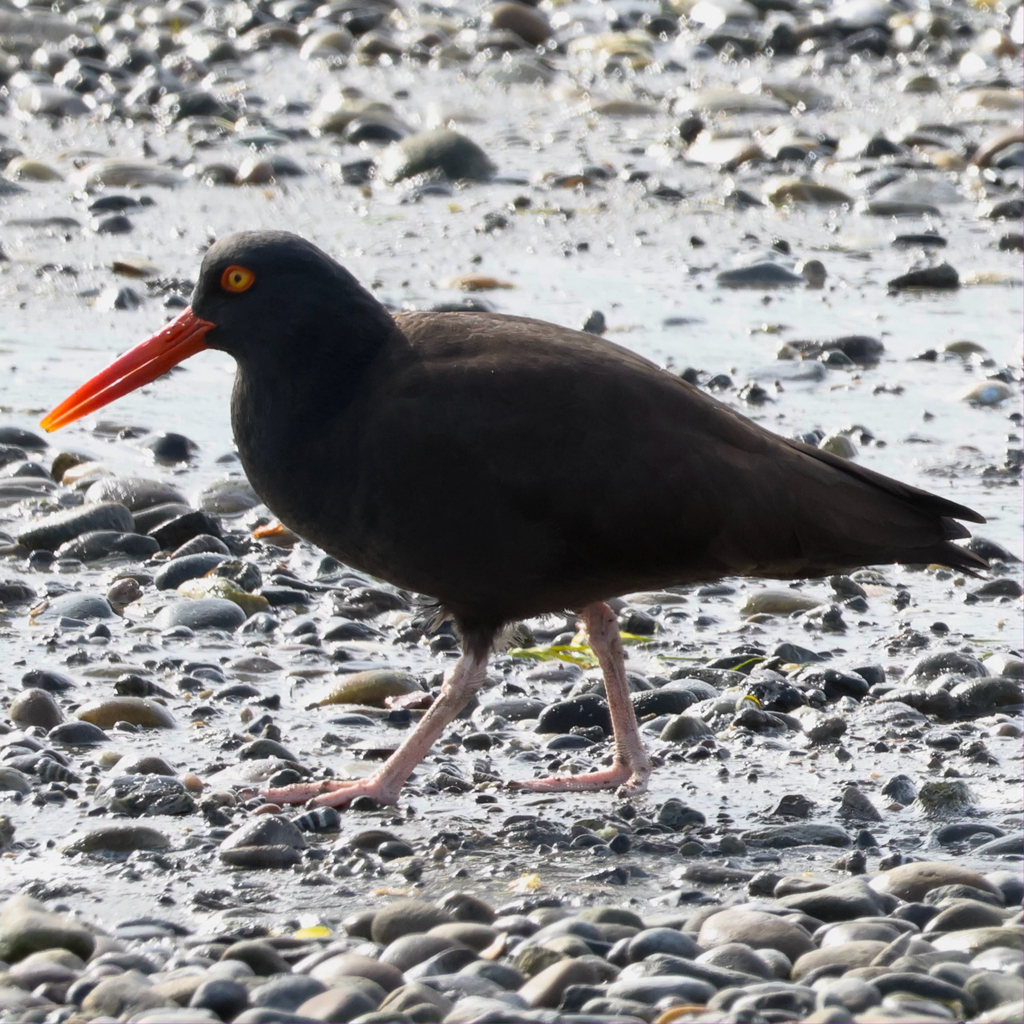
Black Oystercatcher
Photo © Ben
Photo © Ben — CC0 1.0 — Source: iNaturalist #360310593Identification
The black oystercatcher is a large, unmistakable shorebird with predominantly black plumage on its head, neck, and breast, contrasting with a dark brown body. Its most striking features are its long bright red or orange bill (approximately 9 cm), pink legs, bright yellow iris, and distinctive red eye-ring. Plumage varies slightly across its range, becoming darker further north, which can aid in regional identification for experienced observers.
Range & Habitat
This species is found exclusively along the shoreline of western North America, ranging from the Aleutian Islands of Alaska south to the coast of the Baja California peninsula. It is the only oystercatcher representative across most of its range, though it overlaps slightly with the American oystercatcher in Baja California. The black oystercatcher is strongly tied to coastal environments and never strays far from shore, showing a particular preference for rocky shorelines and coastal areas with quieter embayments, such as jetty-protected regions.
Behaviour & Diet
Black oystercatchers are highly territorial, particularly during breeding season, and readily announce their presence with loud vocalizations while flying as they defend their foraging and nesting areas. Some pairs remain together for many years. They forage in the intertidal zone, using their powerful bills to search visually for food and to dislodge and pry open shells. Their diet consists primarily of marine invertebrates, especially molluscs such as mussels, limpets, and chitons, supplemented with crabs, isopods, and barnacles.
During high tides, when foraging is impossible, they remain relatively inactive and rest while awaiting tidal changes. Nests are simple depressions lined with small pebbles and shell fragments, created by the birds flicking material with their bills. Typically two to three remarkably hard eggs are laid; these can even survive submersion during exceptionally high tides. Incubation lasts 26–28 days, and chicks fledge approximately 40 days after leaving the nest. Young birds remain in their parents' territory until the next breeding season, and northern populations may migrate south with their parents.
Best Time & Places to See It
Black oystercatchers can be found year-round along rocky Pacific shorelines from Alaska to Baja California. Look for them in protected bays and around jetties during high tide, when they are most visible and vocal. The breeding season is an excellent time to observe their territorial behavior and loud calls. Northern populations may be more visible during migration periods, particularly in autumn and spring.
Photography Tips
The bird's striking black plumage and bright red bill offer excellent photographic contrast, particularly in coastal light. Position yourself near rocky shorelines and jetties at low tide to capture feeding behavior in the intertidal zone. During high tide, when birds are resting and more stationary, use a telephoto lens to photograph details of the yellow iris and red eye-ring. Early morning or late afternoon light enhances the contrast of their black plumage. Listen for their loud vocalizations to locate territorial birds during breeding season, and be prepared to photograph their characteristic low flights along the water's edge.
Gulf Islands National Park Reserve
Southern Gulf Islands Electoral Area, Canada
+268 birds+26 mammals
Scattered across the Salish Sea in British Columbia's southwestern corner, this national park reserve stitches together a fragmented archipelago of forested islands and rocky outcrops where…
VIEW NATIONAL PARKKenai Fjords National Park
Kenai Peninsula Borough, United States
+164 birds+19 mammals
Granite peaks and tidewater glaciers dominate Alaska's Kenai Peninsula, where nearly 7,900 square kilometers of pristine coastal wilderness descend from the Harding Icefield toward the Gulf…
VIEW NATIONAL PARKKatmai National Park
Lake and Peninsula Borough, United States
+160 birds+19 mammals
Across southwestern Alaska's Lake and Peninsula Borough, nearly 27,000 square kilometers of subarctic wilderness sprawl between volcanic peaks and coastal wetlands, anchored by the confluence of…
VIEW NATIONAL PARKGlacier Bay National Park
Unorganized Borough, United States
+221 birds+15 mammals
Tidewater glaciers calving into fjords of impossible blue, where temperate rainforest rises steeply from the water's edge and alpine peaks pierce the clouds—this is the ecological…
VIEW NATIONAL PARKRedwood National Park
Humboldt County, United States
+343 birds+43 mammals
Where the Pacific fog rolls deep into northern California's coastal valleys, some of the tallest trees on Earth rise from a landscape shaped by tectonic forces…
VIEW NATIONAL PARKOlympic National Park
Jefferson County, United States
+263 birds+35 mammals
Where temperate rainforest meets alpine wilderness, Olympic National Park sprawls across nearly 11,000 square kilometers of the Pacific Northwest's most pristine landscape. The park's three distinct…
VIEW NATIONAL PARKWrangell-Saint Elias National Park
Unorganized Borough, United States
+155 birds+13 mammals
Where granite peaks thrust above 5,400 metres and vast fields of glacial ice dominate the landscape, Wrangell-Saint Elias encompasses one of North America's most extreme wilderness…
VIEW NATIONAL PARKGwaii Haanas National Park Reserve and Haida Heritage Site
Area E (Moresby Island), Canada
+98 birds+8 mammals
Where temperate rainforest meets the Pacific's edge, the islands of southern Haida Gwaii rise as one of North America's most pristine coastal wilderness areas. Spanning approximately…
VIEW NATIONAL PARKSt. Paul Island
Saint Paul, United States
+255 birds+8 mammals
Windswept tundra rolls across this remote Pribilof island, where volcanic basalt cliffs plunge into the Bering Sea and fog rolls in thick enough to erase the…
VIEW PROTECTED LANDSCAPEEl Vizcaíno
Laguna San Ignacio, Mexico
+317 birds+29 mammals
Where the Baja California peninsula thins into a tapestry of salt lagoons and coastal desert, one of Mexico's most biodiverse reserves sprawls across half a million…
VIEW BIOSPHERE RESERVEChannel Islands National Park
Santa Barbara County, United States
+330 birds+15 mammals
A chain of eight volcanic islands rises from the cold Pacific waters off the California coast, their rugged sea cliffs and windswept terrain shaped by millions…
VIEW NATIONAL PARKLake Clark National Park
United States
+158 birds+11 mammals
Where subarctic tundra meets volcanic terrain and pristine waterways, Lake Clark National Park unfolds across southwestern Alaska as a landscape carved by ice age glaciers and…
VIEW NATIONAL PARKKodiak National Wildlife Refuge
United States
+221 birds+22 mammals
Where temperate rainforest meets subarctic coast, Kodiak National Wildlife Refuge sprawls across Alaska's largest island, a sanctuary defined by steep valleys carved by tidewater glaciers and…
VIEW WILDLIFE SANCTUARYAlaska Maritime National Wildlife Refuge
Alaska, United States
+391 birds+58 mammals
Where the North Pacific collides with Alaska's rugged coastline, a sprawling archipelago of islands, rocky outcrops, and coastal headlands forms one of North America's most remote…
VIEW WILDLIFE SANCTUARYIzembek National Wildlife Refuge
Cold Bay, United States
+138 birds+9 mammals
Where the Aleutian archipelago reaches westward into the Bering Sea, subarctic tundra and shallow coastal waters converge to create one of Alaska's most ecologically vital wildlife…
VIEW WILDLIFE SANCTUARYBecharof National Wildlife Refuge
United States
+146 birds+2 mammals
Across southwestern Alaska's windswept lowlands, where the Bristol Bay watershed spills into vast tidal flats and sedge marshes, lies one of North America's most pristine subarctic…
VIEW WILDLIFE SANCTUARYDon Edwards San Francisco Bay National Wildlife Refuge
Fremont, United States
+286 birds+20 mammals
Where the San Francisco Bay's shallow margins dissolve into tidal salt marshes and mudflats, this wildlife sanctuary preserves one of California's most ecologically vital estuarine systems.…
VIEW WILDLIFE SANCTUARYFarallon National Wildlife Refuge
San Francisco, United States
+384 birds+16 mammals
Windswept granite peaks rising abruptly from the Pacific, the Farallon Islands form a wildlife sanctuary of extraordinary seabird abundance and ecological significance just twenty-seven miles west…
VIEW WILDLIFE SANCTUARYNo community photos yet. Log in to add the first one.
No community observations of this species yet.