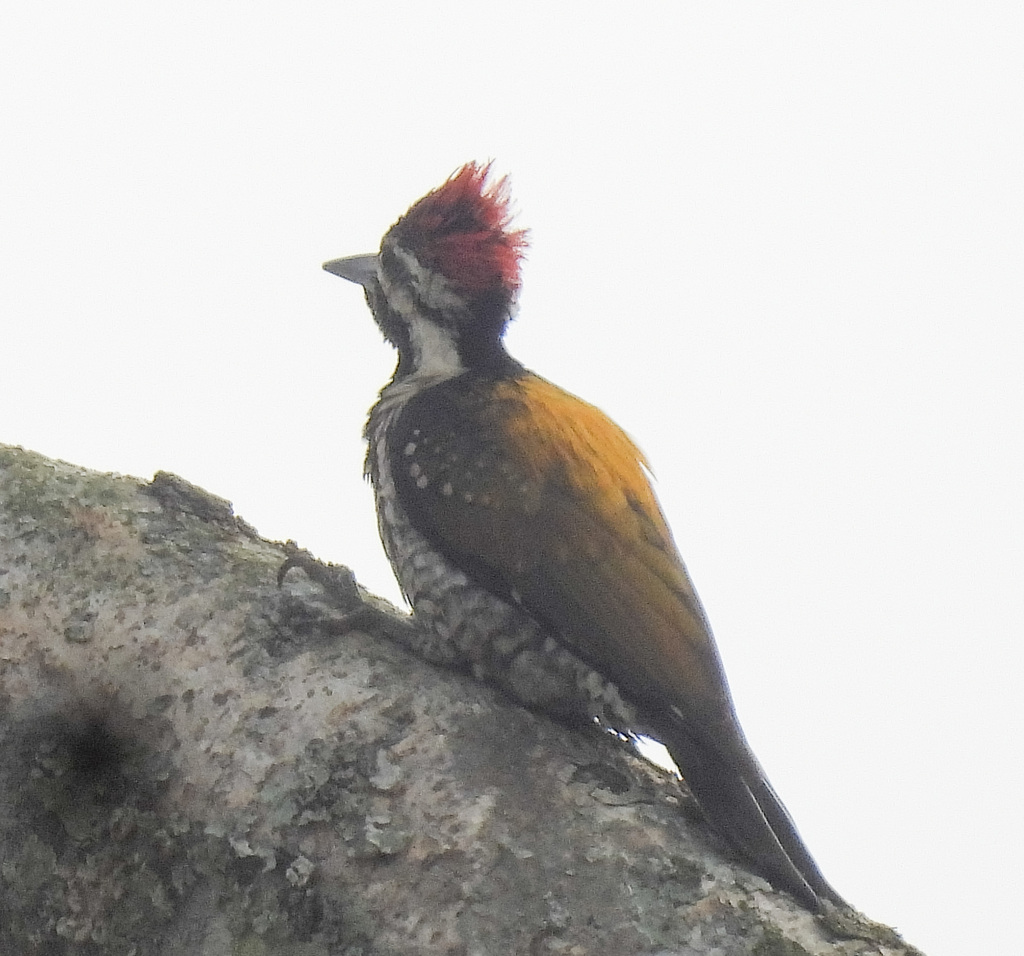
Black-rumped Flameback
Photo © Rejoice Gassah
Photo © Rejoice Gassah — CC BY 4.0 — Source: iNaturalist #300329900Identification
The black-rumped flameback is a large woodpecker, measuring 26–29 cm in length, with a distinctive appearance that makes it readily identifiable. Its most striking feature is the golden-yellow wing coverts, combined with a black rump—a feature that sets it apart from the closely related greater flameback. The underparts are white with dark chevron markings, while the head is whitish with a black nape and throat finely marked with white. This black throat immediately distinguishes it from all other golden-backed woodpeckers in the Indian region. A greyish eye patch is also visible, and notably, this species lacks the dark moustachial stripes present in the greater flameback.
Sexual dimorphism is evident in plumage: adult males display a striking red crown and crest, while females have a black forecrown spotted with white, with red restricted to the rear crest. Young birds resemble females but are duller. Like all woodpeckers, this species possesses the characteristic adaptations: a straight pointed bill, a stiff tail for support against tree trunks, and zygodactyl feet with two toes pointing forward and two backward, plus an extendable tongue for capturing insects.
Range & Habitat
The black-rumped flameback is found widely distributed across the Indian subcontinent, ranging from Pakistan and India south of the Himalayas, extending eastward to the western Assam valley and Meghalaya, and occurring throughout Bangladesh and Sri Lanka. The species inhabits areas from the plains up to approximately 1200 metres elevation. It is associated with open forest and cultivation, and notably, it is one of the few woodpeckers regularly seen in urban areas, where it frequents wooded avenues and tree-lined streets. The species is somewhat rare in arid regions such as the Kutch and desert areas of Rajasthan.
Different subspecies show varying preferences and characteristics across their ranges. The nominate form inhabits low elevations across India, while the northwestern race prefers old gnarled tamarisks, Acacia and Dalbergia trunks. Geographic variation also reflects in plumage coloration and patterning, with the southern peninsular form displaying bright golden-yellow upperparts and the Western Ghats race being more olive above.
Behaviour & Diet
The black-rumped flameback is normally encountered in pairs or small parties and frequently joins mixed-species foraging flocks. These birds forage throughout the forest strata, from ground level to the canopy, often moving with hopping movements around branches. Their diet comprises mainly beetle larvae extracted from under bark, supplemented by visits to termite mounds and occasional nectar feeding. The species shows remarkable adaptability to human-modified habitats, making use of artificial constructions, fallen fruits, and even food scraps.
During the breeding season, which varies with weather and typically occurs between February and July, birds frequently drum. The nest hole is usually excavated by the birds themselves and features a horizontal entrance descending into a cavity; occasionally, birds usurp nest holes from other species or nest in mud embankments. The typical clutch consists of three elongate, glossy white eggs laid inside an unlined cavity. Eggs hatch after approximately 11 days of incubation, and chicks fledge after about 20 days in the nest.
Best Time & Places to See It
The black-rumped flameback is widely distributed and relatively common throughout most of its range, making it accessible to nature travellers across the Indian subcontinent. The best opportunities for viewing occur during the breeding season from February to July, when birds are more vocal and active, frequently drumming to establish and maintain territories. Urban and suburban areas with wooded avenues offer excellent viewing opportunities without the need for extensive field travel, making this species particularly convenient for those based in or visiting towns and cities.
Travellers visiting open forests, cultivated areas, and well-treed regions from the plains up to moderate elevations (up to 1200 metres) will have good chances of encountering this species. Sri Lanka and Bangladesh offer reliable locations, as does most of India south of the Himalayas. However, the arid regions of Kutch and Rajasthan are less favorable, as the species is somewhat rare in these areas.
Photography Tips
The golden-yellow wing coverts and contrasting black rump provide excellent photographic subjects with strong colour contrast. The characteristic undulating flight pattern offers dynamic shooting opportunities, though patience and a fast shutter speed are essential for capturing birds in flight. The black throat with fine white markings and the greyish eye patch warrant close-up photography to showcase these distinguishing features.
Since the species is often seen in pairs or small groups and frequents urban and suburban areas, photographers need not travel to remote locations. Early morning sessions during the breeding season (February to July) are particularly rewarding, as birds are more active and vocal. The species' habit of foraging methodically around branches and tree trunks allows for extended observation periods and careful composition. Look for the diagnostic posture of woodpeckers clinging vertically to trunks—a quintessential pose that captures the essence of the species.
Lunugamvehera National Park
Sri Lanka
+204 birds+14 mammals
Dry scrubland and shallow wetlands converge in Sri Lanka's southeastern lowlands, where Lunugamvehera National Park anchors one of the island's most ecologically vital landscapes. The park's…
VIEW NATIONAL PARKOrang National Park
Rangagarapathar, India
+298 birds+1 mammals
Where the Brahmaputra's floodplains meet the foothills of Assam, Orang National Park unfolds across a mosaic of riverine grasslands, forests and wetlands that pulse with the…
VIEW NATIONAL PARKRanthambhore National Park
Sawai Madhopur, India
+294 birds+20 mammals
Granite ridges and ravines carved through the Aravalli Range frame this protected landscape in eastern Rajasthan, where deciduous forest mingles with open scrubland and seasonal water…
VIEW NATIONAL PARKEravikulam National Park
Devikulam, India
+192 birds+7 mammals
High in the Western Ghats of Kerala, where monsoon mists cling to slopes that rise above 2,000 metres, Eravikulam National Park preserves one of South India's…
VIEW NATIONAL PARKKanha Tiger Reserve
Kanha Kisli F.V., India
+321 birds+23 mammals
Where sal forests give way to emerald meadows and crystalline streams carve through ancient valleys, one of India's finest wilderness reserves unfolds across the Maikal Range.…
VIEW NATIONAL PARKTadoba National Park
Palasgaon Singru, India
+270 birds+20 mammals
Where sal forests meet open grasslands and rocky outcrops rise from red laterite soil, central India's landscape unfolds in raw, untamed beauty. Ancient teak woodlands and…
VIEW NATIONAL PARKBandhavgarh National Park
Garhpuri, India
+285 birds+17 mammals
Where granite ridges rise dramatically above sal and bamboo forests, one of India's most pristine tiger reserves unfolds across the Vindhyan plateau. Ancient rock formations tower…
VIEW NATIONAL PARKPanna National Park
Badgadi Kalan, India
+271 birds+17 mammals
Where granite gorges slice through central India's Vindhyan plateau, a landscape of stark beauty unfolds across nearly six hundred square kilometers. The Ken River carves through…
VIEW NATIONAL PARKKaziranga National Park
Kohora, India
+422 birds+26 mammals
Dawn breaks over the floodplains of the Brahmaputra, where tall grasslands stretch endlessly beneath monsoon-heavy skies. This sprawling wilderness of northeastern Assam is a mosaic of…
VIEW NATIONAL PARKKeoladeo National Park
Shreenagar Rural, India
+326 birds+14 mammals
Where shallow wetlands shimmer beneath vast Rajasthani skies, one of Asia's finest bird sanctuaries pulses with extraordinary life. This former maharaja's hunting reserve, now spanning 29…
VIEW NATIONAL PARKPeriyar National Park
Mlappara, India
+232 birds+4 mammals
Dawn breaks over mist-shrouded ridges where the Western Ghats tumble toward Kerala's spice-scented lowlands. Here, ancient tropical forests envelope a glittering artificial lake, creating a mosaic…
VIEW NATIONAL PARKPampadum Shola National Park
Vattavada, India
+258 birds+14 mammals
Where misty shola forests cling to the high plateaus of the Nilgiri Mountains, ancient evergreen remnants create a world apart. This 2,316-hectare reserve protects one of…
VIEW NATIONAL PARKBandipur National Park
Hirehalli, India
+302 birds+19 mammals
Where the Western Ghats descend into the Deccan plateau, ancient deciduous forests blanket a landscape carved by the Nugu River. Bandipur unfolds across 880 square kilometres…
VIEW NATIONAL PARKNagarahole Tiger Reserve
Nalkeri Forest, India
+323 birds+23 mammals
Where granite escarpments rise above dense deciduous forests and the Kabini River carves through pristine wilderness, one of India's most biodiverse landscapes unfolds across the Western…
VIEW NATIONAL PARKGir National Park
Asundrali, India
+258 birds+13 mammals
Dry deciduous forests cloak the rolling hills of western Gujarat where the Gir landscape rises as a final sanctuary for one of the world's rarest felids:…
VIEW NATIONAL PARKNo community photos yet. Log in to add the first one.
No community observations of this species yet.