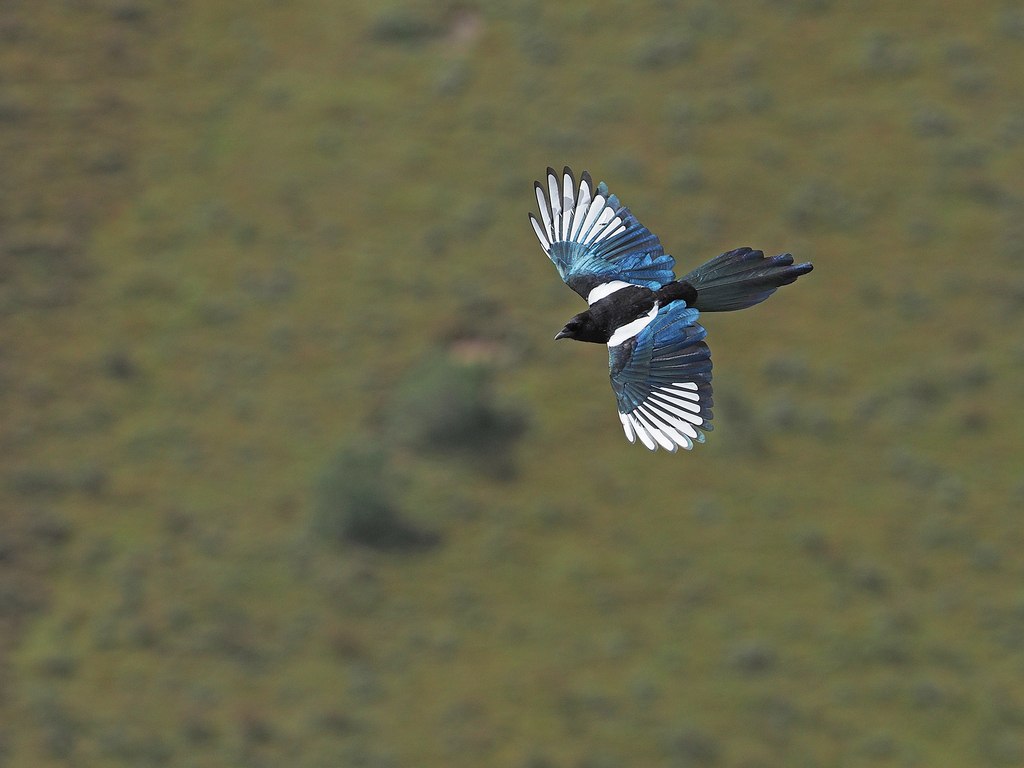
Black-rumped Magpie
Photo © James Eaton
Photo © James Eaton — CC0 1.0 — Source: iNaturalist #207907614Identification
The black-rumped magpie is a striking black-and-white corvid with distinctive iridescent plumage. Its most notable feature is its namesake black rump, which sets it apart from closely related Oriental and Eurasian magpies. The wings and tail are black with greenish-blue to purple iridescence, displaying prominent white stripes on the primary feathers that are especially visible in flight. The flanks and central underparts are white, creating a bold pied pattern. Compared to its relatives, this species has a brighter overall appearance, a stouter bill, and a notably shorter tail.
Range & Habitat
The black-rumped magpie inhabits the high-altitude regions of the Tibetan Plateau, from central Bhutan eastward through western Sichuan and Qinghai to eastern Tibet in west-central China. It has been reported from Sikkim, and a verified Indian record was documented in Kalimpong district, West Bengal, in May 2023. These birds favor semi-open habitats including farmland, agricultural districts, parks, and gardens, typically remaining close to human settlements, particularly in Bhutan. While uncommon at the highest elevations, they have been recorded at altitudes up to 4,800 meters, with nests documented as high as 4,400 meters.
Behaviour & Diet
Black-rumped magpies are monogamous and social birds, forming long-term pair bonds that persist across seasons and into communal flocking. They are typically seen in pairs, family groups, or communal roosts numbering up to 30 individuals. Breeding begins in late March, with nest construction undertaken by both sexes. A single brood is raised annually, with eggs laid from April to June. Clutches typically contain 4–5 eggs, though numbers may range from 3 to 6. Nests are impressive, domed structures built from twigs and plant fibers, sometimes constructed atop previous nests.
The diet is primarily carnivorous, consisting of invertebrates, lizards, small mammals, frogs, other birds, and carrion. These magpies forage mainly on the ground using a characteristic side-hopping motion to catch prey, holding their tail upright while hunting. Interestingly, they will occasionally perch on cattle and sheep to feed on ectoparasites. Like many corvids, they produce a subdued, warbling song interrupted by high-pitched notes and rarely mimicry, typically audible only at close range and mainly sung by unpaired individuals. Their typical call is a raucous, explosive rapid chatter.
Best Time & Places to See It
The breeding season from April to June offers the best opportunity to observe black-rumped magpies, as they are most active during nest construction and egg-laying. In Bhutan, where they remain closest to human habitation, farmland and semi-open areas near settlements provide the most reliable viewing opportunities. The high-altitude plateaus of Qinghai and western Sichuan in China are also worth exploring for dedicated birdwatchers. Early morning hours are ideal for observing these birds as they forage on the ground and may gather at communal roosts.
Photography Tips
The bold pied plumage and iridescent wings make black-rumped magpies rewarding subjects for photographers. The greenish-blue and purple iridescence on the wings and tail is best captured in strong, natural light—overcast conditions may render these colors less vibrant. When these birds are in flight, the prominent white stripes on the primary feathers provide excellent contrast and are particularly striking against the dark wings. Focus on capturing their characteristic side-hopping foraging behavior on the ground, with the tail held upright, which is both distinctive and visually dynamic. Given their preference for semi-open farmland habitats, photographers should scout locations with good sightlines across agricultural areas, particularly near villages and cultivated land where these magpies congregate.
Baima Snow Mountain National Nature Reserve
Giant Panda National Park
Huanglong Scenic and Historic Interest Area
Jiuzhai Valley
Qinghai Lake National Nature Reserve
Sanjiangyuan National Park
Wolong National Nature Reserve
Nothing matches these filters.
No community photos yet. Log in to add the first one.
No community observations of this species yet.