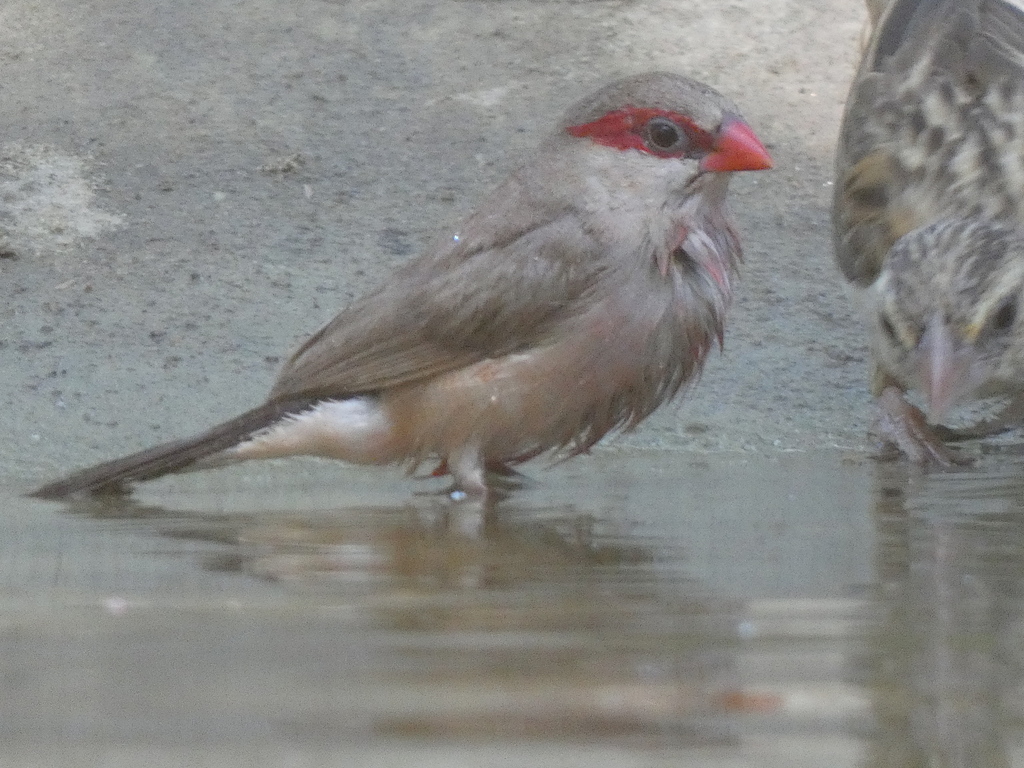
Black-rumped Waxbill
Photo © Don Wellmann
Photo © Don Wellmann — CC0 1.0 — Source: iNaturalist #144032569Identification
The black-rumped waxbill is a small estrildid finch easily recognized by its distinctive black rump, which contrasts sharply with its overall plumage. This striking feature gives the species its common name and makes it relatively straightforward to identify in the field, even for less experienced birdwatchers.
Range & habitat
The black-rumped waxbill is a common species found across a vast range in Southern Africa and sub-Saharan regions, with an estimated global extent of occurrence of 2,000,000 km². Its natural range extends throughout much of West and Central Africa, including countries such as Senegal, Mali, Mauritania, Guinea, Côte d'Ivoire, Ghana, Nigeria, Cameroon, Chad, and into East Africa through Kenya, Uganda, and Ethiopia.
Beyond its native range, the species has been introduced to several regions worldwide. It is established in parts of France (specifically Guadeloupe), Portugal, the United States (Puerto Rico), the Virgin Islands (though populations there may have died out), and Japan, where breeding has been recorded in Tokyo with sightings also reported in Osaka and Saitama prefectures. Introductions have also been documented in Spain and Hawaii, as well as various Lesser Antilles islands.
Behaviour & diet
As an estrildid finch, the black-rumped waxbill is a small songbird adapted to its African habitat. While specific dietary details are not extensively documented in available sources, like other waxbills it likely feeds on small seeds and insects. The species' commonality across its range suggests it is well-suited to local conditions and possesses considerable adaptability.
Best time & places to see it
The black-rumped waxbill's status as a common species throughout its African range makes it a relatively accessible sighting for wildlife travellers. The bird's widespread distribution across West, Central, and East Africa means that visitors to countries such as Senegal, Ghana, Nigeria, Kenya, and Uganda have good opportunities to encounter it. Its abundance across an estimated 2,000,000 km² of habitat increases the likelihood of observation during general birdwatching activities in these regions.
Photography tips
Photographers seeking to capture images of the black-rumped waxbill should focus on highlighting its most distinctive feature—the black rump. This characteristic plumage element is most visible when the bird is in flight or when perched with its rear end displayed toward the camera. Given the species' small size, a telephoto lens will prove essential for obtaining detailed shots. The bird's commonality throughout its range suggests reasonable opportunities for patient photographers to obtain quality images during visits to suitable African habitats.
Serengeti National Park
Tanzania
+558 birds+57 mammals
Across Tanzania's northern plateau, where volcanic soils meet acacia woodland and open grassland, unfolds one of Earth's most dynamic ecosystems. The Serengeti National Park sprawls across…
VIEW NATIONAL PARKBwindi Impenetrable National Park
Kanyashogi, Uganda
+603 birds+26 mammals
Steep ridges cloaked in montane forest rise from Uganda's southwestern borderlands, where the landscape grows so dense and tangled that early explorers named it impenetrable. At…
VIEW NATIONAL PARKKidepo Valley National Park
Uganda
+478 birds+24 mammals
Where the Narus and Kidepo rivers carve through northeastern Uganda's semi-arid lowlands, a landscape of sparse acacia woodland, grassland, and riverine thickets creates one of East…
VIEW NATIONAL PARKMurchison Falls National Park
Uganda
+608 birds+33 mammals
Where the Victoria Nile compresses through a narrow gorge and explodes across a 45-meter precipice, the landscape speaks in thunder. Murchison Falls National Park sprawls across…
VIEW NATIONAL PARKToro-Semliki Proposed National Park
Uganda
+474 birds+5 mammals
Where the Albertine Rift's western escarpment rises above the Semliki River valley, a vast mosaic of forest, savanna and wetland converges to create one of East…
VIEW NATIONAL PARKQueen Elizabeth National Park
Uganda
+672 birds+30 mammals
Across the southwestern escarpment of Uganda, where the Western Rift Valley descends through ancient volcanic terrain, Queen Elizabeth National Park sprawls across more than 8,300 square…
VIEW NATIONAL PARKZiwa Rhino and Wildlife Ranch
Nakasongola, Uganda
+359 birds+11 mammals
Where papyrus wetlands merge into sprawling savanna, Uganda's central landscape opens into one of East Africa's most vital rhino recovery zones. Ziwa Rhino and Wildlife Ranch…
VIEW WILDLIFE SANCTUARYRuma National Park
Suba, Kenya
+250 birds+8 mammals
Where the Winam Gulf narrows toward the Kenyan mainland, Ruma National Park rises as a sanctuary of evergreen woodland set within the humid tropics of Homa…
VIEW NATIONAL PARKNo community photos yet. Log in to add the first one.
No community observations of this species yet.