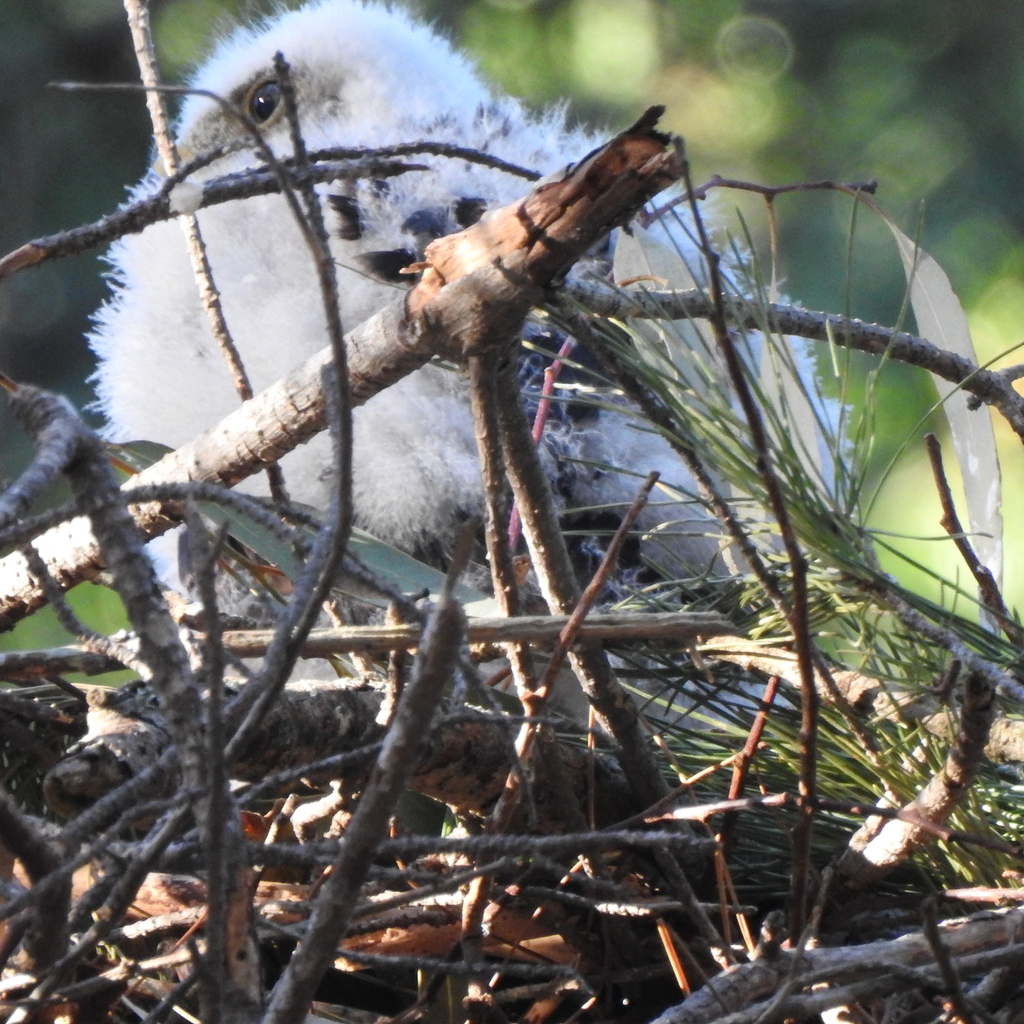
Black Sparrowhawk
Photo © Noeleen du Toit
Photo © Noeleen du Toit — CC BY-SA 4.0 — Source: iNaturalist #174874897Identification
The Black Sparrowhawk is one of the world's largest hawks, distinguished by two striking colour morphs. The "white morph"—predominant across most of the range—displays predominantly black plumage with a white throat, breast and belly. The rarer "black morph" is largely dark, though typically retains some white spots on the breast or a variable white throat. Both morphs show white and black barring on the underside of the wings and tail in flight, with cross-barred tails featuring about three to four paler stripes. Legs are yellow with notably large feet and talons. Females are noticeably larger than males, though plumage differences between sexes are negligible. Juveniles appear brown with russet tones, dark streaks, and light spots, gradually developing red eyes as they mature from their grey juvenile colouration.
Range & Habitat
Black Sparrowhawks occur throughout sub-Saharan Africa, with two recognised subspecies: A. m. temminckii across the northwestern regions from Liberia to Angola, and A. m. melanoleucus from Sudan and Ethiopia southward to South Africa. The species favours forest and non-desert areas, particularly where large trees suitable for nesting are available. Suburban and human-altered landscapes are increasingly important to the species. A notable concentration occurs on the Cape Peninsula in southwestern South Africa, where dark morphs comprise 80% of the population—an unusual pattern that declines to under 20% in the northeast, reflecting adaptations to local parasites and light conditions.
Behaviour & Diet
Black Sparrowhawks prey predominantly on birds of moderate size, particularly pigeons and doves in suburban areas. Despite their adaptations for flying through dense arboreal habitats—reflected in their long tails and tarsi—they conduct most hunting from concealed perches in trees, often in open areas. The two colour morphs exhibit fascinating ecological differences: dark morphs demonstrate superior hunting success in lower light conditions and possess improved blood parasite resistance, while white morphs are more effective hunters in brighter conditions. These advantages suggest different crypsis levels at varying light intensities, allowing both morphs to coexist within shared ranges.
Best Time & Places to See It
Black Sparrowhawks are relatively widespread and common throughout sub-Saharan Africa. Densities vary considerably by location, ranging from one pair per 13 square kilometres in Kenya to one pair per 38–150 square kilometres in South Africa. The Cape Peninsula offers exceptional viewing opportunities, where nests are typically only 500 metres apart within pine plantations and continuous tree belts, making this southwestern corner of South Africa a particularly rewarding destination for encountering the species, especially the distinctive dark morph.
Photography Tips
Photographing Black Sparrowhawks requires patience and attention to perching behaviour, as they hunt from concealed positions in trees. Look for perched birds scanning open areas for prey. The species' large size and contrasting plumage—particularly in white morphs—offer excellent photographic subjects. Capture both perched and in-flight shots to showcase the diagnostic white and black barring visible on underwing and tail feathers. On the Cape Peninsula, where dark morphs dominate, photographers should seek mixed-pair families, which offer variety in composition. Lighting conditions favour different morphs; exploit this by photographing white morphs in bright conditions and dark morphs during overcast periods or low-light hours.
Arusha National Park
Tanzania
+555 birds+16 mammals
Where the slopes of Mount Mawenzi rise above the Arusha region, a compact yet ecologically rich national park unfolds across montane forest, moorland, and alpine zones.…
VIEW NATIONAL PARKGarden Route National Park
George, South Africa
+353 birds+54 mammals
Sweeping across the Western Cape's coastal and mountainous terrain, this sprawling national park encompasses over five thousand square kilometers of extraordinarily diverse landscape—from coastal limestone cliffs…
VIEW NATIONAL PARKAddo Elephant National Park
Sundays River Valley Local Municipality, South Africa
+388 birds+55 mammals
Where the Eastern Cape's semi-arid scrublands meet transitional woodland, Addo sprawls across 13,478 square kilometres of one of southern Africa's most biodiverse landscapes. The terrain rises…
VIEW NATIONAL PARKNairobi National Park
Nairobi, Kenya
+515 birds+35 mammals
Just minutes from Kenya's capital, where the Nairobi River winds through acacia woodland and open grassland, lies one of Africa's most paradoxical wildlife sanctuaries. The park's…
VIEW NATIONAL PARKWatamu Marine National Park
Dabaso ward, Kenya
+328 birds+12 mammals
Where mangrove channels meet coral gardens and sandy shallows blend into the warm waters of the Indian Ocean, Watamu Marine National Park unfolds across the Kilifi…
VIEW NATIONAL PARKNo community photos yet. Log in to add the first one.
No community observations of this species yet.