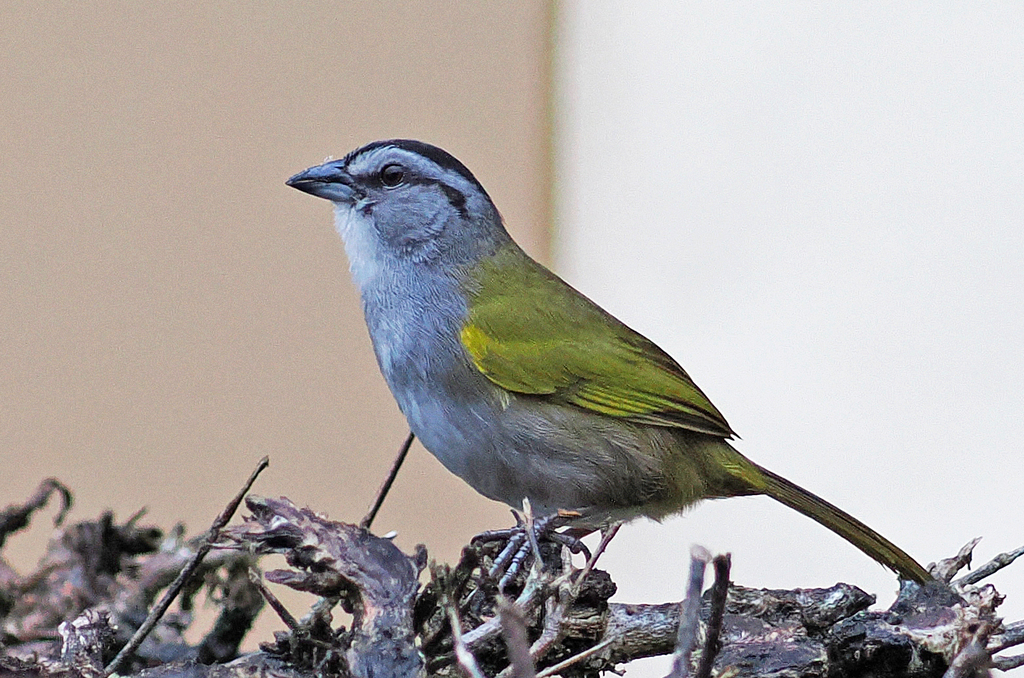
Black-striped Sparrow
Photo © Judy Gallagher
Photo © Judy Gallagher — CC BY-SA 4.0 — Source: iNaturalist photo #557370355Identification
The black-striped sparrow is a compact bird of approximately 16.5 cm (6.5 in) in length, weighing between 26 and 42 grams. The nominate subspecies features a distinctive mostly gray head marked by wide black stripes on either side of the crown and a thin black stripe through the eye. The upperparts, tail, and wings are olive-green with a characteristic yellow patch at the bend of the wing. The throat is whitish, the breast and sides pale gray, and the belly whitish with olive-buff tones on the lower flanks and undertail coverts. All subspecies share a dark red-brown iris, blackish bill, and pinkish to brownish-gray legs and feet. Juvenile birds display a yellowish-olive head with dark brown stripes, dusky-streaked brownish-olive upperparts, and yellowish-olive underparts with dark brown streaking.
Subspecific variation across the bird's range is considerable. Some subspecies show thinner crown stripes and lighter, more yellowish upperparts, while others are notably darker overall. One subspecies is the smallest of the group with brownish-olive upperparts, while another is larger with much grayer upperparts and a purer white throat. These variations make subspecies identification challenging but rewarding for experienced birders working across different regions of Central and South America.
Range & Habitat
The black-striped sparrow occupies a disjunct distribution spanning from Honduras south to Ecuador and Brazil, with unconfirmed reports in Peru. Different subspecies are found across distinct geographic regions, including the Caribbean slope from Honduras through Central America, the Pacific slope from Costa Rica through northern South America, and isolated populations in Colombia, Venezuela, Ecuador, and Brazil. One subspecies is found exclusively on Coiba Island off Panama's Pacific coast, while another inhabits only the upper Magdalena River valley in northern Colombia.
Throughout most of its range, this species favors low-stature landscapes including young secondary forest, woodland edges, fields and pastures with shrubs and thickets, and shady plantations and gardens. One subspecies uniquely inhabits river sandbars with dense vegetation. Elevational range varies considerably by region, from sea level to 600 meters in Honduras, rising to 1,600 meters in Colombia and 1,400 meters in Ecuador, with isolated populations in Brazil reaching 1,500 meters.
Behaviour & Diet
The black-striped sparrow is generally a year-round resident throughout its range, though some individuals are thought to move to lower elevations following the breeding season. The bird primarily feeds on insects, seeds, and fruits, with occasional records of small lizards and frogs in its diet. It forages characteristically by hopping along the ground and gleaning food items from low vegetation, making it relatively easy to observe when present.
Breeding season timing varies geographically; in Colombia, where breeding has been best documented, the season spans from January to October with peak activity concentrated between April and July. The complete breeding ecology and seasonal timing in other parts of the bird's range remain poorly documented, presenting opportunities for field research and observation.
Best Time & Places to See It
The black-striped sparrow's year-round residency means it can potentially be found throughout the year across its range. Travelers visiting Central America should focus on suitable habitat in Honduras, Nicaragua, Costa Rica, and Panama, where the bird is distributed across both Caribbean and Pacific slopes. In South America, the species is found in northern Colombia and Venezuela, with isolated populations in Ecuador and Brazil.
The bird's preference for low-stature landscapes including field edges, secondary growth, scrubby areas, and shaded gardens makes it accessible to travelers exploring rural and semi-rural regions. During the concentrated breeding season from April to July in Colombia, increased vocal activity and breeding behavior may make the species easier to locate. Its ground-foraging habits mean patient observation of appropriate habitat should yield sightings in regions where it occurs.
Photography Tips
The black-striped sparrow's relatively small size and preference for low vegetation present both challenges and opportunities for photographers. The bird's distinctive head pattern—the wide black crown stripes and eye-line on a gray head—makes for striking photographs when well-lit. Position yourself to capture these facial markings clearly, as they are the species' most identifying and photogenic features. The olive-green upperparts and subtle yellow wing patch provide attractive color contrast worth highlighting.
Since the bird forages on the ground and in low vegetation, a low camera angle often produces more engaging compositions than shooting downward. The species' hopping ground-foraging behavior provides opportunities for action shots. Early morning light typically works best for revealing the subtle plumage details and head pattern. Exercise patience near suitable habitat with dense low growth, and allow the bird's natural behavior to unfold rather than attempting to flush it from cover.
Corcovado National Park
Puerto Jiménez, Costa Rica
+444 birds+48 mammals
Where the Osa Peninsula juts into the Pacific, rainforest descends almost to the tide line, and Corcovado National Park protects one of Central America's most intact…
VIEW NATIONAL PARKManuel Antonio National Park
Quepos, Costa Rica
+426 birds+22 mammals
Where tropical rainforest descends steeply to a rocky Pacific coastline, Manuel Antonio National Park distills Central American biodiversity into one of Costa Rica's most compressed and…
VIEW NATIONAL PARKArenal Volcano National Park
Peñas Blancas, Costa Rica
+551 birds+21 mammals
Straddling the border between Alajuela and Guanacaste in northwestern Costa Rica, this national park rises dramatically around one of Central America's most active volcanic systems. The…
VIEW NATIONAL PARKTortuguero National Park
Roxana, Costa Rica
+420 birds+23 mammals
Canals and lagoons thread through a labyrinth of lowland rainforest where the Caribbean coast of Costa Rica meets the wetland frontier. This is terrain shaped by…
VIEW NATIONAL PARKChirripó National Park
Rivas, Costa Rica
+274 birds+6 mammals
Where the volcanic spine of Costa Rica's Central Cordillera reaches its apex, Chirripó National Park encompasses a landscape that shifts dramatically with elevation, from montane cloud…
VIEW NATIONAL PARKBraulio Carrillo National Park
Las Horquetas, Costa Rica
+547 birds+18 mammals
Where the Caribbean slope descends from the central volcanic cordillera toward the humid lowlands of Heredia, Braulio Carrillo National Park preserves one of Costa Rica's most…
VIEW NATIONAL PARKPiedras Blancas National Park
Golfito, Costa Rica
+386 birds+24 mammals
Where the Golfo Dulce meets the southwestern Pacific coast of Costa Rica, Piedras Blancas National Park protects a dramatic transition zone where lowland rainforest descends toward…
VIEW NATIONAL PARKSanta Rosa National Park
Santa Elena, Costa Rica
+359 birds+30 mammals
Where Pacific-facing slopes descend from volcanic uplands toward the Guanacaste lowlands, Santa Rosa National Park unfolds across a mosaic of tropical dry forest, gallery woodland, and…
VIEW NATIONAL PARKGuanacaste National Park
Santa Elena, Costa Rica
+461 birds+17 mammals
Where the Pacific slopes of northwestern Costa Rica rise toward the Continental Divide, dry tropical forest gives way to cloud-laden peaks and misty ridges—a landscape that…
VIEW NATIONAL PARKNatural el Cocuy National Park
Güicán, Colombia
+313 birds+3 mammals
Where the Andes rise to their highest peaks in Colombia's eastern cordillera, El Cocuy National Park sprawls across more than 6,600 square kilometers of some of…
VIEW NATIONAL PARKNatural Sumapaz National Park
Cubarral, Colombia
+368 birds+1 mammals
Where the Andes descend toward the Amazon basin, the high páramo grasslands of Sumapaz National Park sprawl across more than five thousand square kilometers of Meta…
VIEW NATIONAL PARKNatural Sierra de la Macarena National Park
Vista Hermosa, Colombia
+566 birds+15 mammals
Across nearly 20,000 square kilometres of Colombia's Meta Department, the terrain rises from lowland savanna into Andean foothills through a mosaic of gallery forests, palm-fringed wetlands,…
VIEW NATIONAL PARKCoiba National Park
Montijo, Panama
+260 birds+10 mammals
An archipelago of volcanic and sedimentary islands rises from the Pacific waters off Panama's southwestern coast, its densest rainforest canopy unbroken for millennia. Coiba National Park…
VIEW NATIONAL PARKBaru Volcano National Park
Cerro Punta, Panama
+402 birds+6 mammals
Where the land rises sharply toward the Caribbean's western spine, Baru Volcano National Park sprawls across roughly 220 square kilometres of southwestern Panama, anchored by the…
VIEW NATIONAL PARKGeneral de División Omar Torrijos Herrera National Park
La Pintada, Panama
+401 birds+2 mammals
Across the highlands of central Panama, where the continental divide funnels moisture-laden trade winds into steep river valleys, the terrain rises and falls in a landscape…
VIEW NATIONAL PARKSoberanía National Park
Cristóbal, Panama
+495 birds+34 mammals
Rainforest and riverine woodland blanket the rolling terrain of this 714-square-kilometre national park in Colón Province, where the Caribbean watershed feeds a maze of streams and…
VIEW NATIONAL PARKChagres National Park
Caimitillo, Panama
+486 birds+19 mammals
Where the Chagres River carves through the humid tropics of central Panama, a vast montane and lowland forest sprawls across more than 2,300 square kilometers, anchoring…
VIEW NATIONAL PARKDarién National Park
Tucutí, Panama
+534 birds+13 mammals
Where the spine of Central America crumbles into wetland and rainforest, Darién National Park sprawls across more than 20,000 square kilometres of some of the tropics'…
VIEW NATIONAL PARKPortobelo National Park
Portobelo, Panama
+366 birds+9 mammals
Where the Caribbean's turquoise waters meet the Darién's verdant shore, Portobelo National Park sprawls across 570 square kilometers of coastal forest, mangrove wetland, and coral-fringed islands…
VIEW NATIONAL PARKParque Internacional la Amistad
Teribe, Panama
+325 birds+11 mammals
Where the continental divide rises between the Caribbean and Pacific watersheds, a wilderness of extraordinary biological richness unfolds across the Talamanca Range and into lowland rainforest—a…
VIEW NATIONAL PARKCarara National Park
Tárcoles, Costa Rica
+397 birds+19 mammals
Where the Pacific coastal plain meets transitional forest, Carara National Park straddles one of Central America's most dynamic ecological boundaries. The park's landscape encompasses lowland deciduous…
VIEW NATIONAL PARKCahuita National Park
Talamanca, Costa Rica
+359 birds+15 mammals
Where the Caribbean shoreline dissolves into mangrove creeks and coral gardens, Cahuita's mosaic of habitats unfolds across the Limón coast. The park's signature feature—a living coral…
VIEW NATIONAL PARKRincón de la Vieja National Park
Liberia, Costa Rica
+451 birds+30 mammals
Where volcanic slopes rise abruptly from the Guanacaste lowlands, Rincón de la Vieja National Park sprawls across a landscape shaped by geothermal drama and seasonal extremes.…
VIEW NATIONAL PARKTapantí Macizo de la Muerte National Park
Orosi, Costa Rica
+503 birds+18 mammals
Where montane cloud forest rises steeply from the Orosi Valley, Tapantí Macizo de la Muerte National Park enfolds a landscape of perpetual moisture and emerald complexity.…
VIEW NATIONAL PARKLa Amistad International Park
Crorina, Costa Rica
+532 birds+20 mammals
Where the Caribbean slopes of Costa Rica's Talamanca Mountains rise steeply inland from Limón, the boundary between two nations dissolves into an unbroken expanse of rainforest.…
VIEW NATIONAL PARKBarbilla National Park
Chirripó, Costa Rica
+226 birds
Where the Caribbean slope of Costa Rica's eastern cordillera plunges into perpetual moisture, Barbilla National Park rises as one of Central America's most water-rich ecosystems. Fed…
VIEW NATIONAL PARKVolcán Tenorio National Park
Guatuso, Costa Rica
+480 birds+12 mammals
Where volcanic slopes rise through Costa Rica's northwestern borderlands, Volcán Tenorio National Park sprawls across terrain shaped by ancient lava flows and mineral-rich springs. The park's…
VIEW NATIONAL PARKMarino Ballena National Park
Bahía Ballena, Costa Rica
+336 birds+8 mammals
Where mangrove forests meet coral-fringed shorelines along Costa Rica's southern Pacific coast, Marino Ballena National Park encompasses a marine and terrestrial mosaic that ranks among Central…
VIEW NATIONAL PARKCaño Negro National Wildlife Refuge
Caño Negro District, Costa Rica
+486 birds+16 mammals
Where the San Juan River's seasonal floodplain opens into expansive wetlands, Caño Negro Wildlife Sanctuary sprawls across one of Central America's most productive freshwater ecosystems. This…
VIEW WILDLIFE SANCTUARYGandoca-Manzanillo National Wildlife Refuge
Manzanillo, Costa Rica
+394 birds+18 mammals
Where the Caribbean coastal plain surrenders to water-logged forest and mangrove tangles, Gandoca-Manzanillo Wildlife Sanctuary shelters one of Costa Rica's most biodiverse lowland wetland ecosystems. The…
VIEW WILDLIFE SANCTUARYNo community photos yet. Log in to add the first one.
No community observations of this species yet.