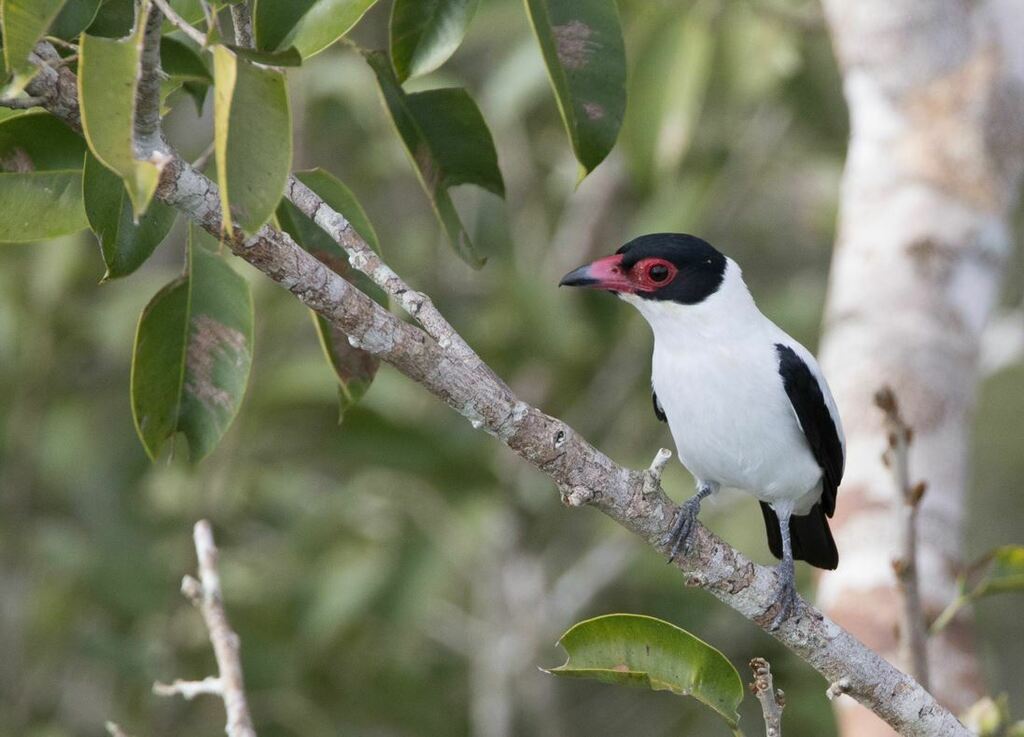
Black-tailed Tityra
Photo © Claude Kolwelter
Photo © Claude Kolwelter — CC BY 4.0 — Source: iNaturalist photo #341482842Identification
The black-tailed tityra is a robust, short-tailed passerine measuring 20–22 centimetres long and weighing 60–70 grams. It has a distinctive long, hook-tipped bill with a red base and black tip, and a patch of rosy-red bare skin around the eye. Males are dull white above and white below, with black rectrices, primary and secondary flight feathers, a black cap extending below the eyes, and silvery-grey tertiary feathers. Females are darker, with brown rather than black on wings and tail, and brown patterning on the head, back, and underside. Both sexes have dark irises and feet. Like other tityras, this species possesses a peculiar vestigial ninth primary feather.
Range & Habitat
This year-round resident inhabits northern South America east of the Andes, from Trinidad across the Amazon basin to Piauí and Mato Grosso in Brazil and adjacent Bolivia. The western subspecies (T. c. cayana) occurs throughout this range; the eastern subspecies (T. c. braziliensis) ranges from central Brazil southeastward to Misiones and possibly Corrientes Province in Argentina. The species favours forest edges, second growth, and plantation shade trees in pantanal and cerrado habitats, as well as terra firme and várzea forests, typically below 500 metres but occasionally reaching 1,100 metres elevation.
Behaviour & Diet
Black-tailed tityras are predominantly frugivorous and important seed dispersers, particularly of species such as Cabralea canjerana. They are most commonly seen in pairs or occasionally singly or in small groups, perching conspicuously while foraging for medium-sized fruits gleaned from vegetation or picked off in mid-hover. While adults rarely catch large insects, these are mainly fed to young birds. The species is intolerant of other birds and rarely attends mixed-species feeding flocks, preferring to forage alone high in the canopy.
Breeding occurs mainly from November to March, though activity has been recorded in June and July in some regions, suggesting possible multiple broods or lack of a strict breeding season. Nests are placed several metres above ground in tree holes, such as abandoned woodpecker nests or dead palm crowns, with brown-marked buff eggs laid on a bed of dry leaves. The female alone incubates for nearly three weeks, while both parents feed chicks after hatching. Fledging takes at least three weeks, possibly up to one month. This species is a host to the brood parasitic shiny cowbird.
Best Time & Places to See It
The black-tailed tityra is not uncommon across its large range and occurs in many national parks and protected areas throughout tropical South America. Its year-round residency means it can be encountered throughout the year, though the main breeding season from November to March may offer increased activity and visibility. Forest edges and second-growth areas in accessible protected regions of the Amazon basin, Pantanal, and cerrado offer the best opportunities for observation.
Photography Tips
Look for this species perching conspicuously while feeding on fruiting trees, making it relatively straightforward to locate and photograph. The rosy-red bare facial patch and distinctive black-and-white plumage of males, contrasting with the browner females, provide good identification features for the camera. Early morning or late afternoon light will enhance the subtle grey and white tones of male plumage. Position yourself to capture the long, hooked bill and characteristic short tail. Although the species calls more often in flight than when perched, patient observation of fruiting trees in forest edges and second growth will reward photographers with extended viewing opportunities.
Amacayacu National Park
Amazônia National Park
Anavilhanas National Park
Araucárias National Park
Bahuaja Sonene National Park
Carlos Botelho State Park
Chaco National Park
Chapada Diamantina National Park
Chapada dos Guimarães National Park
Nothing matches these filters.
No community photos yet. Log in to add the first one.
No community observations of this species yet.