Black-tailed Trogon
Photo © David F. Belmonte
Photo © David F. Belmonte — CC BY 4.0 — Source: iNaturalist photo #588424104Identification
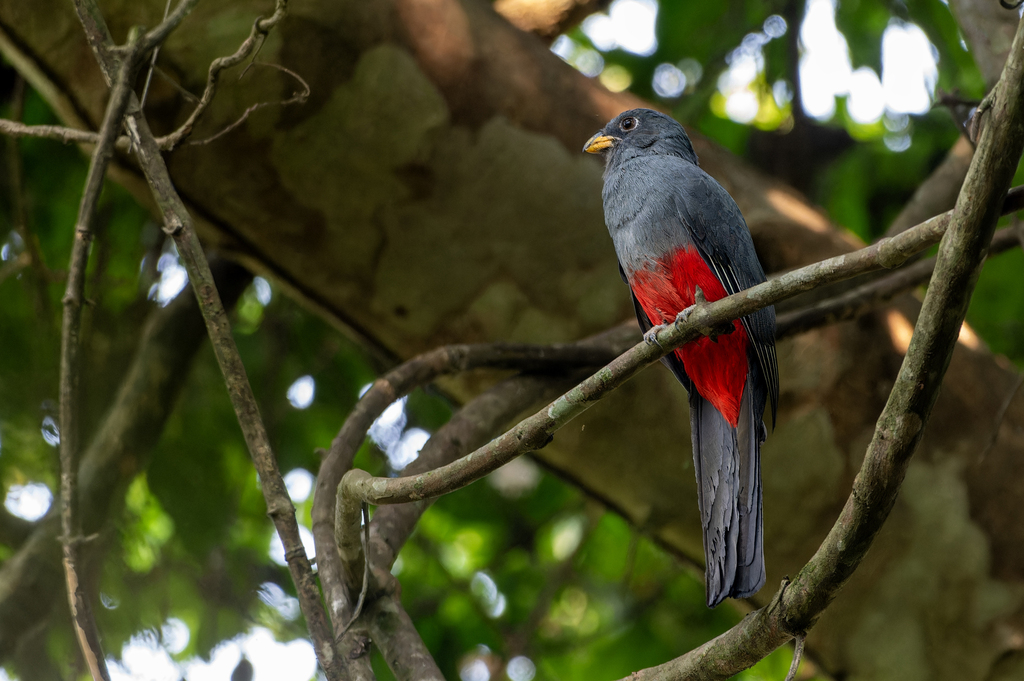
The black-tailed trogon is a compact bird measuring 28 to 30 cm in length, weighing between 52 and 122 grams. Males of the nominate subspecies are striking birds, featuring a yellow bill, blackish face and throat, and a distinctive orange-red eye-ring. The crown, nape, and upperparts are vibrant green, with a green breast separated from a red belly and vent by a crisp white band. The tail displays a deep blue upper surface contrasting with a slaty gray underside, while the folded wings show fine vermiculation appearing gray at distance. Females are more subdued in coloration, with slaty maxillas and gray plumage replacing the male's green. They retain white arcs before and after the eye rather than the bold orange-red ring. Different subspecies show subtle variations in wing and tail coloration and patterning.
Range & Habitat
The black-tailed trogon occupies a vast range across Panama and northern South America, with different subspecies distributed across distinct regions. Populations extend from Panama east of the Canal Zone through Colombia and Venezuela, across the Guianas, and into Amazonian Brazil, with some populations reaching as far south as northern Bolivia and southeastern Brazil's São Paulo region. The species demonstrates remarkable habitat flexibility across its range, inhabiting humid lowland and foothill forests in Panama, rainforests in Venezuela and French Guiana, and diverse Amazonian forest types including transitional, swamp, gallery, terra firme, and várzea forests. Elevation preferences vary regionally: in Colombia west of the Andes it reaches 2,200 meters, while in Venezuelan lowlands north of the Orinoco it remains below 100 meters, though southern populations climb to 1,000 meters.
Behaviour & Diet
The black-tailed trogon is largely resident throughout most of its range, though Bolivian populations move seasonally between dry forests and lowland rainforests. This species feeds on a wide variety of insects supplemented by fruits, and occasionally small amphibians and reptiles. It displays flexible foraging behavior, sometimes joining mixed-species flocks in the canopy while also foraging in lower strata. Breeding seasons vary dramatically across the species' extensive range, from March in Panama to September and October in Peru. Birds nest in cavities within arboreal termitaria and possibly in decayed trees, typically laying clutches of two or three eggs. The species is vocal, producing a distinctive song consisting of "'kwo-kwo-kwo...' in series of up to 46 notes," along with a bubbly purring trill.
Best Time & Places to See It
The black-tailed trogon is generally common throughout its range and classified as Least Concern with stable populations. Its very large range and habitat flexibility make it accessible to travelers across much of Panama and northern South America. The species' varied breeding season across its distribution means suitable viewing opportunities exist year-round in different regions: March in Panama, through to September and October in Peru and other Amazonian areas. Primary and secondary humid forests, rainforests, and various Amazonian forest types all harbor populations, offering multiple venues for encountering this species.
Photography Tips
Photographers should focus on the male's striking plumage contrasts—the bold orange-red eye-ring against the blackish face, the white breast band dividing green from red, and the deep blue upper tail surface all provide compelling compositional elements. The species' habit of joining mixed-species canopy flocks offers opportunities for action shots, while lower foraging behavior provides alternatives when canopy birds prove difficult to access. Patience in scanning appropriate forest habitats, particularly during breeding season when birds are more vocal and active, increases chances of productive encounters. The species' preference for foraging at multiple heights means photographers should scan both high canopy and mid-story levels rather than focusing exclusively on one stratum.
Yasuní National Park
Aguarico, Ecuador
+601 birds+43 mammals
Where the western Amazon basin converges with Ecuador's Orellana Province, lowland rainforest reaches toward the horizon in an unbroken canopy of staggering botanical density. Yasuní National…
VIEW NATIONAL PARKNatural Sierra de Chiribiquete National Park
Solano, Colombia
+359 birds+27 mammals
Massive table-top mountains rise abruptly from the lowland rainforest of southeastern Colombia, their sheer sandstone cliffs and isolated summits creating some of the most dramatic topography…
VIEW NATIONAL PARKNatural Utría National Park
Alto Baudó (Pie de Pató), Colombia
+372 birds+11 mammals
Where the Chocó's coastal mountains plunge toward the Pacific, Utría National Park preserves one of Colombia's most biodiverse and least-visited wilderness expanses. Sprawling across 1,287 square…
VIEW NATIONAL PARKNatural la Paya National Park
Puerto Leguízamo, Colombia
+262 birds+4 mammals
Where the Amazon's western reaches fold into the Andes foothills, La Paya National Park sprawls across more than 8,500 square kilometers of pristine Amazonian rainforest in…
VIEW NATIONAL PARKNatural Farallones de Cali National Park
Buenaventura, Colombia
+733 birds+27 mammals
Where the Pacific coastal plain meets the western slopes of the Andes, Farallones de Cali National Park sprawls across nearly 3,500 square kilometers of dramatic topography…
VIEW NATIONAL PARKNatural Uramba Bahía Málaga National Park
Buenaventura, Colombia
+308 birds+15 mammals
Where the Pacific coastal rainforest descends to mangrove estuaries and rocky headlands, Uramba Bahía Málaga National Park unfolds across nearly 1,000 square kilometres of Colombia's Valle…
VIEW NATIONAL PARKNatural Sierra de la Macarena National Park
Vista Hermosa, Colombia
+566 birds+15 mammals
Across nearly 20,000 square kilometres of Colombia's Meta Department, the terrain rises from lowland savanna into Andean foothills through a mosaic of gallery forests, palm-fringed wetlands,…
VIEW NATIONAL PARKAmacayacu National Park
Leticia, Colombia
+567 birds+25 mammals
Where the Rio Amazonas curves through the tri-border region where Colombia, Peru, and Brazil converge, Amacayacu National Park sprawls across more than 5,250 square kilometres of…
VIEW NATIONAL PARKViruá National Park
Brazil
+389 birds+6 mammals
Across the northern frontier of Roraima, where the forest canopy rises from ancient Amazonian lowlands, Viruá National Park protects nearly 3,700 square kilometres of terra firme…
VIEW NATIONAL PARKAmazônia National Park
Brazil
+439 birds+6 mammals
Where the Rio Amazonas and its tributaries weave through the heart of Pará state, a vast tapestry of rainforest stretches across 23,611 square kilometers of unbroken…
VIEW NATIONAL PARKMapinguari National Park
Brazil
+354 birds
Vast tracts of western Amazonian rainforest blanket the remote terrain of this 56,827 square kilometre national park in Amazonas state, where seasonal rivers wind through dense…
VIEW NATIONAL PARKJaú National Park
Brazil
+354 birds+3 mammals
Vast floodplain forests and blackwater rivers define this remote corner of western Amazonas, where the Rio Negro and its tributaries have carved an intricate mosaic of…
VIEW NATIONAL PARKPacaás Novos National Park
Brazil
+279 birds+1 mammals
Across the border between Rondônia and Amazonas, vast tracts of humid tropical forest rise and fall in gentle undulations, carved by clear-flowing rivers that feed into…
VIEW NATIONAL PARKAnavilhanas National Park
Brazil
+468 birds+8 mammals
Across the Rio Negro in central Amazonas, an archipelago of over a thousand islands rises from the world's largest rainforest river system, creating a labyrinth of…
VIEW NATIONAL PARKCampos Amazónicos National Park
Amazonas, Brazil
+434 birds+7 mammals
Sprawling across the southwestern Amazon basin in Amazonas state, this 27,263-square-kilometre national park encompasses some of the region's most pristine lowland rainforest, where terra firme forest…
VIEW NATIONAL PARKSerra do Divisor National Park
Brazil
+448 birds+10 mammals
Where the western Amazon meets the Andes foothills, Serra do Divisor National Park sprawls across one of South America's most biodiverse and least accessible frontiers. Spanning…
VIEW NATIONAL PARKManu National Park
Manu, Peru
+892 birds+26 mammals
Across the eastern slopes of the Peruvian Andes, tropical rainforest descends into the Amazon basin with a complexity that few terrestrial ecosystems match. Manu National Park…
VIEW NATIONAL PARKSierra del Divisor National Park
Alto Tapiche, Peru
+298 birds+2 mammals
Where the western Amazon meets the Andes foothills, nearly 41,000 square kilometres of pristine rainforest rise across Peru's Alto Tapiche region in a landscape of extraordinary…
VIEW NATIONAL PARKBahuaja Sonene National Park
San Pedro de Putina Punco, Peru
+602 birds+8 mammals
Where the Madre de Dios and Heath rivers converge in southeastern Peru rises one of South America's most biodiverse wilderness regions: a vast protected realm of…
VIEW NATIONAL PARKCordillera Azul National Park
Pampa Hermosa, Peru
+322 birds+1 mammals
Where the eastern Andes descend into the western Amazon basin, Cordillera Azul National Park sprawls across nearly 38,000 square kilometres of some of Peru's most pristine…
VIEW NATIONAL PARKSoberanía National Park
Cristóbal, Panama
+495 birds+34 mammals
Rainforest and riverine woodland blanket the rolling terrain of this 714-square-kilometre national park in Colón Province, where the Caribbean watershed feeds a maze of streams and…
VIEW NATIONAL PARKChagres National Park
Caimitillo, Panama
+486 birds+19 mammals
Where the Chagres River carves through the humid tropics of central Panama, a vast montane and lowland forest sprawls across more than 2,300 square kilometers, anchoring…
VIEW NATIONAL PARKDarién National Park
Tucutí, Panama
+534 birds+13 mammals
Where the spine of Central America crumbles into wetland and rainforest, Darién National Park sprawls across more than 20,000 square kilometres of some of the tropics'…
VIEW NATIONAL PARKPortobelo National Park
Portobelo, Panama
+366 birds+9 mammals
Where the Caribbean's turquoise waters meet the Darién's verdant shore, Portobelo National Park sprawls across 570 square kilometers of coastal forest, mangrove wetland, and coral-fringed islands…
VIEW NATIONAL PARKNo community photos yet. Log in to add the first one.
No community observations of this species yet.