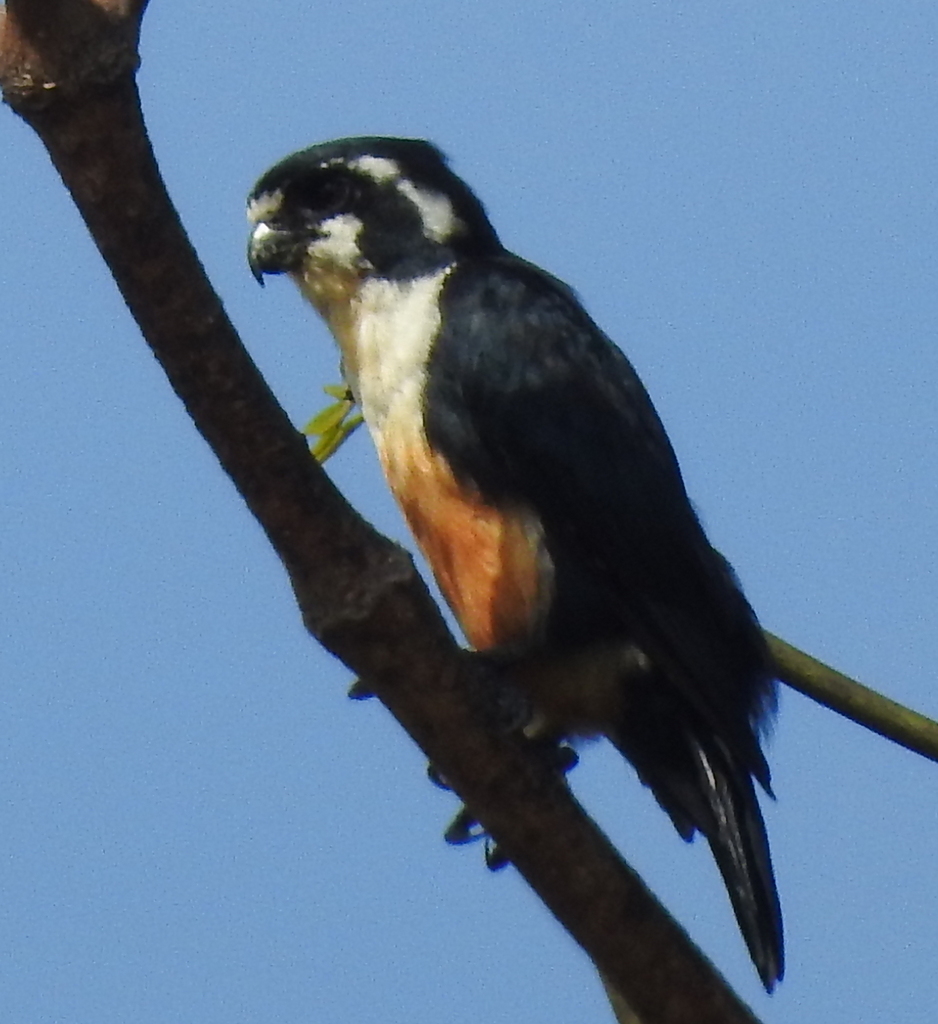
Black-thighed Falconet
Photo © anukma
Photo © anukma — CC BY 4.0 — Source: iNaturalist #182606431Identification
The black-thighed falconet is one of the world's smallest birds of prey, measuring just 14–16 centimetres long with a wingspan of 27–32 centimetres—barely larger than a sparrow. This minute, shrike-like falcon has a distinctive squarish tail that is frequently spread in flight. Adult males are glossy black above with a striking white forehead streak that arcs around black cheeks, a white or rufous-washed throat, and a white breast shading into a rufous abdomen. The diagnostic black thighs and flanks give the species its name. In flight, males display white underwings with black barring on the primary and secondary feathers. The tail is plain black with three white bars visible from below. Adult females are similar but have longer tails, while juveniles show rufous coloring where adults display white on the head.
The species has a distinctive voice: a hard, high-pitched cry of 'shiew' and a fast repeated 'kli-kli-kli-kli' that can aid identification in the field.
Range & Habitat
The black-thighed falconet is native to Brunei, Myanmar, Thailand, Malaysia, Singapore, and Indonesia, with vagrant records from Sri Lanka. It favors forest, forest edges, and wooded open areas, and is frequently encountered around human cultivation, villages, and areas of active slash-and-burn forest clearance. The species shows a strong affinity for riverine and wetland environments, often found near streams and paddy fields. It typically inhabits lowland regions below 1,500 metres elevation and demonstrates considerable tolerance for habitat disturbance, making it adaptable to human-modified landscapes.
Behaviour & Diet
The black-thighed falconet is a gregarious and social species, typically observed in loose pairs or groups of up to ten or more individuals. It feeds predominantly on insects—particularly moths, butterflies, dragonflies, alate termites, and cicadas—supplemented occasionally by small birds and lizards. A distinctive feature of its feeding ecology is the social nature of foraging, with feeding parties of up to ten birds recorded. Most prey is captured during quick, decisive flights launched from an exposed perch, a hunting technique typical of small falcons.
Best Time & Places to See It
Breeding seasons vary by latitude: northern populations breed primarily from February to June, while southern populations in Java lay eggs in November to December. The species shows variable abundance across its range, from common in Sumatra and Borneo, to fairly common in Thailand, to scarce in Java and Bali. Its tolerance of disturbed habitats means it can often be found in accessible areas around villages and cultivated lands, making it relatively approachable for patient observers. Early morning and late afternoon typically offer the best viewing opportunities when falconets are most active in feeding.
Photography Tips
The small size and active, acrobatic flight of the black-thighed falconet present significant challenges for photographers. Use a fast shutter speed (at least 1/2000th second) to freeze the rapid wing beats during hunting flights. Position yourself near likely perches—dead branches overlooking open ground or water—where birds pause between feeding sorties. Early morning light is ideal, as it illuminates the glossy black plumage and highlights the diagnostic white markings on the head and underwings. A telephoto lens of 500mm or greater is essential given the species' small size and tendency to keep distance. Patience and persistence are crucial; spending time in known feeding areas during active periods increases the likelihood of capturing dramatic in-flight shots or detailed perch portraits.
Hat Noppharat Thara-Mu Ko Phi Phi National Park
Ao Nang, Thailand
+253 birds+9 mammals
Where limestone karsts rise dramatically from turquoise waters, Hat Noppharat Thara-Mu Ko Phi Phi National Park unfolds across a mosaic of beach, mangrove forest, and island…
VIEW NATIONAL PARKBako National Park
Kuching, Malaysia
+210 birds+17 mammals
Weathered sandstone cliffs rise dramatically from the South China Sea, their ochre faces sculpted by millennia of wind and tide into a landscape of extraordinary geological…
VIEW NATIONAL PARKTaman Negara National Park
Kampong Samas, Malaysia
+393 birds+48 mammals
Where ancient rainforest meets limestone peaks, one of Southeast Asia's oldest protected wilderness preserves sprawls across 4,343 square kilometers of primordial landscape. Dipterocarp giants tower overhead,…
VIEW NATIONAL PARKTaman Negara Bukit Lambir National Park
Miri, Malaysia
+153 birds+7 mammals
Rainforest cascades down sandstone ridges where crystal streams carve through ancient geology, creating a landscape of profound biological richness in Sarawak's interior. This 68-square-kilometre sanctuary protects…
VIEW NATIONAL PARKGunung Mulu National Park
Long Seridan, Malaysia
+280 birds+39 mammals
Where granite monoliths pierce the rainforest canopy of Sarawak, an ancient limestone karst landscape reveals one of Southeast Asia's most biodiverse strongholds. Soaring peaks cloaked in…
VIEW NATIONAL PARKTaman Nasional Baluran
Situbondo, Indonesia
+189 birds+9 mammals
Across the northeastern tip of East Java, where monsoon winds sweep down from the Bali Strait, a landscape of contrasts unfolds within 374 square kilometres of…
VIEW NATIONAL PARKTaman Nasional Meru Betiri
Jember, Indonesia
+93 birds+1 mammals
Across East Java's southeastern coast, where the Indian Ocean meets a landscape of volcanic soils and monsoon-fed forests, sprawls a national park that epitomizes the ecological…
VIEW NATIONAL PARKWest Bali National Park
Gerokgak, Indonesia
+240 birds+8 mammals
Across West Bali's northwestern reaches, where the Indian Ocean meets volcanic slopes and limestone cliffs plunge toward turquoise shallows, sprawls a protected realm of roughly 325…
VIEW NATIONAL PARKKerinci Seblat National Park
Kerinci, Indonesia
+228 birds+16 mammals
Across nearly 67,000 square kilometres of Sumatra's spine, a mountainous realm of equatorial rainforest rises from steaming lowlands to volcanic peaks shrouded in cloud. Kerinci Seblat…
VIEW NATIONAL PARKWay Kambas National Park
Lampung Timur, Indonesia
+237 birds+20 mammals
Across the low swamplands of eastern Lampung, where freshwater wetlands merge into tidal mangrove forests along the Sunda Strait, sprawls one of Sumatra's most vital sanctuaries.…
VIEW NATIONAL PARKNo community photos yet. Log in to add the first one.
No community observations of this species yet.