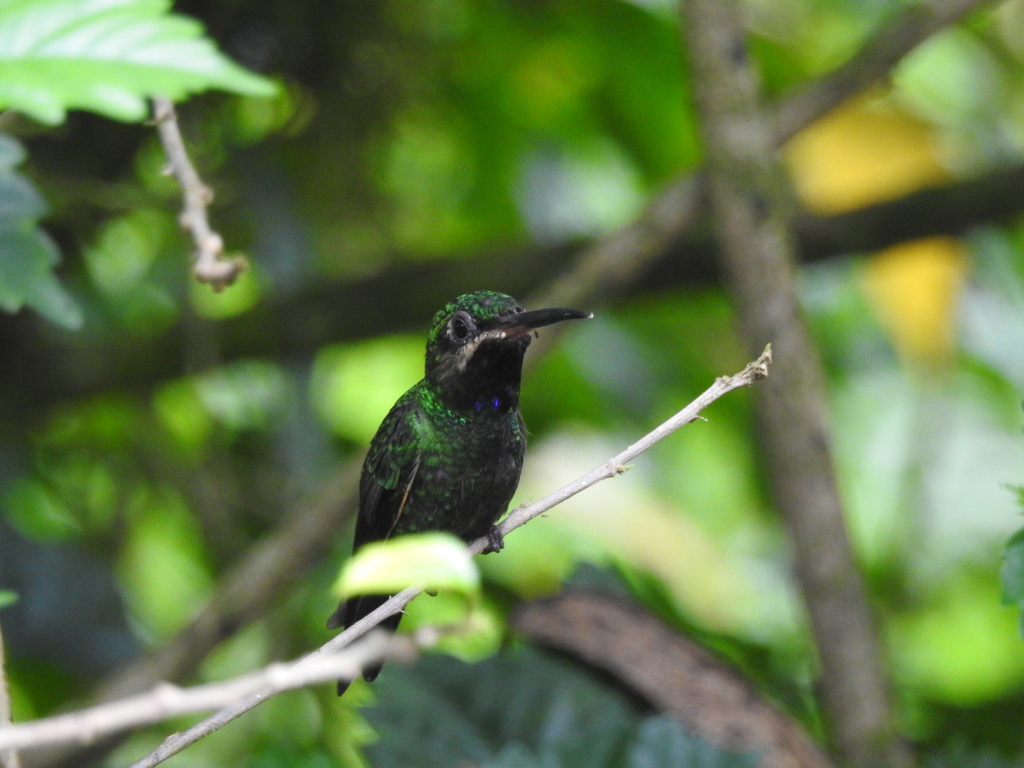
Black-throated Brilliant
Photo © Tristan Jobin
Photo © Tristan Jobin — CC BY 4.0 — Source: iNaturalist #64144614Identification
The Black-throated Brilliant is a small hummingbird, measuring 11.5 to 13 cm in length with a nearly straight dark bill of about 2.8 cm. Males are distinctly marked with shining green upperparts and a glittering green forehead, while the underparts are black with a small glittering purple patch and narrow glittering green band on the lower throat. The most striking feature is the steel blue tail, which is very long and deeply forked in males. Females have similar green upperparts but display a whitish to rufous malar stripe, gray underparts with bronzy-green spotting, and a less deeply forked tail with green central feathers. Both sexes share a small white spot behind the eye. Juveniles resemble females but with more intensely colored malar stripes.
Two subspecies exist with subtle differences. The nominate subspecies H. s. schreibersii shows the contrasting black throat described above, while H. s. whitelyana has shining green upperparts including the forehead, with males otherwise similar in appearance. Females of both subspecies are nearly identical.
Range & Habitat
The Black-throated Brilliant inhabits the northwestern Amazon basin, with the nominate subspecies ranging from southeastern Colombia south through eastern Ecuador into northeastern Peru, with populations also occurring in the upper Rio Negro watershed of extreme northwestern Brazil. The subspecies H. s. whitelyana is found in central and southeastern Peru. Both subspecies prefer the interior of mature humid forest and scrublands.
Elevation varies between subspecies. The nominate subspecies typically occurs between 400 and 1,000 m, though in eastern Ecuador it regularly reaches 1,450 m and occasionally up to 1,900 m. H. s. whitelyana inhabits humid montane forest at elevations between 600 and 1,250 m. The species appears uncommon and patchily distributed throughout its range.
Behaviour & Diet
The Black-throated Brilliant is a sedentary species that primarily forages for nectar in the forest understory, typically between 2 and 4 meters high. It shows a preference for flowering plants of the families Ericaceae and Malvaceae. In addition to nectar feeding, it actively captures small insects by hawking from perches, supplementing its diet with protein-rich prey.
The breeding season of the nominate subspecies spans at least from February to May, potentially extending as late as October. Females incubate a clutch of two eggs, though other aspects of breeding biology remain poorly documented. The species produces a distinctive vocalization described as a repeated, drawn-out, descending reeling trill lasting approximately 4 to 5 seconds, along with single sharp "chup" notes.
Best Time & Places to See It
The Black-throated Brilliant is best encountered in primary and mature secondary humid forest in the northwestern Amazon region. Observers should focus on the understory, where this species forages for nectar at low heights of 2 to 4 meters. The breeding season from February through May offers the most activity and vocal calling, making this an ideal period for observation and identification.
The nominate subspecies is most reliably found in southeastern Colombia, eastern Ecuador, and northeastern Peru, with populations also present in the Brazilian upper Rio Negro watershed. H. s. whitelyana can be found in montane forests of central and southeastern Peru. Given the species' patchy distribution and uncommon status, patience and careful listening for its distinctive trill are essential for successful observation.
Photography Tips
Photographing the Black-throated Brilliant requires patience and attention to the understory habitat where the species forages. Position yourself quietly near flowering plants of Ericaceae and Malvaceae families, watching for this small hummingbird at heights of 2 to 4 meters. Early morning offers the best light for capturing the iridescent throat and tail feathers, which display their glittering green and steel blue colors most vividly in direct sunlight.
The male's deeply forked tail and glittering throat patch are key identifying features worth capturing in detail. Use a fast shutter speed to freeze wing motion during feeding bouts, and be prepared for quick movements as the bird hawks for insects from perches. The species' sedentary nature means that once a preferred feeding location is identified, returning to the same spot during subsequent visits may yield rewarding photographic opportunities.
Yasuní National Park
Aguarico, Ecuador
+601 birds+43 mammals
Where the western Amazon basin converges with Ecuador's Orellana Province, lowland rainforest reaches toward the horizon in an unbroken canopy of staggering botanical density. Yasuní National…
VIEW NATIONAL PARKPodocarpus National Park
Zamora, Ecuador
+496 birds+6 mammals
Where the Andes descend toward the Amazon basin, Podocarpus National Park sprawls across nearly 2,800 square kilometres of the most biodiverse terrain in Ecuador's southern highlands.…
VIEW NATIONAL PARKSumaco Napo-Galeras National Park
Loreto, Ecuador
+563 birds+4 mammals
Where Ecuador's Amazon transitions into cloud forest, a massive shield volcano rises from the emerald lowlands of Orellana Province, anchoring one of the continent's most biodiverse…
VIEW NATIONAL PARKAmacayacu National Park
Leticia, Colombia
+567 birds+25 mammals
Where the Rio Amazonas curves through the tri-border region where Colombia, Peru, and Brazil converge, Amacayacu National Park sprawls across more than 5,250 square kilometres of…
VIEW NATIONAL PARKNo community photos yet. Log in to add the first one.
No community observations of this species yet.