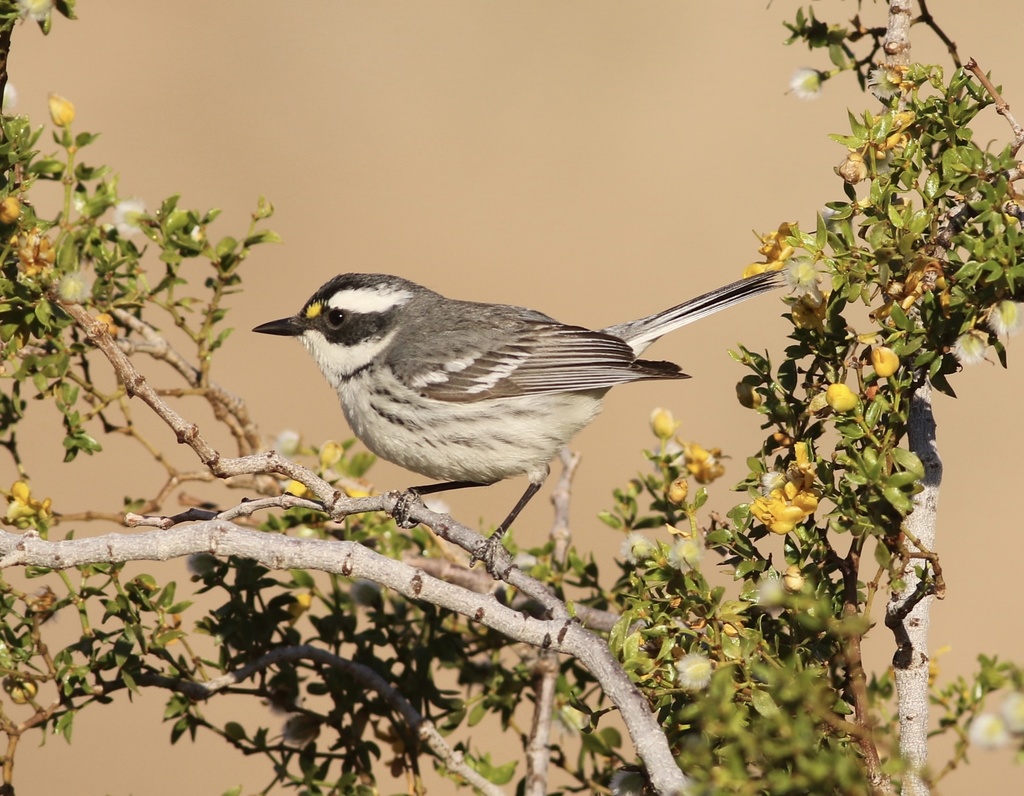
Black-throated Grey Warbler
Photo © Cricket Raspet
Photo © Cricket Raspet — CC BY 4.0 — Source: iNaturalist photo #188669375Identification
The Black-throated Grey Warbler is a small passerine, 13 cm long, with distinctive grey and white plumage marked by bold black striping. The male displays its namesake black throat along with black stripes on the crown and below the eye, white markings around the chin and above the eye, and black streaks on the flanks. The female is a paler version, featuring a white throat and less pronounced black markings on the head, wings, and flanks. Both sexes show a small, diagnostic yellow spot between the eye and bill. The bird weighs approximately 8.4 grams with a wingspan of 7.5–7.8 inches. Its soft plumage lacks gloss, and it is most easily confused with the Black-and-white or Blackpoll Warblers, though its plumage pattern is distinctly different from both.
The male's song is a series of buzzy notes with the earlier notes doubled and the penultimate note pitched high, with three variations including a quiet soft song given while following females. The bird also gives a sharp, flat call similar to Townsend's Warbler, and a high see flight call.
Range & Habitat
This warbler breeds throughout western North America from southwestern British Columbia along the Pacific coast to northern Baja California, and eastward to New Mexico and southern Montana. It winters primarily in Mexico from southern Baja California to Oaxaca state. The species has recently expanded into parts of Wyoming and Montana as Juniperus osteosperma has spread due to warming climate conditions. Vagrants occasionally appear across eastern North America and Cuba.
Black-throated Grey Warblers favour open coniferous and mixed forests with brushy understory, dry open oak forests, chaparral, and scrubland, showing particular association with pinyon pines, junipers, and oaks. The species migrates south in late fall and returns north in mid-spring. It remains fairly common throughout its range and is not seriously threatened by habitat destruction, unlike many migratory warblers, earning it a Least Concern conservation status.
Behaviour & Diet
The Black-throated Grey Warbler is usually approachable and easily observed while foraging. It feeds on insects gleaned from low branches, with a particular preference for caterpillars. The bird often forages in mixed flocks with other species. It nests in an open cup constructed of grass stalks and plant fibres, lined with feathers and hair, typically positioned a few metres above the ground on a horizontal tree branch or shrub. Females lay three to five pinkish eggs marked with brown dots.
Both parents feed the young, though detailed breeding behaviour remains poorly documented. Despite its commonality in many localities, the species remains poorly known scientifically, particularly regarding its breeding ecology.
Best Time & Places to See It
This warbler is common in suitable habitat throughout its breeding range, making it fairly accessible to observers. Birds return to their breeding grounds in mid-spring, offering excellent viewing opportunities during spring migration and the breeding season. The species is typically approachable and easily observed while foraging in low vegetation. Look for it in pinyon-juniper woodlands, mixed coniferous forests, and oak scrubland across the western United States and southwestern British Columbia. During winter, the species can be found in Mexico's dry woodlands and scrubland.
Photography Tips
The Black-throated Grey Warbler's approachable nature and active foraging behaviour make it a rewarding subject for photographers. Its diagnostic markings—particularly the male's bold black throat and head stripes—are best captured with clear side or front lighting. Photograph birds while foraging on low branches and in shrubs where the soft, non-glossy plumage can be properly rendered without harsh highlights. The small yellow spot between the eye and bill is a key identifying feature worth highlighting in close-up shots.
Spring migration and the breeding season offer the most reliable opportunities, when birds are actively vocal and visible. Patience near suitable habitat—pinyon-juniper woodlands and mixed forests with oak understory—will reward you with extended observation and shooting opportunities. The bird's preference for low branches makes it accessible for photography without extreme focal lengths.
Alaska Maritime National Wildlife Refuge
Alligator River National Wildlife Refuge
Arches National Park
Big Bend National Park
Bitter Lake National Wildlife Refuge
Black Canyon of the Gunnison National Park
Bosque del Apache National Wildlife Refuge
Bryce Canyon National Park
Cabeza Prieta National Wildlife Refuge
Nothing matches these filters.
No community photos yet. Log in to add the first one.
No community observations of this species yet.