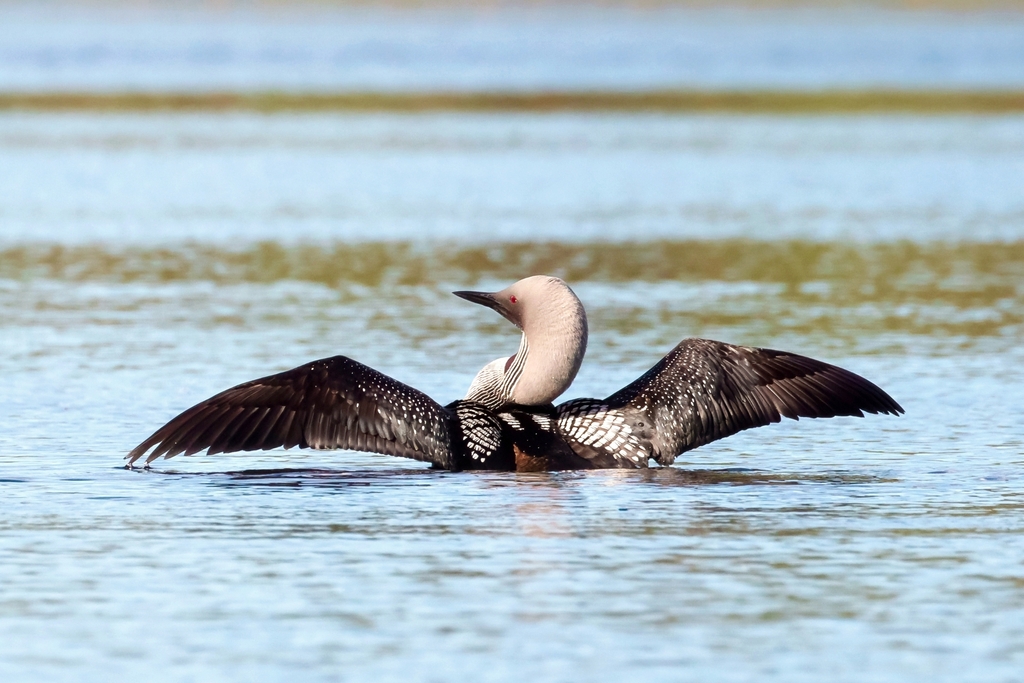
Black-throated Loon
Photo © Олеся
Photo © Олеся — CC BY 4.0 — Source: iNaturalist photo #552899980Identification
The black-throated loon measures approximately 70 cm (28 in) in length and weighs between 1.3 and 3.4 kilograms. In breeding plumage, adults display mostly black upperparts with white squares on some mantle and scapular feathers. The head and hindneck are grey, and the distinctive black throat patch gives the species its name, though this patch varies between subspecies—the nominate race has a black throat, while G. a. viridigularis sports a green one. The underparts and flanks are white, a feature that helpfully distinguishes this species from the similar Pacific loon.
Non-breeding birds lose the prominent throat patch, which is replaced by white plumage. Most black lines on the throat disappear except those on the lower sides, and the upperparts become less patterned, retaining only a few white spots on the upperwing. Juveniles resemble non-breeding adults but are overall browner in appearance.
Range & Habitat
The black-throated loon is a migratory species found across the Northern Hemisphere. Two subspecies occupy distinct ranges: the nominate G. a. arctica breeds across northern Europe and into central and northern Asia as far as the Lena River and Transbaikal region, while G. a. viridigularis inhabits eastern Russia from the Lena River eastward to the Chukotka Peninsula, Kamchatka, and northern Sakhalin. Both subspecies breed on freshwater lakes in their respective ranges.
During winter, birds migrate to sheltered, ice-free coasts. The nominate subspecies winters along the coasts of northwestern Europe and around the Mediterranean, Black, and Caspian Seas, while G. a. viridigularis relocates to the northwestern Pacific coasts, making them accessible to birdwatchers across a wide geographic range.
Behaviour & Diet
The black-throated loon is primarily piscivorous, feeding mainly on fish. It forages by diving from the water surface, typically reaching depths no greater than 5 metres, with most dives proving successful. The bird hunts solitarily or in pairs and very rarely joins foraging groups, making it a relatively solitary feeder compared to some other waterfowl species.
The breeding season timing varies across its range: southern populations begin breeding in April, while northern birds wait until after the spring thaw. Adults construct small oval nests approximately 23 centimetres across near breeding lakes or on emergent vegetation. Clutches typically consist of two brown-green eggs with dark splotches. After an incubation period of 27 to 29 days, chicks hatch and are fed small fish and invertebrates. Breeding success is highly variable, ranging from 30% to 90%, with predation and flooding responsible for most nest failures.
Best Time & Places to See It
Black-throated loons are best observed during their wintering periods on sheltered coastal waters. The nominate subspecies can be found along northwestern European coasts and around the Mediterranean, Black, and Caspian Seas during winter months. The eastern subspecies inhabits northwestern Pacific coasts seasonally, offering opportunities for birdwatchers in that region. Breeding birds may be encountered on freshwater lakes in their northern breeding grounds during the breeding season, though timing varies by latitude.
While the population is currently declining overall, the IUCN maintains a "least concern" conservation status, indicating the species remains relatively accessible to observers. The bird's migratory nature means seasonal timing is essential for locating this species in any given location.
Photography Tips
Photographing black-throated loons requires patience and attention to seasonal plumage changes. Breeding plumage offers the most distinctive and photogenic appearance, with the striking black throat patch providing excellent contrast and visual interest. The grey head and hindneck combined with patterned upperparts create appealing compositional opportunities during the breeding season.
Winter birds present a more subtle appearance, but the elegant white underparts and grey-and-white head pattern can still produce striking images. Since these loons are generally solitary or found in pairs rather than flocks, approach cautiously to avoid disturbing birds. Capturing diving sequences can be rewarding, as the bird's foraging behavior is a key part of its natural history. Coastal wintering sites may offer more accessible viewing opportunities than remote northern breeding lakes.
Alaska Maritime National Wildlife Refuge
Altai Tavan Bogd National Park
Åsnens National Park
Baikal National Park
Beinn Eighe National Nature Reserve
Białowieża National Park
Biebrza National Park
Brijuni National Park
Cabo Peñas
Nothing matches these filters.
No community photos yet. Log in to add the first one.
No community observations of this species yet.