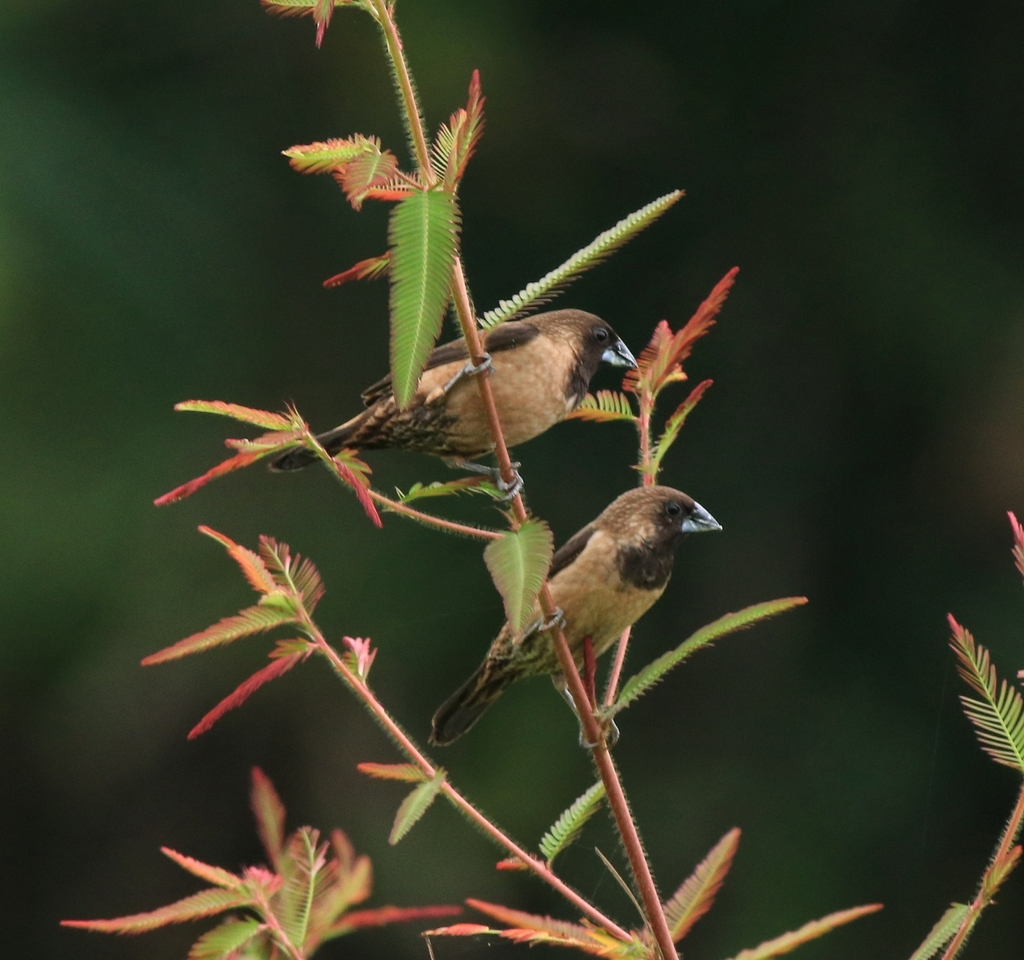
Black-throated Munia
Photo © Afsar Nayakkan
Photo © Afsar Nayakkan — CC BY 4.0 — Source: iNaturalist #185884679Identification
The black-throated munia is a small finch measuring just 12 centimetres in length, characterized by a notably long black tail and stubby grey bill. Three distinct subspecies occur across its range, each with subtle plumage variations that reflect their geographic origin. The southwestern Indian population (L. k. jerdoni) displays dark brown upperparts with pale shaft streaks, a blackish face and bib, and pinkish-brown underparts with scaly markings towards the vent. The Eastern Ghats form (vernayi) is distinguished by paler pinkish underparts, while the nominate Sri Lankan subspecies (L. k. kelaarti) features scaly patterning on the underparts and vent with pale, almost whitish shaft streaks that contrast sharply against the darker back.
The sexes are similar in appearance across all populations, which can make field identification challenging. Immature birds are easier to overlook, as they lack the distinctive darker face marking and display more uniform, less contrasted underparts than adults. This relatively inconspicuous plumage means that careful observation and familiarity with the species' subtle field marks are essential for confident identification in the field.
Range & Habitat
The black-throated munia is a resident breeding bird found in the hills of southwest India, the Western Ghats, Eastern Ghats, and Sri Lanka. As a non-migratory species, populations remain in their respective regions year-round, making them a permanent fixture of the landscapes they inhabit. This restricted range makes them a particularly rewarding species for those exploring the hill stations and montane regions of southern India and Sri Lanka.
The species favours open hill woodland and cultivation, where it can forage freely among crops and natural vegetation. These birds are highly gregarious, typically encountered in flocks rather than as solitary individuals, which can aid in locating them once you are in suitable habitat.
Behaviour & Diet
The black-throated munia is primarily a seed-eater, foraging on the ground and in vegetation for small seeds that constitute the bulk of its diet. Its gregarious nature means that sightings often involve multiple birds feeding together, sometimes creating a distinctive fluttering and chattering presence in open areas.
During the breeding season, pairs construct large, elaborate domed grass nests positioned in trees or among creepers on houses. Clutch sizes vary between populations: birds in India lay between 3 and 8 white eggs, while Sri Lankan birds typically lay five eggs. This breeding behaviour makes the species relatively accessible for observation during the nesting period when birds are tied to specific locations.
Best Time & Places to See It
The breeding season is the most rewarding period for observing black-throated munias, as birds are concentrated near their nest sites and more conspicuous. Hill stations and montane regions of the Western Ghats, Eastern Ghats, and southwest India offer the best opportunities for encountering this species. Sri Lankan hill country, particularly areas with open woodlands and cultivated land interspersed with natural vegetation, is similarly productive.
Photography Tips
The small size and gregarious habits of black-throated munias require patience and a telephoto lens for effective photography. Look for flocking birds in open areas where light is good and backgrounds are uncluttered. Early morning sessions often prove most productive, as birds are active during feeding times. The long tail and subtle plumage details reward close focusing and careful composition to capture the distinctive field marks of each subspecies.
Lunugamvehera National Park
Sri Lanka
+204 birds+14 mammals
Dry scrubland and shallow wetlands converge in Sri Lanka's southeastern lowlands, where Lunugamvehera National Park anchors one of the island's most ecologically vital landscapes. The park's…
VIEW NATIONAL PARKEravikulam National Park
Devikulam, India
+192 birds+7 mammals
High in the Western Ghats of Kerala, where monsoon mists cling to slopes that rise above 2,000 metres, Eravikulam National Park preserves one of South India's…
VIEW NATIONAL PARKPeriyar National Park
Mlappara, India
+232 birds+4 mammals
Dawn breaks over mist-shrouded ridges where the Western Ghats tumble toward Kerala's spice-scented lowlands. Here, ancient tropical forests envelope a glittering artificial lake, creating a mosaic…
VIEW NATIONAL PARKPampadum Shola National Park
Vattavada, India
+258 birds+14 mammals
Where misty shola forests cling to the high plateaus of the Nilgiri Mountains, ancient evergreen remnants create a world apart. This 2,316-hectare reserve protects one of…
VIEW NATIONAL PARKBandipur National Park
Hirehalli, India
+302 birds+19 mammals
Where the Western Ghats descend into the Deccan plateau, ancient deciduous forests blanket a landscape carved by the Nugu River. Bandipur unfolds across 880 square kilometres…
VIEW NATIONAL PARKNagarahole Tiger Reserve
Nalkeri Forest, India
+323 birds+23 mammals
Where granite escarpments rise above dense deciduous forests and the Kabini River carves through pristine wilderness, one of India's most biodiverse landscapes unfolds across the Western…
VIEW NATIONAL PARKNo community photos yet. Log in to add the first one.
No community observations of this species yet.