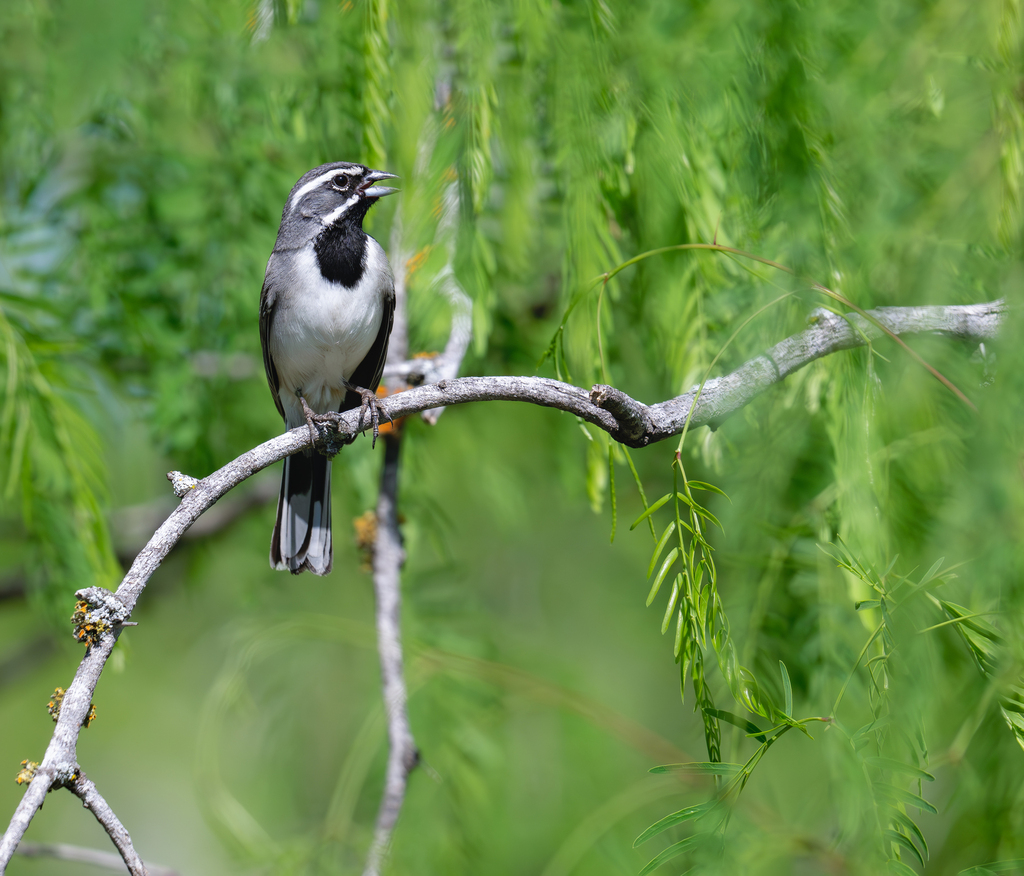
Black-throated Sparrow
Photo © Karen Szafrajda
Photo © Karen Szafrajda — CC BY 4.0 — Source: iNaturalist #236531078Identification
The Black-throated Sparrow is a small sparrow, measuring 12–14 cm in length with a wingspan of about 19.5 cm. Both sexes share identical plumage. The nominate subspecies displays striking field marks: a black forehead and lores, gray crown and nape, and distinctive white supercilium and malar stripes bordered in thin black. The throat and upper breast are deep black, contrasting sharply with white underparts tinged plumbeous on the sides. The back is brownish gray, and the tail is mostly brownish black with white edging on the outer feathers. Dark slate ear coverts and a dark maxilla further distinguish this species. Subspecies vary subtly across the range, with differences in mantle coloration, underpart tones, and tail markings, though all share the characteristic dark grayish iris and bluish gray mandible.
Range & Habitat
The Black-throated Sparrow is found across Mexico and the southwestern United States, with nine recognized subspecies distributed from north-central Texas south through the interior West to central Mexico, and including populations on islands in the Sea of Cortez. The three northernmost subspecies (bilineata, opuntia, and deserticola) are partial migrants, vacating northern breeding areas seasonally, while southern and island populations are year-round residents. The species primarily inhabits dry to arid semi-open landscapes with scattered shrubs and small trees such as mesquite and juniper, including scrublands, thorn bush, canyons, and badlands. During migration and winter, it occasionally ventures into grassy and weedy fields.
Behaviour & Diet
Migratory movements are complex: northern populations winter in the southern portions of their ranges and beyond, while year-round residents in the Southwest may shift to lower elevations during winter months. The Black-throated Sparrow forages primarily by hopping on the ground and gleaning prey. During breeding season, it feeds mainly on insects supplemented by seeds and plant material. In winter, its diet shifts almost entirely to seeds, allowing it to persist in arid regions where other food sources become scarce.
Best Time & Places to See It
The Black-throated Sparrow is present year-round in southeastern California, southern Arizona, southern New Mexico, and Texas, making these regions reliable destinations. Northern populations are present during the breeding season in their respective ranges. Look for this species in dry scrubland and arid semi-open habitats with scattered shrubs. Early morning visits to suitable habitat offer the best opportunities to observe foraging birds before the heat of the day.
Photography Tips
The Black-throated Sparrow's bold facial pattern and contrasting throat make it a rewarding photographic subject. Photograph in early morning or late afternoon light to emphasize the white facial stripes and black markings. Ground-feeding behavior provides excellent opportunities for low-angle compositions. A patient approach is essential, as these birds are often wary. The arid habitats they favor can present challenging lighting; use fill flash or reflectors to illuminate facial details and the distinctive black throat patch that defines this species.
Arches National Park
Bear River Migratory Bird Refuge
Big Bend National Park
Bitter Lake National Wildlife Refuge
Black Canyon of the Gunnison National Park
Bosque del Apache National Wildlife Refuge
Bryce Canyon National Park
Cabeza Prieta National Wildlife Refuge
Canyonlands National Park
Nothing matches these filters.
No community photos yet. Log in to add the first one.
No community observations of this species yet.