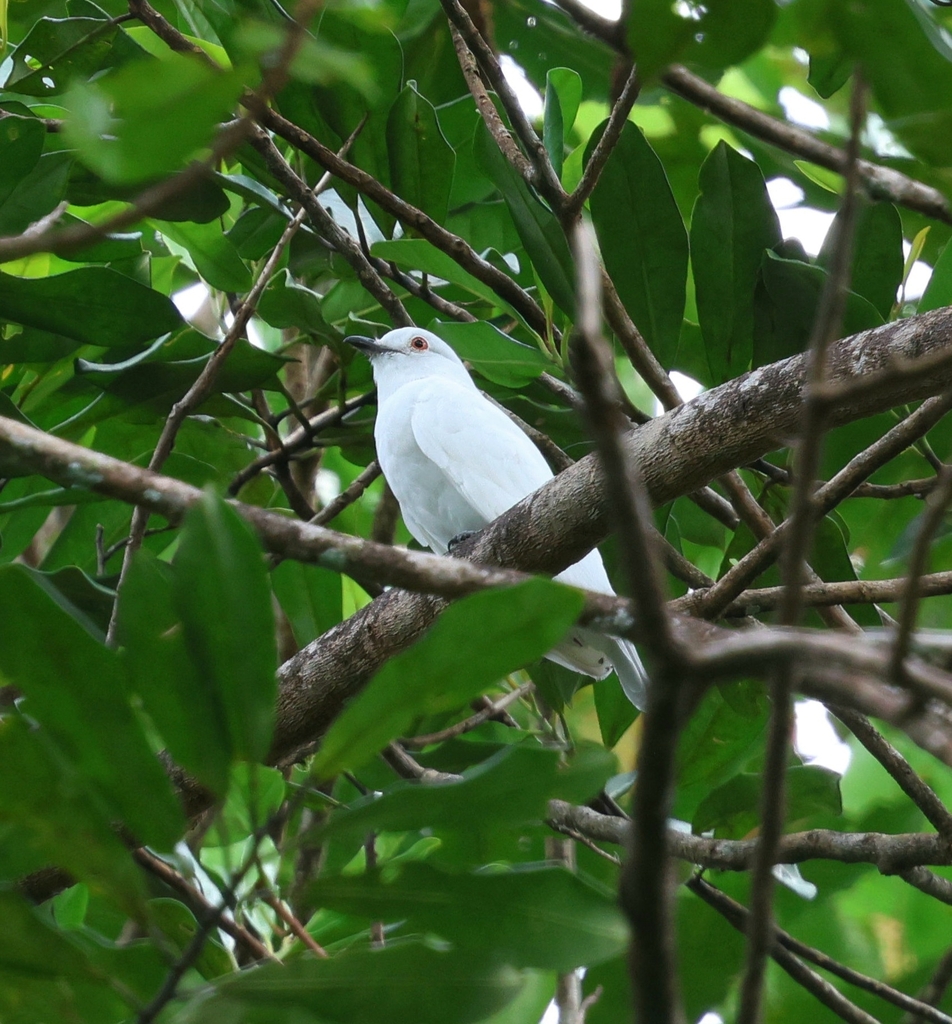
Black-tipped Cotinga
Photo © Miguel
Photo © Miguel — CC BY-SA 4.0 — Source: iNaturalist photo #460554523Identification
The black-tipped cotinga is a small bird, 22–25 cm long, and one of the most strikingly dimorphic cotingas in its range. Adult males are almost entirely white with only a very faint gray tinge on the crown, back, and tail, and small blackish spots on the tips of the outer primaries and innermost tail feathers. Their wide flight feathers have distinctive rounded tips. Adult females are dramatically different: they sport a dark grayish head and upperparts with a blackish tail, mostly blackish wings with white edges on the coverts and inner flight feathers, and a pale gray breast fading to white toward the vent. Females' secondaries are noticeably thinner than males'. Both sexes share an orange to dark red iris, blackish legs and feet, and a distinctive black bill with a wide base, ridged culmen, and a small notch on the tip of the maxilla. Immature birds resemble adult females, while subadult males show nearly adult plumage but retain more dark markings on wing feathers and black tips on most tail feathers.
Range & Habitat
The black-tipped cotinga is found from Darién Province in southeastern Panama south through the lowlands of western Colombia into northwestern Ecuador, reaching as far south as northern Pichincha Province, with scattered sightings further south. It inhabits the canopy of humid tropical forests and occasionally ventures into nearby secondary woodland. Elevationally, the species ranges from sea level to 1,000 m in Panama and 1,200 m in Colombia, though it is found mostly below 500 m in Ecuador.
Behaviour & Diet
The black-tipped cotinga is believed to be a year-round resident, though some seasonal movements are suspected. It feeds primarily on fruits, showing a particular preference for those of Cecropia trees, and sometimes forages in small groups of up to six individuals. Males perform distinctive courtship displays involving very slow wing flaps, though other details of breeding biology remain unknown. Vocalizations are poorly documented; as of 2025, only two recordings of calls exist in scientific audio databases, and no song has been described for the species.
Best Time & Places to See It
Finding black-tipped cotingas requires patience and attention to the forest canopy, where they spend most of their time. The species is considered rare to locally fairly common across its range and occurs in several protected areas. Fruit-bearing Cecropia trees in humid lowland forests are productive search locations. Though believed to be year-round residents, seasonal movements mean timing may affect your chances of encountering this elusive species.
Photography Tips
Photographing black-tipped cotingas presents both challenges and rewards. Males' brilliant white plumage can fool camera meters, so bracket exposures or use spot metering on a midtone reference to avoid overexposure. The species' preference for the high forest canopy demands a telephoto lens of at least 400–600 mm. Early morning often brings birds to lower, more accessible perches as they forage. Females' subtle gray and black plumage is easier to meter but requires patience to locate in dense foliage. The male's slow-flap display flight offers a unique photographic opportunity if you can anticipate breeding displays during appropriate seasons.
Darién National Park
Natural Farallones de Cali National Park
Natural Uramba Bahía Málaga National Park
Natural Utría National Park
Nothing matches these filters.
No community photos yet. Log in to add the first one.
No community observations of this species yet.