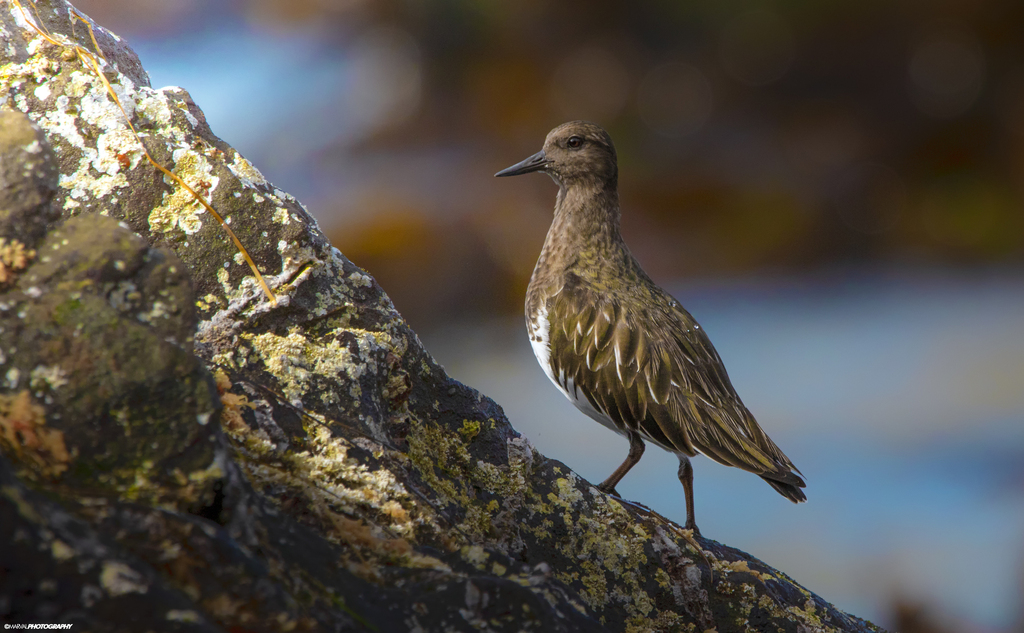
Black Turnstone
Photo © MarvalPhotography19
Photo © MarvalPhotography19 — CC BY 4.0 — Source: iNaturalist photo #609628124Identification
The black turnstone is a small wading bird, measuring 22–25 centimeters in length and weighing 100–170 grams. Its most distinctive feature is its largely black and white plumage, particularly striking in breeding season when adults display a black head and breast contrasted with a white spot between the eye and bill, a white eyebrow stripe, and white flecks on the breast sides. The upper parts are blackish-brown with pale fringes, while the belly and vent are white. In flight, look for a white wingbar, white shoulder patch, and white tail with a broad black band. The slightly upturned bill is black and relatively short at 20–27 millimeters, while the legs and feet are blackish-brown with a reddish tinge.
In winter plumage, the head and breast become largely dark brown with less white, making the bird less strikingly patterned. Juveniles resemble winter adults but appear browner with buff fringes to the wing-coverts and scapulars. The black turnstone is often confused with the ruddy turnstone, but the latter shows rufous-brown markings on the upper parts, more white on the head and breast, and orange legs that are typically brighter than the black turnstone's.
Range & Habitat
This species is native exclusively to the west coast of North America, breeding only in western Alaska from the Alaska Peninsula south to Point Hope, with the bulk of the population nesting in the Yukon–Kuskokwim Delta. The world population is estimated at approximately 95,000 birds. During breeding season, black turnstones nest near the coast, though some populations occur further inland along rivers and lakes, typically in areas with sedges and grasses.
In winter, the species migrates southward along the Pacific coast, ranging from southern Alaska as far as northwestern Mexico, including Baja California and Sonora. During migration, occasional birds appear inland at locations such as the Salton Sea in California and scattered sites across Montana, Wisconsin, Nevada, and Arizona. The species typically winters on rocky shores but also frequents beaches, mudflats, jetties, and breakwaters.
Behaviour & Diet
Black turnstones are named for their foraging behavior: they use their slightly upturned bills to flip over stones, algal mats, and other objects in search of hidden prey. Their diet consists mainly of invertebrates, particularly crustaceans and mollusks in winter and insects during breeding season. They also consume seeds, eggs, and carrion opportunistically. At breeding grounds, they favor wet meadows with sedges.
The species is highly vocal, producing a distinctive rattling trill year-round that is higher and less harsh than that of the similar ruddy turnstone. They also emit loud screeching alarm calls and soft purring vocalizations to chicks. Displaying males produce staccato notes in flight and chirruping trills on the ground. Black turnstones typically arrive at breeding grounds from early May to early June, with males preceding females. They often return to the same territory and pair with the same mate in successive years. Nests are simple scrapes dug mainly by males among sedges, grasses, or under willows, containing four olive or pale greenish eggs with darker spots. Both parents incubate for 21–24 days, and the precocial young can feed themselves shortly after hatching and achieve flight within 25–34 days.
Best Time & Places to See It
Winter is the best season for observing black turnstones outside of Alaska, as they are most accessible along the Pacific coast from southern Alaska to northwestern Mexico. Rocky shores, beaches, and man-made structures like jetties and breakwaters are productive habitats where the birds' feeding behavior can be easily observed. The Salton Sea in southern California offers occasional sightings during migration periods.
For those able to visit Alaska during breeding season (May to June), the Yukon–Kuskokwim Delta hosts the vast majority of the global population. However, breeding birds are less readily accessible than wintering populations, as they occupy coastal and inland wetland habitats that may be remote or difficult to reach.
Photography Tips
Black turnstones are most photogenic in breeding plumage, when their bold black and white patterns are most pronounced. Photograph them in their natural feeding behavior, flipping stones and examining the substrate beneath—this characteristic action makes for compelling images that capture the bird's unique foraging technique. Use longer lenses to avoid disturbance, especially at breeding grounds where birds may be nesting.
Rocky coastal habitats provide excellent opportunities for photography, as the contrasting geology frames the bird's striking plumage well. Winter birds appear duller and less contrasty; focus on breeding-season images for maximum visual impact. Early morning light on rocky shores can produce dramatic photography, highlighting the bird's distinctive white markings against dark rocks and plumage.
Gulf Islands National Park Reserve
Southern Gulf Islands Electoral Area, Canada
+268 birds+26 mammals
Scattered across the Salish Sea in British Columbia's southwestern corner, this national park reserve stitches together a fragmented archipelago of forested islands and rocky outcrops where…
VIEW NATIONAL PARKKenai Fjords National Park
Kenai Peninsula Borough, United States
+164 birds+19 mammals
Granite peaks and tidewater glaciers dominate Alaska's Kenai Peninsula, where nearly 7,900 square kilometers of pristine coastal wilderness descend from the Harding Icefield toward the Gulf…
VIEW NATIONAL PARKKatmai National Park
Lake and Peninsula Borough, United States
+160 birds+19 mammals
Across southwestern Alaska's Lake and Peninsula Borough, nearly 27,000 square kilometers of subarctic wilderness sprawl between volcanic peaks and coastal wetlands, anchored by the confluence of…
VIEW NATIONAL PARKGlacier Bay National Park
Unorganized Borough, United States
+221 birds+15 mammals
Tidewater glaciers calving into fjords of impossible blue, where temperate rainforest rises steeply from the water's edge and alpine peaks pierce the clouds—this is the ecological…
VIEW NATIONAL PARKRedwood National Park
Humboldt County, United States
+343 birds+43 mammals
Where the Pacific fog rolls deep into northern California's coastal valleys, some of the tallest trees on Earth rise from a landscape shaped by tectonic forces…
VIEW NATIONAL PARKOlympic National Park
Jefferson County, United States
+263 birds+35 mammals
Where temperate rainforest meets alpine wilderness, Olympic National Park sprawls across nearly 11,000 square kilometers of the Pacific Northwest's most pristine landscape. The park's three distinct…
VIEW NATIONAL PARKKluane National Park and Reserve
Canada
+171 birds+17 mammals
Where granite peaks thrust through boreal forest to touch the sky, Kluane National Park and Reserve sprawls across southwestern Yukon as one of North America's most…
VIEW NATIONAL PARKGwaii Haanas National Park Reserve and Haida Heritage Site
Area E (Moresby Island), Canada
+98 birds+8 mammals
Where temperate rainforest meets the Pacific's edge, the islands of southern Haida Gwaii rise as one of North America's most pristine coastal wilderness areas. Spanning approximately…
VIEW NATIONAL PARKEl Vizcaíno
Laguna San Ignacio, Mexico
+317 birds+29 mammals
Where the Baja California peninsula thins into a tapestry of salt lagoons and coastal desert, one of Mexico's most biodiverse reserves sprawls across half a million…
VIEW BIOSPHERE RESERVEChannel Islands National Park
Santa Barbara County, United States
+330 birds+15 mammals
A chain of eight volcanic islands rises from the cold Pacific waters off the California coast, their rugged sea cliffs and windswept terrain shaped by millions…
VIEW NATIONAL PARKLake Clark National Park
United States
+158 birds+11 mammals
Where subarctic tundra meets volcanic terrain and pristine waterways, Lake Clark National Park unfolds across southwestern Alaska as a landscape carved by ice age glaciers and…
VIEW NATIONAL PARKKodiak National Wildlife Refuge
United States
+221 birds+22 mammals
Where temperate rainforest meets subarctic coast, Kodiak National Wildlife Refuge sprawls across Alaska's largest island, a sanctuary defined by steep valleys carved by tidewater glaciers and…
VIEW WILDLIFE SANCTUARYKenai National Wildlife Refuge
United States
+152 birds+16 mammals
Across Alaska's Kenai Peninsula, where glacial valleys descend toward the Cook Inlet and the Gulf of Alaska, lies one of North America's most expansive subarctic wildlife…
VIEW WILDLIFE SANCTUARYAlaska Maritime National Wildlife Refuge
Alaska, United States
+391 birds+58 mammals
Where the North Pacific collides with Alaska's rugged coastline, a sprawling archipelago of islands, rocky outcrops, and coastal headlands forms one of North America's most remote…
VIEW WILDLIFE SANCTUARYYukon Delta National Wildlife Refuge
Bethel, United States
+156 birds+12 mammals
Across the Yukon Delta sprawls one of North America's most expansive coastal wetland sanctuaries, where the boreal subarctic climate strips down existence to essentials. This vast…
VIEW WILDLIFE SANCTUARYIzembek National Wildlife Refuge
Cold Bay, United States
+138 birds+9 mammals
Where the Aleutian archipelago reaches westward into the Bering Sea, subarctic tundra and shallow coastal waters converge to create one of Alaska's most ecologically vital wildlife…
VIEW WILDLIFE SANCTUARYBecharof National Wildlife Refuge
United States
+146 birds+2 mammals
Across southwestern Alaska's windswept lowlands, where the Bristol Bay watershed spills into vast tidal flats and sedge marshes, lies one of North America's most pristine subarctic…
VIEW WILDLIFE SANCTUARYDon Edwards San Francisco Bay National Wildlife Refuge
Fremont, United States
+286 birds+20 mammals
Where the San Francisco Bay's shallow margins dissolve into tidal salt marshes and mudflats, this wildlife sanctuary preserves one of California's most ecologically vital estuarine systems.…
VIEW WILDLIFE SANCTUARYFarallon National Wildlife Refuge
San Francisco, United States
+384 birds+16 mammals
Windswept granite peaks rising abruptly from the Pacific, the Farallon Islands form a wildlife sanctuary of extraordinary seabird abundance and ecological significance just twenty-seven miles west…
VIEW WILDLIFE SANCTUARYSalton Sea National Wildlife Refuge
Imperial County, United States
+289 birds+4 mammals
Across the floor of California's inland desert, where summer temperatures soar and rainfall is measured in tenths of inches, lies an improbable oasis of shallow water…
VIEW WILDLIFE SANCTUARYNo community photos yet. Log in to add the first one.
No community observations of this species yet.