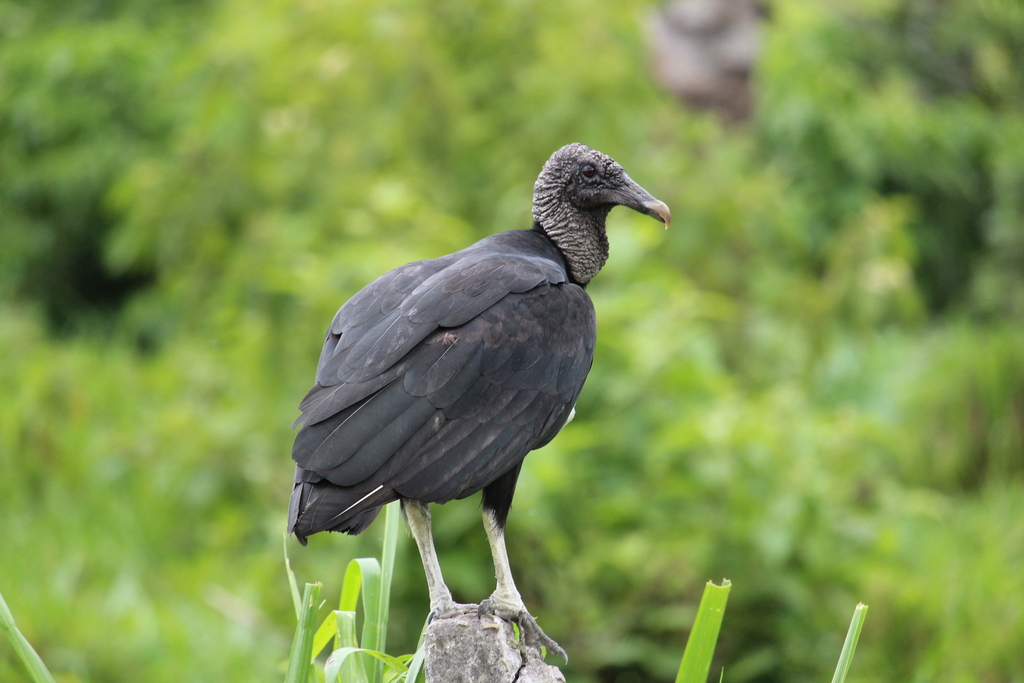
Black Vulture
Photo © Ricard Busquets Reverte
Photo © Ricard Busquets Reverte — CC BY 4.0 — Source: iNaturalist photo #158143837Identification
The black vulture is an imposing bird with a wingspan of 1.5 m (4.9 ft), though relatively small for a vulture. It is immediately recognizable by its entirely black plumage, featherless grayish-black head and neck, and short, hooked beak. These features are all evolutionary adaptations to its scavenging lifestyle: the black plumage stays visibly cleaner than lighter-colored birds, the bare head allows easy access when feeding inside animal carcasses, and the hooked beak is perfectly designed for stripping meat from bones. The absence of head feathers also helps the birds remain largely free of blood and bodily fluids that could attract parasites—a critical advantage for a carrion-feeder.
Range & Habitat
The black vulture's range extends from the southeastern United States to Peru, central Chile, and Uruguay in South America, with particularly common populations throughout Brazil where they are frequently seen in large scavenging groups. Although widespread and common, it has a somewhat more restricted distribution than the turkey vulture, which breeds well into Canada and extends all the way to Tierra del Fuego. The species prefers relatively open areas with scattered trees, such as chaparral, as well as subtropical forested areas and parts of the Brazilian pantanal—habitats that facilitate locating animal corpses, their primary food source.
Behaviour & Diet
Black vultures are obligate scavengers, feeding primarily on carrion, though they occasionally consume eggs, small reptiles, or newborn small animals such as rodents or rabbits. They will also opportunistically prey on extremely weakened, sick, elderly, or otherwise vulnerable animals. In human-populated areas, they readily scavenge at waste disposal sites such as garbage dumps. These vultures locate food using keen eyesight or by following other vultures, particularly those of the Cathartes genus which possess a keen sense of smell. Lacking a syrinx—the vocal organ of birds—their only vocalizations are grunts or low hisses.
Black vultures lay their eggs in caves, cliffside rock crevasses, dead and hollow trees, or on bare ground in the absence of predators, generally raising two chicks each year. Parents feed their young by regurgitation of crop milk. Most vultures bathe after eating when water is available, whether from natural sources such as streams or man-made sources like livestock water tanks.
Best Time & Places to See It
Black vultures are common and widespread throughout their range, making them accessible to travelers across much of Central and South America and the southeastern United States. They are particularly abundant in Brazil, where they can be observed in large scavenging groups. Look for them in open habitats with scattered trees and in subtropical forested areas. Their year-round presence in many regions means there is no specific seasonal window required for viewing, though patience and attention to open areas where carrion may attract multiple birds will increase your chances of observation.
Photography Tips
The black vulture's distinctive silhouette and contrasting bare head make it a compelling photographic subject. The 1.5 m wingspan provides ample opportunity for impressive flight photography, particularly when birds are soaring in groups. The bare, grayish-black head and neck offer striking detail shots, especially in strong side-lighting that emphasizes the texture and coloration. Photographing multiple birds together—common in areas with concentrated food sources—allows for dynamic composition showing their gregarious behavior. Early morning or late afternoon light will best render the subtle tones of the head and neck against the bird's black plumage.
Acadia National Park
Alerce Costero National Park
Alligator River National Wildlife Refuge
Amacayacu National Park
Amazônia National Park
Anavilhanas National Park
Antisana National Park
Araucárias National Park
Arenal Volcano National Park
Nothing matches these filters.
No community photos yet. Log in to add the first one.
No community observations of this species yet.