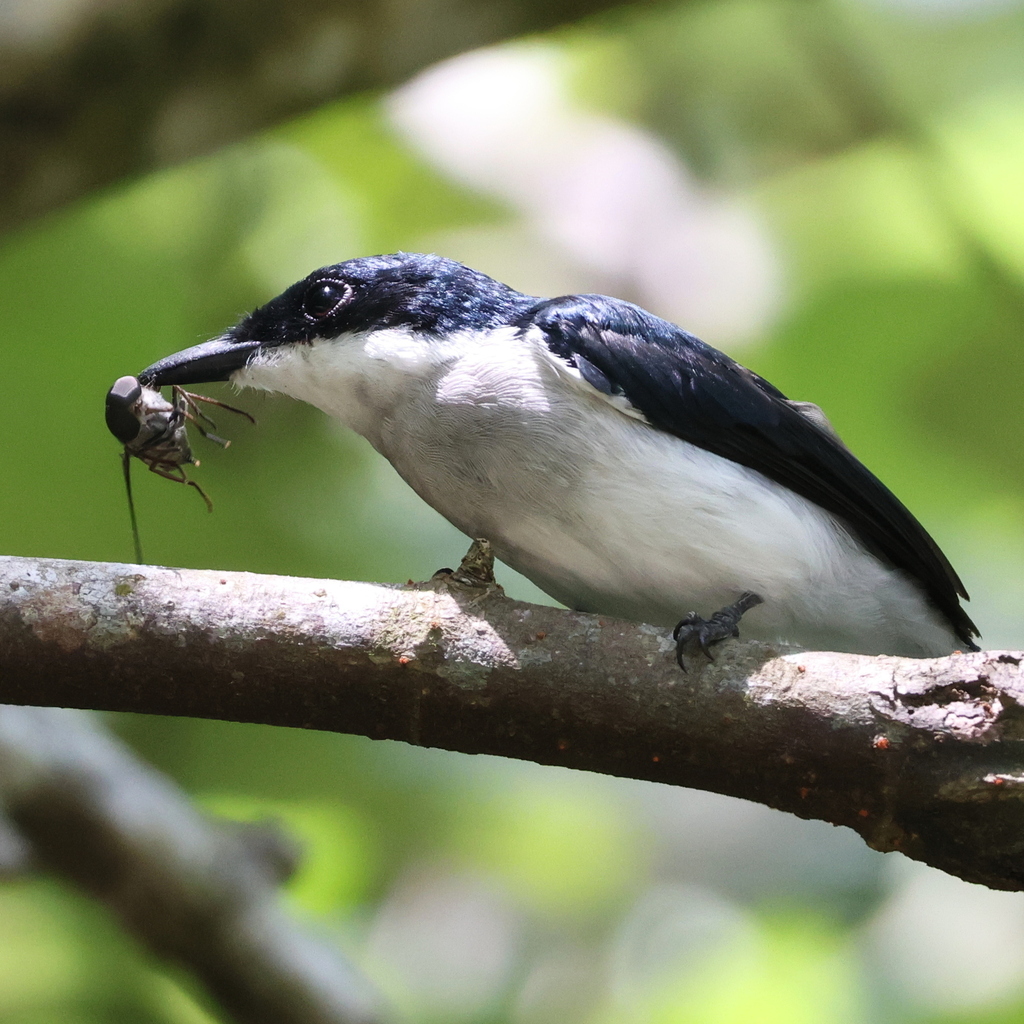
Black-winged Flycatcher-shrike
Photo © Huey
Photo © Huey — CC BY 4.0 — Source: iNaturalist #322059561Identification
The black-winged flycatcher-shrike is a small bird, about 15 cm (5.9 in) long, with striking sexual dimorphism. Males are distinctive, with a black head and upperparts displaying a subtle green sheen, a black tail, and a barred black-and-white rump. The face pattern is elegant: a white chin and upper throat contrasting with gull-grey lower throat and breast, while the belly remains white. Dark grey leg feathers, dark brown eyes, and black beak and feet complete the male's appearance. Females are noticeably duller, with sooty-brown upperparts replacing the male's glossy black. Juvenile birds show sooty-brown plumage with buff fringes and a brownish-black beak, making them readily distinguishable from adults in the field.
Range & Habitat
This species is endemic to Southeast Asia, ranging from the Malay Peninsula through Sumatra, Borneo, Java, and Bali. It inhabits lowland forests and forest edges below 800 m (2,600 ft) elevation, with populations most abundant below 300 m (980 ft), typically at lower altitudes than its congener, the bar-winged flycatcher-shrike. The black-winged flycatcher-shrike favors the canopy of lowland forests, forest roads, and streams, and occasionally ventures into swamps, mangroves, and secondary forest habitats.
Behaviour & Diet
This adroit insectivore gleans insects from the undersides of leaves and catches prey in flight, typically from exposed perches that offer good vantage points. Birds are usually encountered in pairs but may occur singly, in small parties, or within mixed-species foraging flocks. The species is vocal, producing a distinctive wirrawik call, a sharp chisi-wik, and a high-pitched song rendered as twee wi-wi-wi-wi. Breeding occurs from February to July, with pairs constructing cone-shaped nests attached to branches using cobweb. Males collect materials—bark, lichen, fibers, and cobweb—while females mold the nest by pressing against it, creating remarkably camouflaged structures. Eggs are white with dark brown spotting. Molt takes place from May through at least August, with primary feathers replaced sequentially from the innermost outward.
Best Time & Places to See It
Travelers seeking this species should focus on lowland forest habitats throughout its range in Malaysia, Brunei, and the Indonesian islands of Sumatra, Borneo, Java, and Bali, keeping below 300 m elevation for the best chances of encounter. The breeding season, from February to July, is an excellent time to observe birds as they are more active and vocal. The species' preference for canopy and forest-edge habitats means patient scanning of the mid to upper levels of forest vegetation, particularly around fruiting and flowering trees that attract insect prey, will yield the best results.
Photography Tips
Photographing black-winged flycatcher-shrikes requires patience and attention to their foraging behavior. Position yourself where you can observe exposed perches, as birds regularly use these vantage points to spot and pursue aerial prey. The male's striking black and white plumage and the subtle green sheen of the head provide excellent photographic contrast, while the barred rump is a distinctive field mark worth capturing. Early morning light will enhance the glossy quality of male plumage. Since birds are often found in pairs and mixed-species flocks, multiple subjects may present opportunities for dynamic compositions.
Bako National Park
Kuching, Malaysia
+210 birds+17 mammals
Weathered sandstone cliffs rise dramatically from the South China Sea, their ochre faces sculpted by millennia of wind and tide into a landscape of extraordinary geological…
VIEW NATIONAL PARKKuching Wetlands National Park
Kuching, Malaysia
+103 birds+4 mammals
Where brackish waters meet mangrove stilts and freshwater swamps blend into coastal mudflats, one of Southeast Asia's most dynamic wetland ecosystems unfolds across Sarawak's northwestern coast.…
VIEW NATIONAL PARKTaman Negara National Park
Kampong Samas, Malaysia
+393 birds+48 mammals
Where ancient rainforest meets limestone peaks, one of Southeast Asia's oldest protected wilderness preserves sprawls across 4,343 square kilometers of primordial landscape. Dipterocarp giants tower overhead,…
VIEW NATIONAL PARKTaman Negara Bukit Lambir National Park
Miri, Malaysia
+153 birds+7 mammals
Rainforest cascades down sandstone ridges where crystal streams carve through ancient geology, creating a landscape of profound biological richness in Sarawak's interior. This 68-square-kilometre sanctuary protects…
VIEW NATIONAL PARKGunung Mulu National Park
Long Seridan, Malaysia
+280 birds+39 mammals
Where granite monoliths pierce the rainforest canopy of Sarawak, an ancient limestone karst landscape reveals one of Southeast Asia's most biodiverse strongholds. Soaring peaks cloaked in…
VIEW NATIONAL PARKTaman Nasional Baluran
Situbondo, Indonesia
+189 birds+9 mammals
Across the northeastern tip of East Java, where monsoon winds sweep down from the Bali Strait, a landscape of contrasts unfolds within 374 square kilometres of…
VIEW NATIONAL PARKTaman Nasional Meru Betiri
Jember, Indonesia
+93 birds+1 mammals
Across East Java's southeastern coast, where the Indian Ocean meets a landscape of volcanic soils and monsoon-fed forests, sprawls a national park that epitomizes the ecological…
VIEW NATIONAL PARKWest Bali National Park
Gerokgak, Indonesia
+240 birds+8 mammals
Across West Bali's northwestern reaches, where the Indian Ocean meets volcanic slopes and limestone cliffs plunge toward turquoise shallows, sprawls a protected realm of roughly 325…
VIEW NATIONAL PARKGunung Ciremai National Park
Majalengka, Indonesia
+116 birds+1 mammals
Volcanic slopes rise sharply from West Java's interior, where Gunung Ciremai's 3,078-metre summit dominates a landscape carved by geological upheaval and shaped by equatorial monsoon rainfall.…
VIEW NATIONAL PARKGunung Merbabu National Park
Magelang, Indonesia
+61 birds+2 mammals
Where volcanic slopes rise sharply from the plateau of Central Java, Gunung Merbabu National Park encompasses nearly 200 square kilometers of montane forest that transitions through…
VIEW NATIONAL PARKMount Merapi National Park
Hargobinangun, Indonesia
+150 birds+3 mammals
Where the volcanic slopes of central Java rise into mist and montane forest, Mount Merapi National Park guards one of Indonesia's most dynamic landscapes. Spanning roughly…
VIEW NATIONAL PARKKerinci Seblat National Park
Kerinci, Indonesia
+228 birds+16 mammals
Across nearly 67,000 square kilometres of Sumatra's spine, a mountainous realm of equatorial rainforest rises from steaming lowlands to volcanic peaks shrouded in cloud. Kerinci Seblat…
VIEW NATIONAL PARKWay Kambas National Park
Lampung Timur, Indonesia
+237 birds+20 mammals
Across the low swamplands of eastern Lampung, where freshwater wetlands merge into tidal mangrove forests along the Sunda Strait, sprawls one of Sumatra's most vital sanctuaries.…
VIEW NATIONAL PARKNo community photos yet. Log in to add the first one.
No community observations of this species yet.