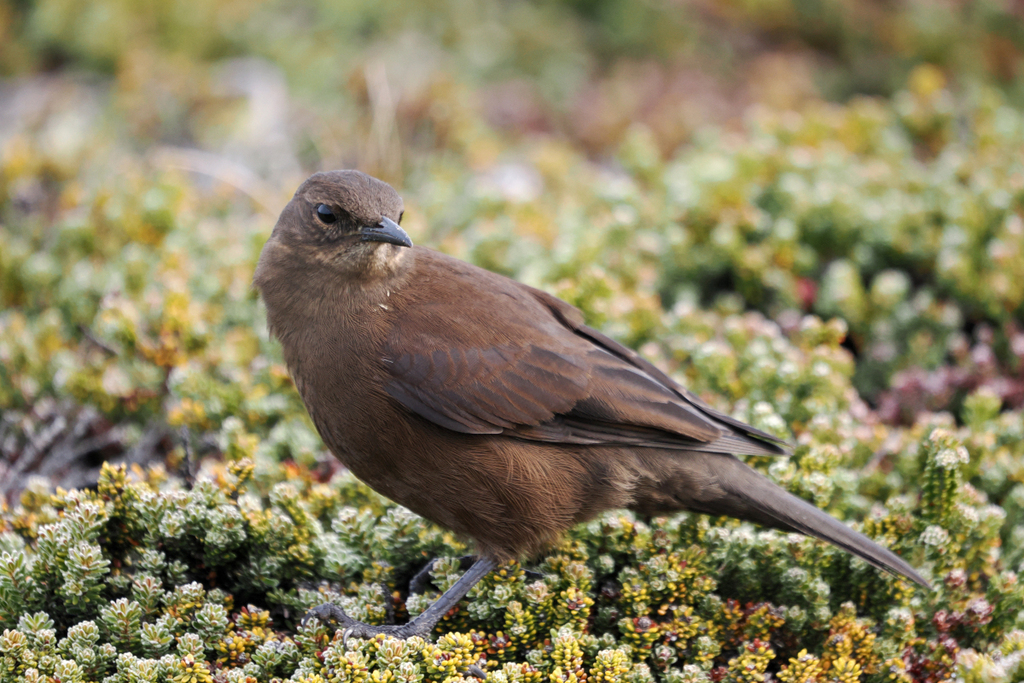
Blackish Cinclodes
Photo © steve b
Photo © steve b — CC0 1.0 — Source: iNaturalist photo #260321849Identification
The blackish cinclodes is a small passerine, measuring 18 to 23 cm in length and weighing approximately 63 grams. Adults of the nominate subspecies are mostly dark sooty brown with a slightly paler throat and some dull rufous visible on the base of the flight feathers, usually only apparent in flight. The bird has a dark brown iris, blackish bill, and blackish legs and feet. Juveniles are generally browner than adults. The subspecies C. a. maculirostris is slightly larger with a shorter bill and longer tail, appearing blacker overall with a visibly yellowish base to its bill and lacking the rufous wing markings of the nominate subspecies.
Range & Habitat
The nominate subspecies is found on the Falkland Islands, where surveys through the late 1990s recorded them on 40 of 59 islands studied. Subspecies C. a. maculirostris inhabits southernmost mainland Chile, both Chilean and Argentine Tierra del Fuego, and other islands in the Cape Horn Archipelago. The blackish cinclodes is primarily coastal, though it ranges as far inland as 0.5 km. The species favors landscapes of short grass and tussock grass, and is common around human habitations, typically found on rocky beaches near colonies of marine mammals and seabirds. Elevations range from sea level to approximately 200 meters.
Behaviour & Diet
This species is a year-round resident throughout its range and is remarkably tame, often approaching humans and their habitations, particularly in the Falklands. The blackish cinclodes feeds mainly on small invertebrates including amphipods, isopods, flies, and orthopterans. Around seabird colonies, it consumes cracked eggs, scraps, and regurgitated matter, and has been documented feeding at wounds on southern elephant seals. The bird gleans and probes for prey on beaches, particularly in kelp, leaps to capture flies in mid-air, and will follow humans to catch disturbed prey. It may also enter houses to take food crumbs.
Breeding occurs from September to January, with two broods often raised. Both subspecies nest in tunnels in earthen banks or rock crevices, lining the nest chamber with grass and feathers. The nominate subspecies also nests in abandoned seabird burrows and under buildings. Clutch size is two or three eggs, with an incubation period of about 16 days and fledging occurring approximately 25 days after hatching. Both adults care for the young.
Best Time & Places to See It
The blackish cinclodes can be seen year-round throughout its range. The Falkland Islands provide the most accessible viewing opportunities, particularly on the 40 islands where the nominate subspecies has been recorded. Look for this species on rocky beaches, grassy areas dominated by tussock grass, and near human settlements where it is particularly tame. Areas cleared of introduced predators show more stable populations. In Tierra del Fuego and the Cape Horn Archipelago, the darker C. a. maculirostris subspecies can be found in similar coastal habitats.
Photography Tips
The blackish cinclodes' habituation to humans, especially in the Falklands, makes it relatively approachable for photography. Focus on capturing the bird in flight to reveal the dull rufous on the flight feathers of the nominate subspecies, or showcase its characteristic behavior of gleaning on beaches and rocky shores. Photographing the species near seabird colonies or engaging in its characteristic habit of following humans along beaches offers compelling behavioral shots. The bird's occasional flight display ending in a dive to the ground provides dynamic photo opportunities. Best light is typically during morning hours when the bird is most active, though its dark plumage requires careful exposure metering to preserve detail.
Sea Lion Island
Sealion Island Settlement, Falkland Islands
+74 birds+3 mammals
Windswept tussock grasslands roll across volcanic terrain where Southern Ocean swells crash against rocky shores, creating one of the Falkland Islands' most dramatic wildlife theatres. This…
VIEW ISLAND & ARCHIPELAGOKidney Island
Stanley, Falkland Islands
+47 birds
Wind-scoured tussock grassland sweeps across this remote South Atlantic outcrop, where peaty soils and exposed rock formations create a landscape as austere as it is vital.…
VIEW ISLAND & ARCHIPELAGOMurrell Farm
falskland islands, Falkland Islands
+54 birds
Rolling grasslands sweep across windswept plateaux where the South Atlantic exerts its relentless influence on the vegetation, sculpting tussock grassland into a tapestry of browns and…
VIEW NATURE RESERVECape Dolphin
falskland islands, Falkland Islands
+54 birds+1 mammals
Where windswept grasslands meet dramatic coastal cliffs, the Falkland Islands' northern reaches reveal one of the Southern Hemisphere's most compelling seabird sanctuaries. The terrain here is…
VIEW NATURE RESERVEVolunteer Point
Stanley, Falkland Islands
+70 birds+3 mammals
Windswept grasslands meet volcanic black sand beaches where three penguin species converge in the South Atlantic's most theatrical wildlife theatre. This remote peninsula on East Falkland…
VIEW NATURE RESERVEWest Point Island
West Point, Falkland Islands
+67 birds+3 mammals
Windswept cliffs plunge dramatically into the South Atlantic, their rust-coloured rock faces sculpted by millennia of gales and spray. This northwestern outpost of the Falkland Islands…
VIEW ISLAND & ARCHIPELAGOCabo de Hornos National Park
Cape Horn, Chile
+88 birds+9 mammals
Where the Andes plunge into the Southern Ocean and the Drake Passage churns between two continents, Cabo de Hornos National Park sprawls across one of Earth's…
VIEW NATIONAL PARKNo community photos yet. Log in to add the first one.
No community observations of this species yet.