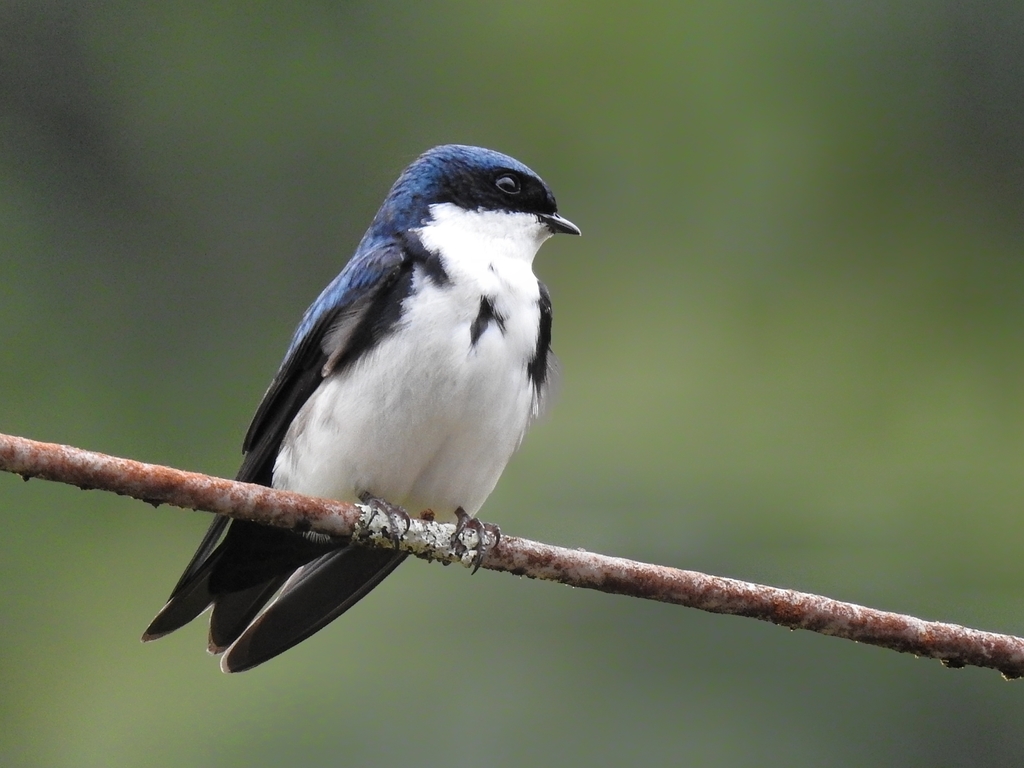
Blue-and-white Swallow
Photo © Esteban Poveda
Photo © Esteban Poveda — CC BY 4.0 — Source: iNaturalist photo #141009853Identification
The blue-and-white swallow is a small passerine, measuring 11–12 cm in length and weighing about 10 g. Adults are unmistakable, with dark blue upperparts contrasting sharply against clean white underparts. The underwings and undersurface of the short forked tail are blackish. In flight, the characteristically fluttery wingbeats and forked tail are diagnostic. Juveniles are duller, with brown upperparts and buff-tinged underparts, and can be distinguished from adults by their less deeply forked tail. The bird's call is a distinctive buzzing dzzzhreeee. Three subspecies are recognized across the range; the southern race is notably larger at 13.5 cm with paler underwings and white basal undertail coverts.
Range & Habitat
This species breeds from Nicaragua south throughout South America, except in the Amazon Basin and desert regions. The southern race is migratory, wintering as far north as Trinidad. The blue-and-white swallow is a bird of open areas, including villages, towns, farms, and forest clearings. In Central America it is primarily a highland species, but across the rest of its range it occupies lowlands up to altitudes of 4,000 m.
Behaviour & Diet
Outside the breeding season, this swallow is often seen in small flocks. It subsists almost entirely on insects caught in flight, and has been observed gathering where termites swarm. The characteristic fluttery flight and frequent perching on wires and branches make it easy to locate and observe. Blue-and-white swallows nest in shallow straw structures built by both adults in a wide variety of natural and man-made cavities: tree holes, rock crevices, and bridges are all utilized. Clutch sizes vary geographically, with up to six eggs in the south and two to three in the north. Both parents incubate for 15 days and feed nestlings for 26 days until fledging, though young birds may return to sleep in the nest for up to two months afterward. Two broods may be raised per season.
Best Time & Places to See It
The blue-and-white swallow is a common and widespread species throughout its range. The southern migratory populations are regular visitors to Trinidad during the winter months. The species has benefited from deforestation and human settlement, making it increasingly abundant in towns, villages, and agricultural areas. Look for them hawking insects over open ground, perched on telephone wires, or gathering above termite swarms, particularly during daylight hours when insect activity is high.
Photography Tips
The blue-and-white swallow's contrasting plumage and small size present both opportunities and challenges for photographers. Position yourself near known perching sites—telephone wires and fence posts are favored—where you can photograph perched birds in good light. Early morning and late afternoon often provide the best lighting for capturing the iridescent blue of the upperparts. In-flight shots require fast shutter speeds (1/2000 s or faster) to freeze the bird's rapid wingbeats. When photographing at nesting sites, exercise caution to avoid disturbing breeding birds, and use longer focal lengths to maintain distance from cavities in trees, bridges, and buildings.
Amacayacu National Park
Antisana National Park
Araucárias National Park
Arenal Volcano National Park
Bahuaja Sonene National Park
Barbilla National Park
Barra del Colorado National Wildlife Refuge
Baru Volcano National Park
Brasília National Park
Nothing matches these filters.
No community photos yet. Log in to add the first one.
No community observations of this species yet.