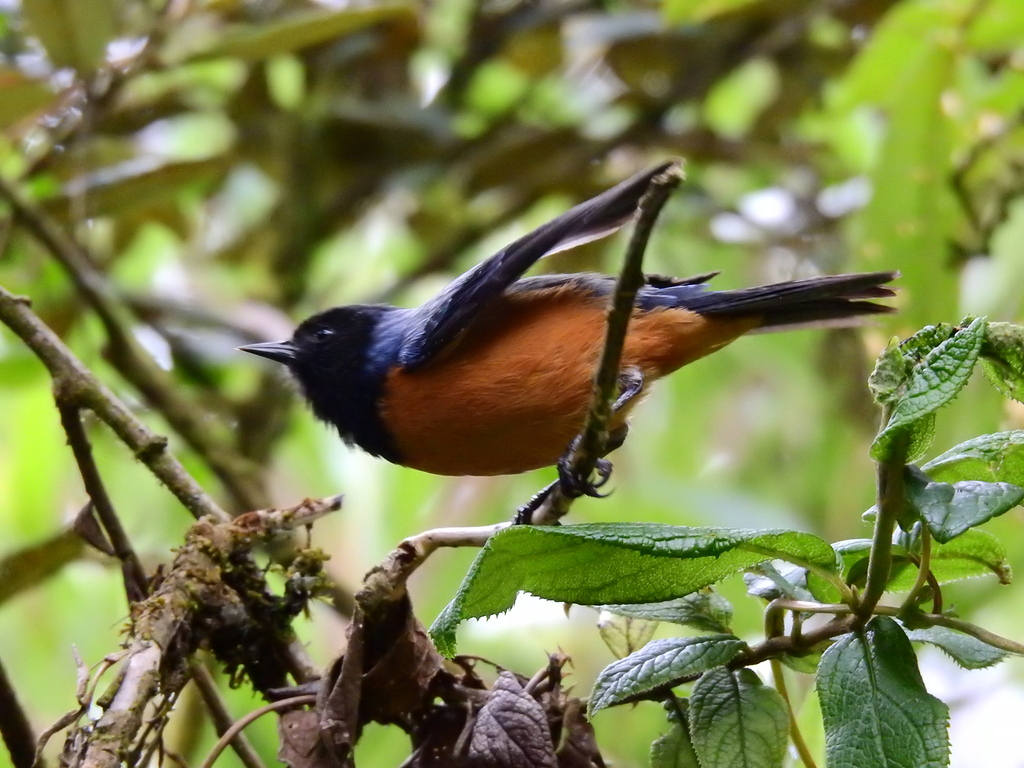
Blue-backed Conebill
Photo © Esteban Poveda
Photo © Esteban Poveda — CC BY 4.0 — Source: iNaturalist photo #354193577Identification
The blue-backed conebill is a small bird weighing 11–13 grams, instantly recognizable by its distinctive plumage combination: a bright blue back, rump, and tail contrasting sharply with black markings on the head and an orange underside. Three subspecies show subtle but diagnostic differences. The nominate subspecies (C. s. sitticolor) displays a fully black head and throat with black wings. C. s. cyaneum features a black face with a striking blue post-ocular stripe and blue wings, while C. s. intermedium presents an intermediate appearance with a black face and crown, a shorter blue post-ocular stripe, and black wings. All subspecies share the characteristic conical bill adapted for gleaning insects.
Range & Habitat
This species inhabits subtropical and tropical moist montane forests along the Andes range from northern to central South America. It occurs across five countries: Colombia, Ecuador, Peru, Venezuela, and Bolivia. The species ranges from Cerro Pintado on the Colombia-Venezuela border northward through various Andean ranges including the Cordillera de Mérida, Sierra de Perijá, and the Central and Eastern Ranges of the Colombian Andes, extending south through Ecuador's La Sierra region and along both the western and eastern slopes of the Peruvian Andes into Bolivia, with its southern limit in Cochabamba Department.
Behaviour & Diet
The blue-backed conebill is an insectivore, actively foraging for small insects in tree canopies. It is highly social, regularly joining mixed-species feeding flocks alongside other insectivores such as the pearled treerunner, streaked tuftedcheek, grey-hooded bush tanager, and black-headed hemispingus. Within these flocks, it shows a particular preference for associating with other conebill species, notably the rufous-browed conebill, white-browed conebill, and capped conebill. Its breeding and nesting habits remain almost entirely unstudied, presenting an intriguing opportunity for field researchers.
Best Time & Places to See It
Look for the blue-backed conebill in montane forests at appropriate elevations throughout its Andean range. In Venezuela, search the Cordillera de Mérida and Sierra de Perijá; in Colombia, the Central and Eastern Ranges; in Ecuador, the La Sierra region; and in Peru and Bolivia, the eastern slopes of the Andes. The best strategy is to locate mixed-species feeding flocks in the canopy, as these birds are often found in such associations rather than in isolation. Patient observation of fruiting or flowering trees in montane forest habitat increases your chances of encounters.
Photography Tips
The blue-backed conebill's compact size and canopy-dwelling habits present challenges for photographers. The striking contrast between its blue upperparts and orange underside offers excellent compositional opportunities when you obtain a clear view. Use a telephoto lens to reach birds in the canopy, and position yourself to capture the distinctive head markings and vibrant coloration. Early morning light in montane forests can beautifully illuminate the blue plumage. Since the bird frequents mixed-species flocks, patience and careful scanning of canopy level will reward you with opportunities to photograph this jewel of Andean forests.
Sangay National Park
Cebadas, Ecuador
+320 birds+10 mammals
High in Ecuador's Andean spine, where the Western Cordillera rises to touch perpetual snow, a landscape of volcanic drama and ecological intensity unfolds across Sangay National…
VIEW NATIONAL PARKPodocarpus National Park
Zamora, Ecuador
+496 birds+6 mammals
Where the Andes descend toward the Amazon basin, Podocarpus National Park sprawls across nearly 2,800 square kilometres of the most biodiverse terrain in Ecuador's southern highlands.…
VIEW NATIONAL PARKYacuri National Park
Las Juntas, Ecuador
+166 birds+1 mammals
Where the eastern slopes of the Andes descend into Ecuador's southern frontier, Yacuri National Park unfolds across nearly 1,300 square kilometers of montane cloud forest and…
VIEW NATIONAL PARKSumaco Napo-Galeras National Park
Loreto, Ecuador
+563 birds+4 mammals
Where Ecuador's Amazon transitions into cloud forest, a massive shield volcano rises from the emerald lowlands of Orellana Province, anchoring one of the continent's most biodiverse…
VIEW NATIONAL PARKAntisana National Park
Quijos, Ecuador
+432 birds+21 mammals
Where the eastern Andean slopes descend into the Amazon basin, Antisana National Park sprawls across roughly 2,500 square kilometers of some of South America's most dramatic…
VIEW NATIONAL PARKCotopaxi National Park
Mulaló, Ecuador
+211 birds+6 mammals
High in Ecuador's volcanic corridor, where the páramo transitions into cloud forest along the slopes of Cotopaxi volcano, the national park unfolds across nearly 500 square…
VIEW NATIONAL PARKCajas National Park
Cuenca, Ecuador
+190 birds+7 mammals
High in the Andes above Cuenca, where elevation ranges from 3,100 to 4,200 metres, the páramo landscape dominates—a windswept realm of cushion plants, alpine grasses, and…
VIEW NATIONAL PARKNatural Munchique National Park
El Tambo, Colombia
+194 birds
Where the Western Cordillera rises steeply from the Pacific plains of southwestern Colombia, Natural Munchique National Park sprawls across 1,078 square kilometers of montane forest that…
VIEW NATIONAL PARKNatural Farallones de Cali National Park
Buenaventura, Colombia
+733 birds+27 mammals
Where the Pacific coastal plain meets the western slopes of the Andes, Farallones de Cali National Park sprawls across nearly 3,500 square kilometers of dramatic topography…
VIEW NATIONAL PARKNatural Chingaza National Park
Junín, Colombia
+285 birds+6 mammals
Where the Andes rise above three thousand metres in the Cundinamarca region, high-altitude grasslands and cloud forests converge in a landscape shaped by both geology and…
VIEW NATIONAL PARKPuracé National Natural Park
Puracé, Colombia
+327 birds+2 mammals
Where the Andes thrust upward across southwestern Colombia, Puracé National Natural Park spans nearly 2,631 square kilometers of some of South America's most dramatic montane terrain.…
VIEW NATIONAL PARKNatural Sumapaz National Park
Cubarral, Colombia
+368 birds+1 mammals
Where the Andes descend toward the Amazon basin, the high páramo grasslands of Sumapaz National Park sprawl across more than five thousand square kilometers of Meta…
VIEW NATIONAL PARKEl Tamá National Park
Toledo, Colombia
+435 birds
Where the Andes descend toward the Caribbean coastal lowlands of northern Colombia, El Tamá National Park sprawls across nearly 3,800 square kilometres of montane forest, cloud…
VIEW NATIONAL PARKNatural Nevado del Huila National Park
Planadas, Colombia
+117 birds
Where the Colombian Andes rise above 5,000 metres, tropical cloud forest yields to páramo and glaciated peaks, and the Planadas region of Tolima contains one of…
VIEW NATIONAL PARKYanachaga–chemillén National Park
Palcazu, Peru
+639 birds+6 mammals
Where the eastern slopes of Peru's central cordillera plunge into cloud forest, Yanachaga–Chemillén National Park protects nearly three thousand square kilometres of montane wilderness that few…
VIEW NATIONAL PARKManu National Park
Manu, Peru
+892 birds+26 mammals
Across the eastern slopes of the Peruvian Andes, tropical rainforest descends into the Amazon basin with a complexity that few terrestrial ecosystems match. Manu National Park…
VIEW NATIONAL PARKNo community photos yet. Log in to add the first one.
No community observations of this species yet.