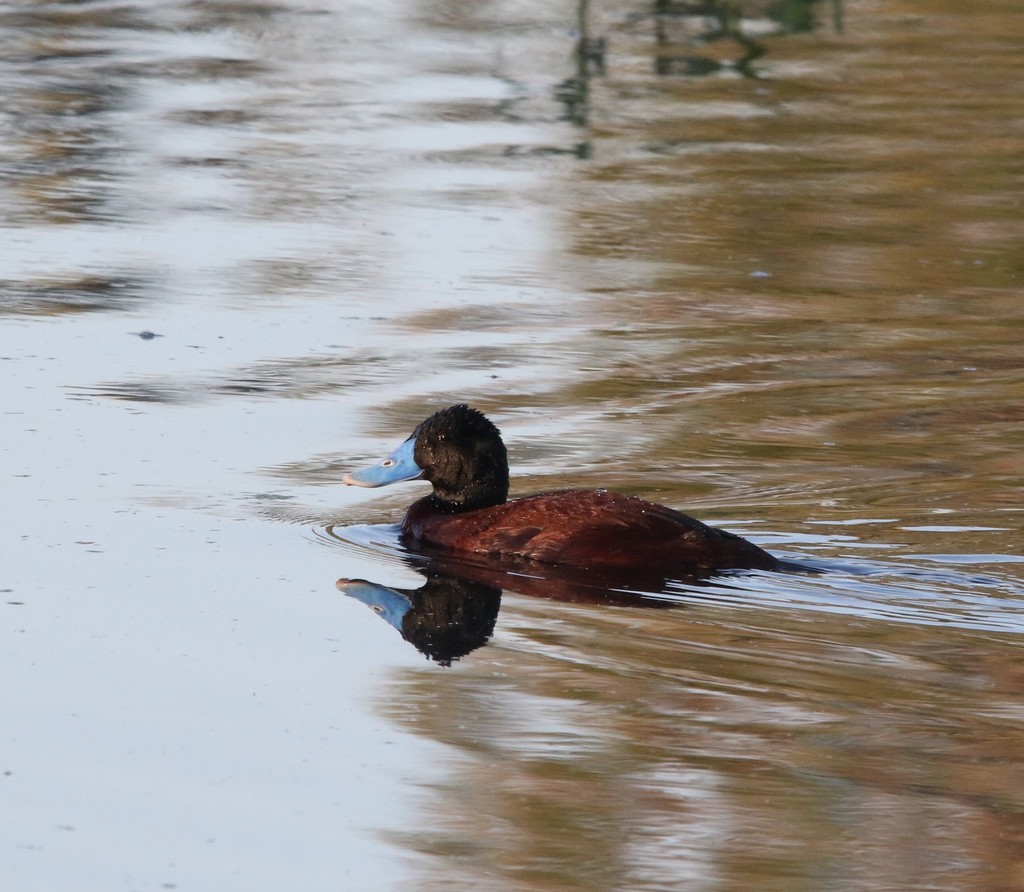
Blue-billed Duck
Photo © Greg Tasney
Photo © Greg Tasney — CC BY-SA 4.0 — Source: iNaturalist #94549794Identification
The blue-billed duck is a small Australian waterfowl measuring 40 cm in length. The most distinctive feature is the male's slate-blue bill, which transforms to a bright blue during breeding season—the origin of the species' common name. During breeding season, males display deep chestnut plumage on their back and wings, with a glossy black head and neck. Outside the breeding season, males revert to dark grey with a black head speckled with grey, though some individuals retain breeding plumage year-round. Females maintain consistent black plumage with brown-tipped feathers throughout the year, creating a mottled appearance, along with a dark grey-brown bill.
Both sexes have distinctive spine-like tail feathers and powerful feet adapted for swimming and diving. The birds sit notably low in the water compared to other ducks. Juveniles resemble adult females but appear paler with a grey-green bill. Both males and females have brown irises, while males have grey feet and females have grey-brown feet.
Range & Habitat
Endemic to Australia's temperate regions, the blue-billed duck's range extends from southern Queensland through New South Wales and Victoria to Tasmania, and is widespread in southwestern Western Australia. The species reaches its greatest abundance in the Murray-Darling basin and rarely appears on the New South Wales coastline except during droughts. These birds are almost entirely aquatic and demonstrate remarkable difficulty walking on land, exhibiting a penguin-like gait.
During non-breeding season, blue-billed ducks gather in flocks of several hundred on open lakes and dams in autumn and winter, preferring areas far from shore. During breeding season, they favor deep, freshwater swamps with dense vegetation, particularly cumbungi (Typha species). They occasionally inhabit lignum swamps in coastal areas during drier seasons and have been found in large rivers and saline waterbodies such as billabongs.
Behaviour & Diet
Blue-billed ducks exhibit behavior closely tied to their breeding cycle. During winter, they gather in large flocks on open lakes, while some mature adults remain in vegetative swamps to breed. Non-breeding birds fly more frequently to escape threats, but breeding birds are secretive and wary, preferring to dive swiftly and quietly underwater, resurfacing at a distance rather than flying. The species produces a low quack that is seldom heard.
Males perform elaborate courtship displays featuring complex behaviors including cheek-rolling, dab-preening, and sousing—a spectacular display where the head is thrown into the water in a prone position with the back arched and legs throwing spray. The blue-billed duck is omnivorous with a strong preference for small aquatic invertebrates including molluscs, chironomid larvae, caddis flies, dragonflies, and water beetle larvae. They feed underwater by sifting mud with their beaks, staying submerged for approximately 10 seconds on average. The diet also includes seeds, buds, and fruit from emergent and submerged plants, with chironomid larvae comprising a large portion of their diet during breeding season in cumbungi swamps.
Best Time & Places to See It
The Murray-Darling basin offers the best opportunity to observe blue-billed ducks in their greatest concentrations. During autumn and winter, large flocks gather on open lakes and dams, making these seasons ideal for viewing. The species can be difficult to observe during breeding season through autumn and winter due to its cryptic nature and preference for remaining within dense vegetation in deep swamps.
Look for blue-billed ducks on natural inland wetlands and artificial wetlands such as sewage ponds, where they can appear in large numbers. Non-breeding season observations on open water bodies will offer the best viewing opportunities, particularly in areas within the temperate regions of southeastern Australia and southwestern Western Australia.
Photography Tips
Photographing blue-billed ducks requires patience and understanding of their behavior. During non-breeding season, when birds gather in larger, more accessible flocks on open lakes and dams, lighting conditions and positioning become easier to manage. The bright blue bill of breeding males provides excellent color contrast for photography, making spring the most visually striking season to photograph this species.
Be prepared for rapid movement underwater; these ducks dive swiftly and resurface at considerable distances from where they submerged. During breeding season, expect cryptic behavior and dense vegetation obscuring views. The birds' distinctive low profile on the water and powerful feet are notable features to capture. Early morning or late afternoon light will best highlight the males' glossy black head plumage and the females' mottled brown and black feathering.
Greater Bendigo National Park
Whipstick, Australia
+202 birds+8 mammals
Across the red volcanic plains of inland Victoria, Greater Bendigo National Park sprawls across more than 1,000 square kilometres of eucalyptus woodland, open grassland, and scattered…
VIEW NATIONAL PARKChiltern-Mt Pilot National Park
Australia
+229 birds+12 mammals
Granite ridges and eucalyptus woodlands define this 869-square-kilometre park straddling the border between Victoria and New South Wales, where rugged terrain rises sharply from gentler foothill…
VIEW NATIONAL PARKBudj Bim National Park
Australia
+137 birds+7 mammals
Across southwestern Victoria's volcanic plains, Budj Bim National Park preserves a landscape shaped by ancient lava flows and Indigenous land stewardship spanning millennia. The park's 184…
VIEW NATIONAL PARKCleland National Park
Australia
+127 birds+14 mammals
Eucalypt woodlands rise and fall across Adelaide's nearby hills, where Cleland National Park sprawls across some twenty square kilometres of native South Australian bushland. The terrain…
VIEW NATIONAL PARKMorton National Park
Australia
+253 birds+57 mammals
Across nearly 4,800 square kilometers of New South Wales's Southern Tablelands, rugged sandstone plateaus rise above sheltered valleys where cool-climate eucalypt woodland meets grassy heath and…
VIEW NATIONAL PARKWilsons Promontory National Park
Australia
+210 birds+21 mammals
Where granite headlands plunge toward Bass Strait, Wilson's Promontory National Park sprawls across nearly 1,300 square kilometers of southeastern Victoria's most rugged coastal wilderness. The park's…
VIEW NATIONAL PARKGrampians National Park
Australia
+214 birds+18 mammals
Where sandstone ridges rise above the Western District of Victoria, Grampians National Park unfolds across rolling terrain sculpted by ancient geology and sustained by a temperate…
VIEW NATIONAL PARKGreat Otway National Park
Australia
+255 birds+42 mammals
Temperate rainforest and wet eucalyptus woodland cloak the ridges and gullies of Victoria's Great Otway National Park, where persistent moisture and mild year-round temperatures sustain a…
VIEW NATIONAL PARKMurray-Sunset National Park
Australia
+205 birds+2 mammals
Across the semi-arid borderlands of northwestern Victoria, where the Murray River defines the state's edge, sprawls a landscape of remarkable resilience and subtle beauty. Murray-Sunset National…
VIEW NATIONAL PARKPort Campbell National Park
Port Campbell, Australia
+170 birds+7 mammals
Dramatic sea cliffs rise from churning waters along Victoria's southwestern coast, where sandstone and limestone formations tower over a hundred metres above the Southern Ocean. Port…
VIEW NATIONAL PARKCoorong National Park
Australia
+217 birds+15 mammals
Where the Murray River meets the Southern Ocean, a chain of shallow lagoons stretches across the South Australian coast, separated from the sea by a ribbon…
VIEW NATIONAL PARKStirling Range National Park
Australia
+149 birds+7 mammals
Where ancient quartzite ranges rise abruptly from the southwestern Australian plateau, Stirling Range National Park unfolds as a realm of dramatic escarpments, deep valleys, and surprising…
VIEW NATIONAL PARKNo community photos yet. Log in to add the first one.
No community observations of this species yet.