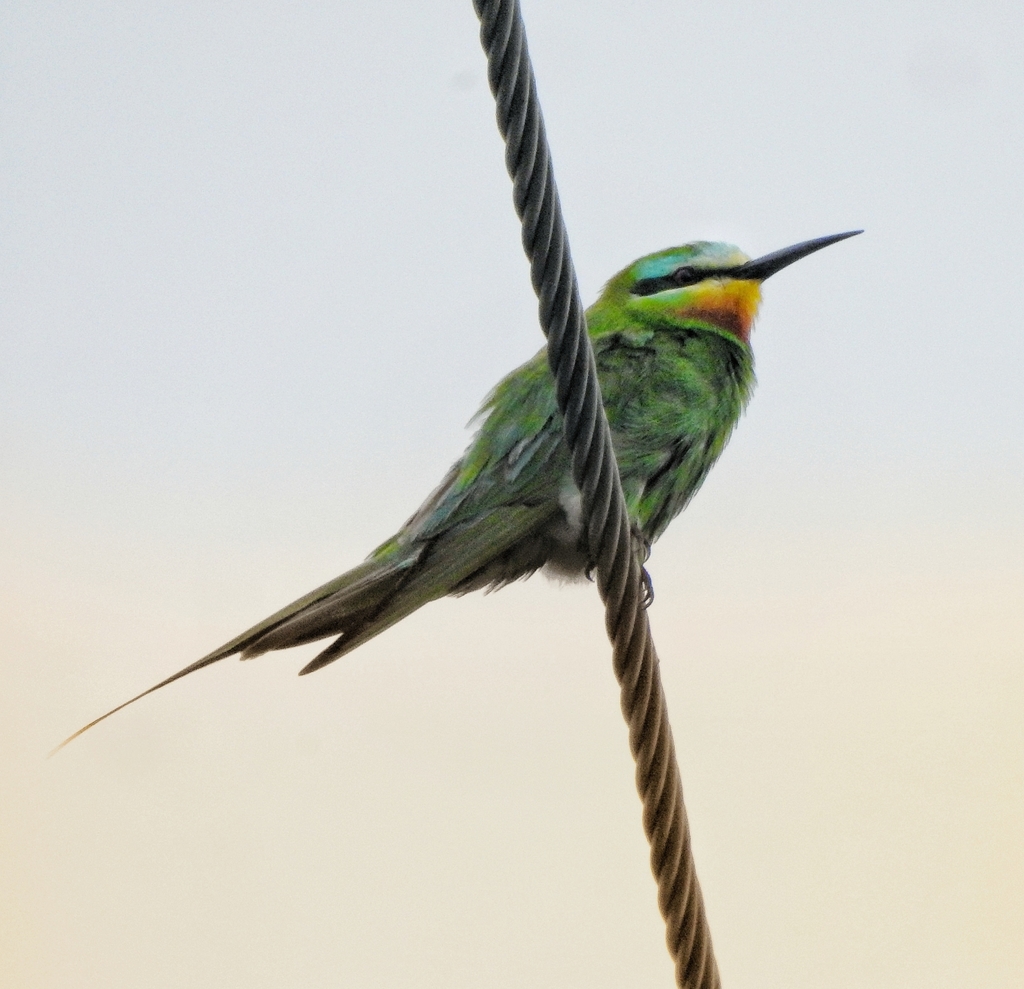
Blue-cheeked Bee-eater
Photo © Afsar Nayakkan
Photo © Afsar Nayakkan — CC BY 4.0 — Source: iNaturalist #120924861Identification
The blue-cheeked bee-eater is a richly coloured, slender bird with predominantly green plumage. Its most distinctive features include bright blue sides to the face, a black eye stripe, and a striking yellow and brown throat contrasting with a black beak. The elongated central tail feathers are a characteristic feature of the species, extending approximately 7 cm beyond the body. Adults typically reach 31 cm in length overall. Sexes are mostly similar, though females have noticeably shorter tail-streamers than males.
Range & Habitat
This species breeds across a vast range spanning Northern Africa and the Middle East, from eastern Turkey eastward to Kazakhstan and India. Two subspecies are recognized: M. p. persicus breeds in Asia and winters in East and Southern Africa, while M. p. chrysocercus breeds in North Africa and winters in West Africa. The species is generally strongly migratory, though some populations remain resident year-round in the Sahel region. Rare vagrants occasionally occur north of the breeding range, with most recorded in Italy and Greece.
Blue-cheeked bee-eaters favour sub-tropical semi-desert habitats with scattered trees, particularly acacia woodland. During winter, they inhabit open woodland and grassland environments.
Behaviour & Diet
Like all bee-eaters, this species is an aerial insectivore, hunting from exposed perches—particularly telephone wires where available. Despite their name, dragonflies form their primary food item, followed by damselflies and lacewings. Bees, wasps, and hornets are also taken regularly, captured in swift sorties from their perch.
Blue-cheeked bee-eaters may nest solitarily or in loose colonies of up to ten individuals, sometimes sharing nesting sites with European bee-eaters. They excavate tunnels 1 to 3 metres long in sandy banks, embankments, low cliffs, or shorelines, notably around the Caspian Sea. Clutches typically comprise six or seven spherical white eggs, though the range is four to eight. Both parents incubate the eggs, though the female alone incubates at night. Incubation lasts 23–26 days. Their call is noticeably flatter and less fluty than that of the European bee-eater.
Best Time & Places to See It
Timing depends on location and subspecies. In Asian breeding grounds, visit during the breeding season; in African wintering grounds, visit during the northern winter months. The Sahel region offers year-round opportunities for resident populations. Look for this species in open, sparsely vegetated landscapes with suitable perching sites and reliable insect prey.
Photography Tips
Position yourself near active perches, particularly telephone wires, where birds regularly launch hunting sorties. Early morning light will best showcase the brilliant blue facial markings and vibrant green plumage. Photograph hunting birds in flight to capture their characteristic aerial manoeuvres. The distinctive tail-streamers are most evident in perched birds, particularly males. A fast shutter speed is essential for documenting aerial feeding sequences.

Private Full-Day Kotu Birdwatching Experience: An Introduction to Kotu’s Diverse Birdlife

Private Half-Day Wake Up With Birds & Breakfast
Nothing matches these filters.
Bwindi Impenetrable National Park
Lake Mburo National Park
Mabamba Swamp
Queen Elizabeth National Park
Abijata-Shalla Lakes National Park
Addo Elephant National Park
Agulhas National Park
Amboseli National Park
Arabuko Sokoke Forest Reserve
Nothing matches these filters.
No community photos yet. Log in to add the first one.
No community observations of this species yet.